restart_process re-execs via tauri::process::restart (spawn + exit(0)),
which skips Tauri's internal cleanup_before_exit and all RunEvent::Exit
plugin hooks. Window state, proxy/live restore and the single-instance
lock were already compensated explicitly; the tray icon was not.
On macOS/Linux the OS drops the status item when the process dies, so
the gap there was cosmetic at most. The real residue risk is the
Windows branch, which never reaches restart_process at all:
update.install() exits the process inside the updater plugin
(std::process::exit(0)), bypassing TrayIcon::drop — no NIM_DELETE is
sent and a stale icon lingers in the shell until hovered, the same
failure remove_tray_icon_before_exit was originally added for on the
quit path.
Call remove_tray_icon_before_exit (set_visible(false), proxied to the
main thread via run_item_main_thread) in restart_process and before
the Windows install. Deliberately not AppHandle::cleanup_before_exit():
it drops tray icons on the calling thread, which is not safe off the
main thread on macOS (NSStatusItem).
The 3.16/3.16.1 update flow was frontend-driven: downloadAndInstall()
then relaunchApp(). relaunch() routed through AppHandle::restart(), and
the old WebView had to keep running JS after the .app bundle was already
swapped — an unstable window that could hang the update or leave the old
version running until a manual restart.
Move the whole download -> install -> cleanup -> restart chain into a new
backend command install_update_and_restart, so it no longer depends on the
old WebView running JS after the bundle is swapped.
Platform-aware install ordering (install() behaves differently per OS):
- Windows: install() launches the external installer and exits the process
internally, so cleanup + single-instance destroy must run before install.
Surface a recovery hint on failure since the proxy may already be stopped.
- macOS/Linux: install() returns, so install first then cleanup — an install
failure no longer wrongly stops the proxy / reverts takeover.
Eliminate the restart vs single-instance race: restart_process() destroys
the single-instance lock (remove socket on macOS, ReleaseMutex on Windows)
before tauri::process::restart(), so the freshly spawned process can't
connect to the old listener and exit itself.
Also remove the now-dead frontend update plumbing (relaunchApp,
UpdateHandle, mapUpdateHandle) and surface backend errors in the toast.
Adapted from the original af4271f4 while rebasing onto #4069: the
ExitRequested handler changes were dropped entirely — the classifier from
#4069 already routes RESTART_EXIT_CODE to Tauri's default restart flow,
and the original should_restart branch (prevent_exit + async cleanup)
would have reintroduced the window-state deadlock that #4069 fixed.
install_update_and_restart bypasses ExitRequested entirely, so the two
fixes compose cleanly.
The updater's relaunch() (and app.restart()) triggers ExitRequested
with code RESTART_EXIT_CODE, which the handler treated as a regular
exit: it called api.prevent_exit() and spawned an async cleanup task.
However Tauri silently ignores prevent_exit() for restart requests
(see ExitRequestApi::prevent_exit docs), so the event loop keeps
shutting down regardless and fires every plugin's RunEvent::Exit hook.
Two threads then deadlock:
- the spawned cleanup task runs save_window_state on a tokio worker,
holding the window-state plugin's internal mutex while querying
window geometry, which dispatches to the main thread and blocks;
- the main thread, already inside the plugin's own RunEvent::Exit
hook, blocks on that same mutex.
The app freezes forever on the restarting screen with the update
already installed; force-quit + reopen comes back on the new version
(#3998). Confirmed on macOS by sampling the frozen process: main
thread parked in tauri_plugin_window_state save_window_state mutex
lock, tokio worker parked in is_maximized -> mpsc recv.
Fix: classify exit requests (None / restart / user exit) and let
restart requests fall through untouched to Tauri's default restart
flow (RunEvent::Exit -> re-exec). On that path window state is saved
by the plugin's exit hook on the main thread, the tray icon is
cleaned up by Tauri's internal cleanup_before_exit, and proxy/live
config restore is unnecessary because the new instance takes over
immediately. The regular exit path (tray quit) is unchanged.
With the fix, a simulated updater relaunch (request_restart) re-execs
the new process in under 200ms, 3/3 runs; normal quit still performs
full cleanup.
Co-authored-by: thisTom <19346741+thisTom@users.noreply.github.com>
Add Unity2.ai, a high-performance AI API relay partner, as a preset for
Claude, Codex, Gemini, OpenCode, OpenClaw, Claude Desktop, and Hermes.
Each preset carries the referral signup link as apiKeyUrl.
- Register the unity2 icon via iconUrls (PNG URL import) + metadata
- Add partnerPromotion copy in zh/en/ja/zh-TW; backfill the missing
zh-TW ccsub entry
- List Unity2.ai in the sponsor section of all README locales
- Codex uses the bare base URL (gateway exposes /responses at root);
OpenCode/OpenClaw/Hermes use the /v1 chat-completions endpoint with
gpt-5.5 as the only preset model
- Trim CCSub OpenCode/OpenClaw/Hermes model lists to gpt-5.5 to match
- Normalize unity2/ccsub banners to the standard 2.41 aspect ratio
The Claude/Codex format-transform non-stream branch returned an opaque 422
"Failed to parse upstream response" whenever a 2xx upstream body was not
valid JSON. The common case: MaaS gateways force-stream a stream:false
request and return an SSE body with a non-SSE Content-Type, defeating the
header-only is_sse() check.
On serde failure, sniff for SSE and aggregate the chunks into a single
JSON, then run the existing converter so clients still receive a valid
non-stream response.
- chat_sse_to_response_value: aggregate chat.completion.chunk SSE
(content / reasoning / refusal / tool_calls / legacy function_call),
tool_calls index-keyed via BTreeMap to avoid unbounded densification,
first-wins finish_reason, message-snapshot override, completeness and
error-event guards; synthesize an id when the upstream omits one
- responses_sse_to_response_value: process the residual trailing block,
tolerating truncation and skipping it once a completed event was seen
- enrich remaining parse failures with content-type / content-encoding /
body-snippet diagnostics
- deflate: try zlib (RFC 9110) before raw; keep the content-encoding
header for unsupported encodings
- gate zero-usage rows on the Claude transform path
- Fold local routing toggle, model mapping, reasoning overrides and custom
User-Agent into a single collapsible advanced section, mirroring the
Claude form (auto-expands when UA is set or local routing is enabled)
- Custom User-Agent becomes configurable for native Responses providers;
it was previously reachable only when openai_chat routing was on
- Collapsed hint names local routing as the entry point for Chat
Completions / non-GPT providers
- Backfill all missing codexConfig keys in zh-TW locale
Polish the provider-level User-Agent override UI on the Claude and Codex forms.
- Add a shared CustomUserAgentField (label + input + preset dropdown + live
validation) so both forms stay in sync.
- Provide curated UA presets (Claude Code / Kilo Code families that pass
coding-plan UA whitelists per #3671); the first is Claude Code's real
`claude-cli/x (external, cli)` format. Whitelists gate on the name prefix,
not the version, so static values stay valid across upgrades.
- Expose presets via a dropdown to the right of the input (z-[200] so it
renders above the dialog layers) instead of inline chips.
- Move the field into the existing advanced/reasoning collapsibles.
- userAgent.ts mirrors the backend byte rule (reject only control chars;
non-ASCII is allowed) for a non-blocking inline hint.
- i18n for all four locales (zh/en/ja/zh-TW).
Extract a shared `parse_custom_user_agent` helper in provider.rs returning
`Result<Option<HeaderValue>>`, and reuse it in the forwarder, stream check,
and model fetch paths so detection, forwarding, and model listing all apply
the same provider-level User-Agent. Previously only the forwarder honored it,
so stream check could fail (or model listing 403) on UA-gated upstreams that
the proxy itself handled fine.
- stream_check injects the provider's custom UA on the claude/codex paths and
still skips the GitHub Copilot fingerprint UA.
- model_fetch service + command and the model-fetch.ts wrapper thread an
optional UA through to GET /v1/models.
- runtime callers silently ignore invalid values via `.ok().flatten()`
(no save-time block, so deeplink imports stay lenient).
- add claude-desktop to AppType/KNOWN_APP_TYPES and the dashboard app
filter; it was hidden because its rows looked like pure failure
noise, which was the app_type attribution bug fixed on the backend
- request detail panel now shows the requested model and the pricing
model when they differ from the response model, making route-takeover
bills auditable from the UI
- locale keys added for zh/en/ja/zh-TW
The model mapped for takeover (env mapping, Claude Desktop routes,
Copilot normalization, Codex chat override) was discarded inside the
forwarder, so usage attribution depended entirely on the upstream
echoing it back. When the upstream omitted the model or mirrored the
client alias, kimi/glm tokens were recorded and priced as claude-*
(roughly 5-25x overstatement).
- capture the final outbound model in forward(), return it via
ForwardResult, and store it on the request context
- attribution fallback order is now: upstream echo (empty string
treated as missing) -> outbound model -> client-requested model
- 'request' pricing mode anchors to the outbound model instead of the
pre-mapping client alias; unchanged when no mapping applies
- persist the resolved pricing_model on every usage row
- Claude Desktop rows now log app_type "claude-desktop" on streaming
and transform paths too (was hardcoded "claude", silently dropping
desktop provider pricing overrides and splitting the cost basis by
the stream flag); its global pricing defaults inherit the claude
config since proxy_config only allows claude/codex/gemini rows
- proxy_request_logs: add pricing_model column recording the basis actually
used at write time (NULL = pre-v11 rows, '' = unpriced error rows)
- cost backfill recomputes strictly by the persisted basis; the
request_model fallback now only applies to placeholder models, so
real-but-unpriced takeover rows stay at zero cost until pricing is
added instead of being permanently frozen at the alias's price
- backfill_missing_usage_costs_for_model can locate rows by pricing_model
- usage_daily_rollups: rebuild with request_model + pricing_model in the
primary key so the alias-to-real-model mapping and the pricing basis
survive the 30-day prune; legacy rows migrate with ''
- rollup_and_prune backfills costs before pruning: prune is irreversible
and used to run before the startup backfill, permanently booking
then-unpriced rows as zero
- get_model_stats groups by the effective pricing model
(COALESCE(NULLIF(pricing_model,''), model)) so costs aggregate under
the model whose prices produced them; response-mode behavior unchanged
The Zhipu quota API returns two TOKENS_LIMIT entries whose identity was
inferred by sorting nextResetTime ascending (nearest = five_hour). In the
last hours of each weekly cycle the weekly window resets sooner than the
current 5-hour session window, so the two buckets were swapped exactly
when users check their weekly quota most.
Classify by the explicit unit field instead (3 = hour window -> five_hour,
6 = week window -> weekly_limit; same shape on bigmodel.cn and api.z.ai,
weekly observed with number 7 and 1 so only unit is matched), falling back
to the old reset-time heuristic when the field is missing.
- Replace the fixed Zap glyph in the usage hero with the selected app's
brand icon via a new AppGlyph component, reusing APP_ICON_MAP
(cloneElement scales 14px -> 20px); falls back to Zap for the "all" view.
- Recolor the Codex title theme from emerald to neutral gray to match
OpenAI's monochrome branding. neutral-500/10 stays visible in both
light and dark modes, unlike a flat black tint.
Codex /responses requests routed to text-only OpenAI-chat upstreams
(e.g. DeepSeek deepseek-v4-flash) failed with HTTP 400 "unknown variant
image_url" when images were sent: the responses->chat conversion turns
input_image items into image_url blocks the model rejects. The media
rectifier previously covered only the Claude adapter, so neither the
proactive strip nor the reactive retry fired for Codex.
- media_retry_should_trigger: accept "Codex" adapter, not just "Claude"
- contains_image_blocks / replace_images: also scan responses `input`
(input_image) in addition to chat `messages`
- is_image_block_type: match image | image_url | input_image
- is_unsupported_image_error: add "unknown variant" hint for the
deserialize error
- forward(): proactively run apply_media_prevention for Codex after the
responses->chat conversion
Proactively strips images for known text-only models (heuristic on by
default) and reactively retries with images replaced on upstream
image-unsupported errors. Adds tests for chat image_url, codex
input_image, the reactive trigger, and the deserialize error match.
Builds on #2774 (which fixed cache_read for the streaming openai_chat path).
Two gaps remained, both double-counting cache tokens when a Claude client
meters as app_type="claude" (input_includes_cache_read=false):
1. cache_read was still added to input on the non-streaming openai_chat path
(transform.rs openai_to_anthropic) and the whole openai_responses family
(transform_responses.rs build_anthropic_usage_from_responses, covering the
non-streaming call site and both streaming_responses call sites).
2. cache_creation was never subtracted on any converted path, including the
streaming openai_chat path #2774 had already touched. Claude billing treats
cache_creation as a separate bucket, so an inclusive upstream carrying a
direct cache_creation_input_tokens field billed it twice.
All four metering points now compute:
input = prompt_tokens - cache_read - cache_creation
restoring the invariant input + cache_read + cache_creation == prompt_tokens.
Pure OpenAI upstreams are unaffected (no cache_creation concept/field).
Tests: update direct-cache assertions (40->20), add a streaming conservation
regression test, and pin prompt<cache underflow (saturating clamp to 0) for all
three metering functions. cargo test 1573 pass, clippy clean.
Note: fix is forward-only; historical rows are not recomputed (cost is frozen at
log time and app_type="claude" mixes native + converted rows).
Audited all proxy format-conversion paths (Chat<->Message, Chat<->Response,
Gemini<->Message) for usage/cache metering. Five issues found and fixed.
The dedup mechanism (request_id PK, proxy/session source isolation) is
untouched, so no double-counting is introduced.
- A (Claude + openai_chat, streaming): inject stream_options.include_usage
so OpenAI-compatible upstreams emit usage in the SSE tail. Without it the
converted Anthropic message_delta was all-zero and the whole request's
input/output/cache was dropped. Same root cause as the already-fixed
Codex Chat path; the injection is extracted into a shared helper
(transform::inject_openai_stream_include_usage) reused by both paths.
- C (Claude + gemini_native): subtract cachedContentTokenCount from
input_tokens in build_anthropic_usage so input becomes fresh input
(Anthropic semantics). Previously the cache-hit tokens were billed twice
because this path meters as app_type="claude" (input_includes_cache_read
= false) while Gemini's promptTokenCount includes the cache.
- D (Codex + openai_chat, streaming): gate log_usage on
has_billable_tokens() to skip the synthetic all-zero usage the converter
emits when a non-compliant upstream omits usage, preventing empty-row
request-count inflation.
- P2 (from_claude_stream_events): use has_billable_tokens() for the return
gate instead of input>0||output>0, so a fully-cached streamed request
(cache_read>0, input==output==0) is still recorded. Affects all
Claude-streaming paths, not just Gemini.
- P3 (Codex Chat->Responses, non-streaming): apply the same
has_billable_tokens() filter the streaming branch got, since the
synthesized all-zero usage makes from_codex_response return Some and
bypass the `if let Some` guard.
Add TokenUsage::has_billable_tokens() as the unified predicate. New tests
cover include_usage injection, gemini input subtraction, the gate itself,
cache-only stream recording, and synthetic all-zero codex usage.
Full lib suite: 1569 passed.
The local session-log scanner dropped any assistant message that lacked
a stop_reason or had output_tokens==0. Claude Code Workflow / sub-agent
fan-out frequently produces messages that only wrote a message_start
snapshot (output=1, stop_reason=None) without a final block, yet their
input + cache_read + cache_creation tokens are already billed by
Anthropic (charged once the request is accepted). Dropping them
under-counted usage by ~4.1% overall, 92% concentrated in
workflow/subagent transcripts.
Replace the stop_reason/output gate with a billable-token check (any of
input/output/cache_read/cache_creation > 0). The per-message-id dedup
selection is unchanged, and request_id = "session:"+msg_id PRIMARY KEY
with INSERT OR IGNORE keeps each message single-inserted, so relaxing
the gate cannot double-count. Add a regression test covering a
stop_reason-less message with real cache cost plus an all-zero skip.
This is the parser-layer half of the Workflow under-counting fixed at
the collector layer in 8d332925.
collect_jsonl_files only walked <project>/<session>/subagents/*.jsonl,
so it missed Workflow sub-agent transcripts which live one level deeper
at subagents/workflows/wf_*/agent-*.jsonl. As a result all Workflow
token usage was invisible to the no-proxy session-log accounting.
Descend into subagents/workflows/wf_*/ as well, via a new
push_jsonl_children helper that keeps the fixed-depth, no-recursion
design. journal.jsonl carries no assistant rows so it is skipped at
parse time and needs no filename special-casing. Existing dedup
(request_id PK + INSERT OR IGNORE + should_skip_session_insert) keeps
the next sync's backfill idempotent.
Add test_collect_jsonl_files_includes_workflow_subagents.
The JS-script usage path resolved {{apiKey}}/{{baseUrl}} with env-only
field guessing, so apps that store credentials elsewhere (Codex:
auth.OPENAI_API_KEY + config.toml base_url) always got empty values and
custom-template queries failed despite a fully configured provider.
- query_usage / test_usage_script now delegate to
Provider::resolve_usage_credentials, the same per-app resolver used by
the native balance/coding-plan path and mirrored by the frontend
getProviderCredentials; explicit non-empty script values still win
- test_usage_script loads the provider and applies the same fallback,
so testing matches what a saved script does
- the custom-template variable preview shows the effective values
(script overrides first, then provider config) instead of always
showing provider credentials
- extract_codex_base_url documents and test-locks the frontend-mirror
invariant: non-active [model_providers.*] sections are never read
Reworked from the original patch to reuse the existing resolver instead
of duplicating per-app extraction.
Co-authored-by: Jason <farion1231@gmail.com>
* fix: prevent duplicate YAML keys in Hermes config
Three changes in hermes_config.rs:
1. deduplicate_top_level_keys() - scan and remove duplicate top-level
keys before YAML parsing, preventing "duplicate entry" parse errors
2. remove_all_sections() - helper to strip all occurrences of a given
top-level key from raw YAML text
3. replace_yaml_section() now calls remove_all_sections() on the
remainder after replacing the primary occurrence, preventing
duplicate sections from accumulating on repeated writes
Fixes the issue where mcp_servers (or any top-level key) gets
duplicated in config.yaml, causing "Failed to parse Hermes config
as YAML: duplicate entry with key" errors.
Co-Authored-By: que3sui <204201112+que3sui@users.noreply.github.com>
* fix: handle CRLF and LF line endings in top-level key deduplication
is_top_level_key_line only accepted empty, space, or tab after the colon,
but deduplicate_top_level_keys uses split_inclusive('\n'), so lines end
with \n (LF) or \r\n (CRLF). Without accepting \r and \n as valid
post-colon characters, the dedup safety net never activates.
Add \r and \n checks to is_top_level_key_line, and three tests covering
LF, CRLF, and first-occurrence preservation.
Co-Authored-By: Claude Opus 4.7 <noreply@anthropic.com>
* refactor(hermes): keep last occurrence when healing duplicate YAML keys
Reworks the healing layers on top of the CRLF root-cause fix:
- deduplicate_top_level_keys: keep the LAST occurrence of each duplicated
key instead of the first. Duplicates come from section replacement
degrading into appends (#3633), so the last block is the newest data --
and Hermes itself reads the config with PyYAML, whose duplicate-key
semantics are last-wins. Keeping the first occurrence would silently
roll users back to stale config and diverge from what Hermes runs with.
Healthy files take a fast path and are returned untouched.
- Drop the unused dup_key variable (fails cargo clippy -- -D warnings,
which CI enforces).
- replace_yaml_section: clean residual duplicate sections from the
remainder via remove_all_sections; values come from the keep-last
healed read, so dropping all stale on-disk copies loses nothing.
- Add regression tests for the actual root cause (find/replace on CRLF
input must replace in place, not append), keep-last semantics,
identity on healthy files, end-to-end heal-then-parse, and duplicate
cleanup on write.
Fixes#3633#2973#2529#3310#3762
---------
Co-authored-by: que3sui <204201112+que3sui@users.noreply.github.com>
Co-authored-by: Claude Opus 4.7 <noreply@anthropic.com>
Co-authored-by: Jason <farion1231@gmail.com>
Problem: Kimi and Moonshot preset links were user-clickable without the cc-switch affiliate query.\n\nDecision: Update only UI-facing preset website/API-key links and leave API request endpoints untouched.\n\nChange: Add aff=cc-switch to Kimi/Moonshot websiteUrl values and Codex/OpenCode API-key links.
Co-authored-by: xumingyuan <xumingyuan@msh.team>
Move the CCSub preset to sit right after DouBaoSeed, at the end of the
partner block and before the first non-partner provider, so its position
is consistent across all six apps:
- Codex / OpenCode: moved up from the 2nd slot (between Shengsuanyun and
the next partner) to the block tail
- OpenClaw / Hermes: moved up from the aggregator section to the block tail
- Claude / Claude Desktop: already at the block tail
Also add the missing CHANGELOG entry for the CCSub preset, and drop the
provider preset order test that enforced a now-unneeded ordering invariant.
Add CCSub, a multi-model aggregator partner, as a preset for Claude, Codex, OpenCode, OpenClaw, Claude Desktop, and Hermes. Each preset carries the referral signup link as apiKeyUrl.
- Register the ccsub icon via iconUrls (1.1MB SVG URL import) + metadata
- Add partnerPromotion copy in zh/en/ja
- List CCSub in the sponsor section of all README locales
- Use gpt-5.5 and gemini-3.1-pro as the OpenAI/Gemini model ids
Add the v3.16.2 CHANGELOG entry covering the 41 commits since v3.16.1,
bump the version across package.json, tauri.conf.json, Cargo.toml, and
Cargo.lock, and add trilingual (zh/en/ja) release notes.
* fix(proxy): strip cache_control from OpenAI format conversion (#3805)
- Remove cache_control passthrough from system messages, text blocks,
and tools to prevent 400 errors on strict OpenAI-compatible endpoints
- Always simplify single text block content to plain string format
- Fixes two format conversion bugs reported in issue #3805
* fix(proxy): apply cargo fmt to fix CI formatting check
The proxy-takeover block previously fell back to the isOfficial heuristic
(empty base_url / missing key) when category was absent. That misjudged
custom providers whose endpoint lives in meta or whose fields are simply
unfilled: their switch button got disabled, making users think the config
was broken. That extra UI block was also "virtual" — the executor in
useProviderActions only ever honored category === "official", so the
front end blocked more than the backend would enforce.
Gate the block solely on explicit category === "official", matching the
executor and unifying both verdicts on a single source of truth.
Also rework the blocked-state UI:
- drop the red "blocked" badge for a plain disabled Enable button
- move title/cursor onto a wrapper span (disabled buttons set
pointer-events:none, so an on-button title/cursor never fired)
- replace the account-ban warning tooltip with a lighter hint
(provider.blockedByProxyHint), four locales kept in sync
Convert Responses input_file (requiring file_id or file_data, never file_url which Chat file parts do not support) and input_audio parts into their Chat Completions equivalents, and handle top-level input_* items that previously fell through and were dropped, clearing stale pending reasoning for non-assistant messages.
Replace the unconditional finalize at chat-to-responses stream end with a three-way guard: complete normally when finish_reason or [DONE] arrived, emit an incomplete response when substantive output exists without a finish_reason, and emit a failed (stream_truncated) event for empty truncation instead of masking it as completed. Also propagate late-arriving reasoning_content onto still-active tool-call items.
Generalize the cross-turn reasoning cache in codex chat history from function_call only to the full tool-call triad (function_call, custom_tool_call, tool_search_call) and their *_output counterparts, so apply_patch and tool-search calls keep their reasoning_content when restored via previous_response_id.
Switch website/apiKey URLs to sssaicodeapi.com and replace base URL
nodes with node-hk.sssaicodeapi.com (default), node-hk.sssaiapi.com,
and node-cf.sssaicodeapi.com across all 7 app presets.
When listen_port is 0 the OS assigns the port at bind time, so the
configured value can no longer be trusted for building takeover URLs.
- server: read listener.local_addr() after bind and propagate the
actual port to the global proxy port, status, and ProxyServerInfo
- services: start the proxy before takeover when port is 0 so live
configs get the real port instead of :0, and persist the resolved
port back to the DB for DB-only URL paths; stop the pre-started
server on any takeover failure
- claude_desktop: reject an unresolved :0 port instead of emitting a
broken gateway URL
- build_proxy_urls: prefer the running server's port and error out if
the port is still 0
Add tests for takeover with an ephemeral port and the claude_desktop
:0 rejection; switch existing codex takeover tests to an ephemeral
port for isolation.
* feat(proxy): add GET /v1/models endpoint for Codex CLI reachability check
Codex CLI probes GET /v1/models at startup. Without this endpoint the proxy
returns 404, causing Codex to fail before any request reaches the upstream
LLM.
Return an OpenAI-compatible model list derived from the cc-switch–managed
model catalog file.
Fixes#3812
* fix(proxy): return Codex catalog schema from /v1/models
Codex deserializes the response as a catalog with a top-level `models`
field, not the OpenAI `{"object":"list","data":[...]}` envelope.
Return the catalog file content directly so the format matches what
Codex expects.
Co-authored-by: Codex review bot
* fix(proxy): guard /v1/models against serving stale catalog
Only return the model catalog when config.toml still references it via
`model_catalog_json`. After switching to a provider without a custom
catalog, the old file lingers on disk — serving it unconditionally
would advertise the previous provider's models to Codex.
Co-authored-by: Codex review bot
* fix(proxy): match relative model_catalog_json in stale-guard
cc-switch writes `model_catalog_json = "cc-switch-model-catalog.json"`
(relative) via set_codex_model_catalog_json_field. Match on the
filename constant rather than the absolute path so the guard works
with both relative and absolute paths.
Co-authored-by: Codex review bot
* fix(proxy): parse model_catalog_json field instead of substring match
Replace raw config_text.contains() with proper TOML field parsing so
commented-out lines and stray mentions of the filename in other fields
don't defeat the stale guard. Also switch from contains() to exact
filename match (Path::new(val).file_name() == Some(...)) to stay
consistent with resolve_cc_switch_catalog_path in codex_config.rs.
Add log::debug! when the guard blocks serving so the operator can
distinguish "no models configured" from "guard blocked stale catalog".
* refactor(proxy): reuse resolve_cc_switch_catalog_path in handle_models
Replace the inline config.toml parsing and filename match in
handle_models with the existing resolve_cc_switch_catalog_path helper
(now pub(crate)). This removes the duplicated stale-guard logic, keeps
a single source of truth for catalog-path ownership, and makes the
handler honor absolute model_catalog_json paths the same way Codex
live-setting import does.
---------
Co-authored-by: Jason <farion1231@gmail.com>
* Fix Codex VS Code session previews
* fix(codex): use last IDE request heading for session previews
A markdown heading inside the active selection / open file could precede the real injected request, so matching the first "## My request for Codex:" heading picked selection content instead of the user prompt. Scan for the last matching heading (the IDE injects the real request as the final section) on both the Rust title path and the frontend TOC preview path.
Add regression tests for the selection-heading case, and pin the known best-effort limitation when the request body itself repeats the heading.
---------
Co-authored-by: Jason <farion1231@gmail.com>
On Windows, Path::strip_prefix produces backslash-separated relative
paths. The update-check matching logic uses rsplit('/') to extract the
install name, so subdirectory skills (e.g. skills/my-skill) never
matched and updates were silently skipped. Replace backslashes with
forward slashes when building the directory string.
Some Anthropic-compatible SSE providers (e.g. qwen, minimax) report the
full context (fresh + cached) as input_tokens in message_start, double
counting the cached portion that is also reported in
cache_read_input_tokens. This inflated the cacheable-input denominator
and pushed the displayed cache hit rate artificially low.
When a message_delta carries a smaller positive input_tokens, prefer it
over the message_start value and adopt the cache counts from the same
usage block to avoid double counting; fall back to the start cache
values when the delta omits them. Native Claude (no input in delta) and
OpenRouter-converted (input only in delta) paths are unchanged.
Refs #3580
APINebula is an OpenAI-compatible relay (its base URL ends in /v1, matching
its Codex/OpenClaw/Hermes presets), but the OpenCode preset loaded the
@ai-sdk/openai package, which targets the OpenAI Responses API and fails
against chat-completions-only upstreams. Switch the npm field to
@ai-sdk/openai-compatible so requests use the OpenAI Chat Completions format.
Fixes#3701.
`query_zhipu` was hard-coded to `https://api.z.ai`, so a user who
configured the mainland China preset (`Zhipu GLM` on
`open.bigmodel.cn`) could not retrieve usage once the international
endpoint became unreachable from their network (or vice versa).
The two endpoints share the same quota path (`/api/monitor/usage/quota/limit`)
and return JSON in the same shape, and — crucially — each user only
ever uses one of them: the quota host is the same host they're already
running coding on. So we can route by the configured `base_url` and
skip the cross-host fallback entirely.
What this PR changes
--------------------
A single helper that maps the user's `base_url` to the matching quota
host, and `query_zhipu` rebuilt to take `base_url` and pick the right
host:
fn zhipu_quota_base(base_url: &str) -> &'static str {
if base_url.contains("bigmodel.cn") {
"https://open.bigmodel.cn"
} else {
"https://api.z.ai"
}
}
async fn query_zhipu(base_url: &str, api_key: &str) -> SubscriptionQuota {
let url = format!(
"{}/api/monitor/usage/quota/limit",
zhipu_quota_base(base_url),
);
// ... original 401/403 -> Expired / make_error / parse path, unchanged
}
The dispatcher already distinguishes `ZhipuCn` from `ZhipuEn` via
`detect_provider()` and routes the call through
`query_zhipu(base_url, api_key)` in the same match arm.
Why no cross-host fallback
--------------------------
Farion's review pointed out that adding a fallback would be
over-engineered and actively harmful:
1. Reachability is determined by the preset the user chose. Their
configured host is the host they are already using to run coding;
if it were unreachable, the user could not have reached the
"query usage" step at all.
2. The fallback path required distinguishing "both 401/403" (genuine
bad key) from "one 401/403 + one network error" (regional block),
which silently misclassified the second case as a generic query
failure and hid the upstream "Session expired" UX for invalid
keys.
3. It also cost the worst-case ~10s+10s≈20s serial timeout for users
on a working primary.
With the URL-based routing in place, 401/403 returns to the original
`CredentialStatus::Expired` semantics — same UX as `query_kimi` and
`query_minimax`.
Files changed
-------------
- `src-tauri/src/services/coding_plan.rs` — 1 file, +35 / -20
Testing
-------
- 3 new `zhipu_quota_base_*` routing tests
- 15 existing `coding_plan` parser tests still pass
- `cargo fmt --check` clean
- `cargo clippy --lib --no-deps -- -D warnings` clean
Co-authored-by: Yongmao Luo <yongmao.luo@columbia.edu>
Co-authored-by: Claude Opus 4.7 <noreply@anthropic.com>
When previous stop_with_restore() failed to restore the user's original
Live (e.g. app crash mid-stop, settings.json unwritable, or any pre-existing
state where Live carries the proxy placeholders), the next
start_with_takeover would read the still-placeholder Live and overwrite the
good backup row with the proxy config itself. After that, every subsequent
stop would restore the proxy placeholder back to Live — making the proxy
toggle a no-op and leaving the client pinned at http://127.0.0.1:15721.
Fix: in both backup write paths (`backup_live_configs` and
`backup_live_config_strict`) detect that Live is already a proxy
placeholder and skip the save, preserving any existing good backup. In
`restore_live_config_for_app_with_fallback_inner`, detect the same
condition in the parsed backup and fall through to the existing
SSOT (current provider DB) path that was added in c3d810a.
Both sides share a new `live_has_proxy_placeholder_for_app` dispatch
helper so the placeholder check stays in lockstep with the existing
per-app detection functions.
Co-authored-by: Yongmao Luo <yongmao.luo@columbia.edu>
Co-authored-by: Claude Opus 4.7 <noreply@anthropic.com>
* feat(usage): add OpenCode session usage sync
Add OpenCode as a fourth app type in the usage statistics system.
Reads per-message token data from opencode's local SQLite database
(~/.local/share/opencode/opencode.db) and imports into proxy_request_logs.
- New session_usage_opencode.rs module following Codex/Gemini pattern
- Parses assistant message.data JSON for tokens, cost, model
- Adds "opencode" to AppType union and filter tabs
- Updates dedup filters to include opencode_session data_source
- Adds i18n keys for all 4 locales
* fix(usage): add opencode to UsageHero title themes
* fix: respect XDG_DATA_HOME and platform defaults for OpenCode DB path
- Support OPENCODE_DB env var override (absolute and relative paths)
- Use ~/Library/Application Support/opencode/ on macOS
- Use XDG_DATA_HOME/opencode/ when set
- Fall back to ~/.local/share/opencode/ on Linux
- Rename misleading test to test_parse_message_data_ignores_role
* fix(usage): use ~/.local/share/opencode on all platforms
OpenCode relies on xdg-basedir, which ignores macOS/Windows conventions,
so its DB always lives at ~/.local/share/opencode. The previous macOS
default pointed at ~/Library/Application Support/opencode, which does not
exist, making the sync a silent no-op for macOS users without
XDG_DATA_HOME set.
* fix(usage): include opencode -wal mtime in freshness check
OpenCode runs its SQLite DB in WAL mode; new commits land in the -wal
file and the main DB file's mtime only advances on checkpoint. Keying
the freshness gate solely on opencode.db could skip newly written
sessions until a checkpoint occurred. Take the max of the db and -wal
mtimes instead.
* style(usage): apply cargo fmt to opencode session sync
Fixes Backend Checks cargo fmt --check failure.
Co-Authored-By: Claude Opus 4.8 <noreply@anthropic.com>
* fix(usage): ignore empty OPENCODE_DB and XDG_DATA_HOME env vars
An empty OPENCODE_DB collapsed the path to the data dir (dropping the opencode.db filename); an empty XDG_DATA_HOME produced a relative "opencode" path. Treat empty strings as unset, per the XDG spec.
Co-Authored-By: Claude Opus 4.8 <noreply@anthropic.com>
* fix(usage): harden OpenCode session sync error handling and labeling
- Map '_opencode_session' provider_id to 'OpenCode (Session)' display name
- Return accurate inserted flag from insert_opencode_message (was always true)
- Do not advance file/session sync_state when a session errors, so failed
inserts are retried next run instead of being permanently skipped
- Surface per-message insert failures into the sync result errors
- Add opencode_session data-source icon and i18n labels (zh/zh-TW/en/ja)
- Add provider-stats labeling test for opencode session rows
* fix(usage): only import finalized OpenCode messages
An in-progress assistant message holds partial tokens; OpenCode updates the same message_id with final values later. Since request_id is fixed and the insert uses INSERT OR IGNORE, a partial row could never be corrected. Skip messages without time.completed so each turn is imported once with final usage.
Co-Authored-By: Claude Opus 4.8 <noreply@anthropic.com>
* fix(usage): keep OpenCode incomplete sessions retryable
---------
Co-authored-by: Eira Hazel <kip3vx9ma@mozmail.com>
Co-authored-by: Eria hazel <git config --global user.email your@email.com>
Co-authored-by: Claude Opus 4.8 <noreply@anthropic.com>
Co-authored-by: Jason <farion1231@gmail.com>
* Add S3 Cloud Sync design document
Design for adding AWS S3 as a new Cloud Sync backend alongside WebDAV.
Hybrid approach: extract shared sync protocol, add independent S3 transport.
Co-Authored-By: Claude Opus 4.6 <noreply@anthropic.com>
* Add S3 cloud sync implementation design (reqwest + Sig V4)
Updated design based on 2026-03-06 draft: switches from rust-s3 crate
to hand-rolled AWS Sig V4 on existing reqwest for broader S3-compatible
service support (AWS, MinIO, R2, Alibaba OSS, Tencent COS, Huawei OBS).
Co-Authored-By: Claude Opus 4.6 <noreply@anthropic.com>
* Add S3 cloud sync implementation plan (11 tasks, TDD)
Detailed step-by-step plan covering: sync_protocol extraction, S3 Sig V4
transport, settings, sync/auto-sync modules, Tauri commands, frontend
presets/dynamic form, and i18n.
Co-Authored-By: Claude Opus 4.6 <noreply@anthropic.com>
* deps: add hmac crate for S3 Sig V4 signing
Co-Authored-By: Claude Opus 4.6 <noreply@anthropic.com>
* refactor: extract sync_protocol.rs from webdav_sync.rs for shared use
Move transport-agnostic sync protocol logic (constants, types, snapshot
building, manifest validation, artifact verification, snapshot application,
utilities) into a new shared sync_protocol module so both WebDAV and the
upcoming S3 transport can reuse it.
Co-Authored-By: Claude Opus 4.6 <noreply@anthropic.com>
* fix: use transport-neutral error keys in sync_protocol
Co-Authored-By: Claude Opus 4.6 <noreply@anthropic.com>
* feat: add S3 transport layer with AWS Sig V4 signing
Co-Authored-By: Claude Opus 4.6 <noreply@anthropic.com>
* feat: add S3SyncSettings to AppSettings
Co-Authored-By: Claude Opus 4.6 <noreply@anthropic.com>
* feat: add S3 sync module with upload/download/fetch
Implements the S3 sync protocol layer (s3_sync.rs) that combines the
shared sync_protocol with the S3 transport. Mirrors the WebDAV sync
module structure with independent sync mutex, connection check,
upload, download, fetch_remote_info, and sync status persistence.
Co-Authored-By: Claude Opus 4.6 <noreply@anthropic.com>
* feat: add S3 auto sync worker with debounce
Co-Authored-By: Claude Opus 4.6 <noreply@anthropic.com>
* feat: add S3 sync Tauri commands and auto sync worker startup
Co-Authored-By: Claude Opus 4.6 <noreply@anthropic.com>
* feat: add S3 sync TypeScript types and API layer
Co-Authored-By: Claude Opus 4.6 <noreply@anthropic.com>
* feat: add S3 sync i18n translations (en/zh/ja)
Co-Authored-By: Claude Opus 4.6 <noreply@anthropic.com>
* feat: add S3 sync presets and dynamic form to sync settings
Co-Authored-By: Claude Opus 4.6 <noreply@anthropic.com>
* fix: preserve HTTP scheme for S3 custom endpoints (MinIO support)
Co-Authored-By: Claude Opus 4.6 <noreply@anthropic.com>
* test: add live S3 integration tests (env-var driven, --ignored)
Run with: S3_TEST_AK=... S3_TEST_SK=... S3_TEST_BUCKET=... cargo test --lib services::s3::integration_tests -- --ignored
Verifies test_connection, put_object, get_object, head_object, and 404
handling against a real S3 bucket using the project's own Sig V4 signing.
Co-Authored-By: Claude Opus 4.6 <noreply@anthropic.com>
* chore: remove internal design docs before PR
* fix: wire S3 auto-sync to DB hook & sync UI state on async load
- P1: Add s3_auto_sync::notify_db_changed call in SQLite update_hook
so S3 auto-sync worker receives DB change signals (was only wired
for WebDAV, leaving S3 worker idle)
- P2: Add useEffect to update syncType selector when s3Config loads
asynchronously, preventing stale "webdav" default for S3 users
* fix: satisfy clippy for s3 sync
* fix: address s3 sync review feedback
---------
Co-authored-by: Keith (via OpenClaw) <keithyt06@users.noreply.github.com>
Co-authored-by: Claude Opus 4.6 <noreply@anthropic.com>
Co-authored-by: Jason <farion1231@gmail.com>
Strict OpenAI-compatible upstreams (vLLM, enterprise gateways) reject
requests that carry tool_choice or parallel_tool_calls without a
non-empty tools array, returning 503/400 with:
"When using `tool_choice`, `tools` must be set."
The Responses→Chat Completions converter unconditionally forwarded
tool_choice and parallel_tool_calls even when tools ended up absent
or empty after conversion. This commit adds a guard that removes both
fields when the resulting tools array is missing or empty.
Added 9 regression tests covering:
- tool_choice dropped when tools absent
- tool_choice dropped when tools is empty array
- parallel_tool_calls dropped when tools absent
- tool_choice dropped when all tools filtered (e.g., missing name)
- tool_choice preserved when tools present (auto + function type)
- clean output when neither tool_choice nor tools present
- tool_choice 'none' dropped when no tools
- tool_search_output providing tools keeps tool_choice
Refs #3557
Co-authored-by: yueqi.guo <guo_yueqi@qq.com>
An upstream gateway (e.g. nginx client_max_body_size) rejecting an oversized request body with HTTP 413 was wrapped as "CC Switch local proxy failed ..." with the full nginx HTML page echoed as the cause. This misled users into thinking CC Switch imposed the limit, when the local DefaultBodyLimit is already 200MB and the real cap lives on the provider's server.
413 now gets a dedicated message that points at the upstream gateway, states it is the provider's server-side limit (not CC Switch), and gives actionable recovery steps (/compact, drop large logs/images, ask the provider to raise its limit). Structured fields (upstream_status, provider, model, endpoint) are preserved; other error paths are unchanged.
Refs #666
Claude Desktop appends a local [1m] marker to the model name when the
1M-context beta is active (e.g. claude-opus-4-8[1m]). The proxy route
matcher compared this raw name against clean route IDs, so every match
tier failed and the is_claude_safe_model_id guard also blocked the role
keyword fallback, surfacing as route_unknown (HTTP 400) when switching
to a 1M-capable model mid-conversation.
Strip the [1m] suffix inside map_proxy_request_model before lookup so
exact/alias/legacy/role matching all see the clean ID, while keeping the
original name in the route_unknown error for diagnostics. The upstream
request still carries the mapped real model; 1M capability is negotiated
via the anthropic-beta header, not the model-name suffix.
Fixes#3588
Replace unsupported Anthropic image blocks with an [Unsupported Image] marker when routed models are text-only or upstream rejects image input.
Add rectifier settings for media fallback and heuristic model detection, wire the controls into the settings UI, and cover the sanitizer and forwarder gates with regression tests.
* fix(copilot): raise infinite-whitespace threshold from 20 to 500
The previous threshold of 20 falsely aborted legitimate tool calls whose
arguments contain indented code (write_file / edit_file with 4-8 levels
of indentation in Python / YAML / Rust / Markdown easily exceed 20
consecutive whitespace chars, especially when newlines are counted).
The real infinite-whitespace bug emits hundreds to thousands of
consecutive whitespace characters, so 500 keeps the safety net while
drastically reducing false positives.
Refs #2646
Co-Authored-By: Claude Opus 4.7 (1M context) <noreply@anthropic.com>
* docs: clarify whitespace threshold comment
---------
Co-authored-by: Claude Opus 4.7 (1M context) <noreply@anthropic.com>
Co-authored-by: Jason <farion1231@gmail.com>
* feat: add CherryIN preset provider for Claude Code and Codex
CherryIN (open.cherryin.net) is an API aggregator gateway. Add it as a quick-config preset for both Claude Code (Anthropic format) and Codex (OpenAI-compatible), placed next to AiHubMix, with the official brand icon. Endpoints and model IDs verified against CherryIN's live pricing API.
* feat: add CherryIN preset to Gemini, Claude Desktop, OpenCode, OpenClaw, Hermes
Extend CherryIN coverage to all remaining apps, each placed next to AiHubMix. Anthropic-native (open.cherryin.net) for Claude Desktop/OpenClaw/Hermes, @ai-sdk/anthropic (/v1) for OpenCode, Gemini-compatible endpoint for Gemini CLI. Model IDs verified against CherryIN's live pricing API.
* fix(presets): update Zhipu coding plan endpoints
* fix(model-fetch): probe /models on versioned /vN base URLs
The model-list probe assumed any base URL not ending in /v1 needs /v1/models appended. For providers whose base URL already ends in a version segment like /v4 (Zhipu/Z.AI GLM Coding Plan at .../api/coding/paas/v4), this produced .../v4/v1/models which 404s, so the "Fetch models" button always failed.
Detect a trailing /v{N} version segment and probe {base}/models first, keeping /v1/models as a fallback candidate for non-/v1 versions. Fixes Codex/OpenCode/OpenClaw/Hermes GLM presets and any other vN-style endpoint, with no behavior change for /v1 or non-versioned URLs.
---------
Co-authored-by: Jason <farion1231@gmail.com>
* fix(codex): use relative filename for model_catalog_json
Instead of writing an absolute path (which breaks on WSL/symlink setups),
write only the filename "cc-switch-model-catalog.json" to config.toml.
Codex CLI resolves relative paths from the config directory, and both
files always reside in the same directory (~/.codex/).
This eliminates the need for UNC-to-Linux path translation and makes
the config portable across Windows, WSL, and symlinked directories.
Also simplifies ownership checks in resolve_cc_switch_catalog_path()
and set_codex_model_catalog_json_field() by removing dead string-equality
comparisons that never matched on WSL.
Closesfarion1231/cc-switch#3573
Related: farion1231/cc-switch#3569
* style(codex): fix rustfmt violations in model_catalog tests
Wrap a >100-col UNC-path line and remove a trailing blank line that broke 'cargo fmt --check' in Backend CI. Style-only, no logic change.
---------
Co-authored-by: steponeerror <huxaio0207@qq.com>
Co-authored-by: Jason <farion1231@gmail.com>
* docs(usage): document pricing model matching rules
* docs: refresh user manual for current app support
* docs: clarify Hermes configuration files
* docs: align feature docs with visible app support
Custom (freeform) Codex tools are bridged through Chat Completions as
JSON `{"input": "..."}` functions, but the Chat->Responses stream still
re-emitted them via `response.function_call_arguments.*`, leaking the
JSON wrapper and using event types the Codex client does not route for
freeform tools.
Emit `response.custom_tool_call_input.delta`/`.done` (with the unwrapped
input text) for custom tool calls instead, suppressing the intermediate
function-argument deltas since a partial `{"input":` fragment cannot be
safely unwrapped mid-stream. Custom tool call items now use a `ctc_`
item-id prefix (matching the input events' item_id) consistently across
the streaming and non-streaming paths via a shared
response_tool_call_item_id_from_chat_name helper.
Covered by new streaming and non-streaming custom-tool tests.
When proxying Codex Responses requests through the Chat Completions
format (api_format=openai_chat), the request transform only forwarded
plain `function` tools and silently dropped `tool_search`, `namespace`
(MCP), and `custom` tools, so third-party APIs never saw the official
Codex plugins and could not call them.
Introduce CodexToolContext, built from the original Responses request,
which flattens all four tool kinds into Chat functions and keeps a
chat_name -> CodexToolSpec map. The response path (streaming and
non-streaming) looks names up in this map to restore the original
tool_search_call / custom_tool_call / namespaced function_call items
instead of reparsing the flattened name. Long namespaced names are
truncated with a sha256 suffix to fit the 64-char Chat tool-name limit.
Covered by new round-trip tests for all four tool kinds across both
streaming and non-streaming paths.
During proxy takeover, switching third-party Codex providers left the
client-visible provider name stale: sync_codex_live_from_provider_while_proxy_active
based the live config on the existing live file and only patched
base_url/wire_api/model, never refreshing model_provider or
model_providers.<id>.name. The Codex app kept showing the previous
provider in its bottom-right label.
Rebuild the effective settings from the DB for the selected provider so
the live config carries the correct provider key and display name, then
merge MCP servers back from the existing live config. base_url stays
pointed at the local proxy, and official OAuth in auth.json is untouched
(takeover writes config.toml only when auth preservation is enabled).
Generalize preserve_codex_mcp_servers_in_backup ->
preserve_codex_mcp_servers_from_existing_config since it now serves both
the backup and live-sync paths.
Restyle the proxy-takeover notice in the Codex editor from the boxed
Alert to the amber inline-hint style used by the endpoint hints, and drop
implementation jargon (127.0.0.1 / PROXY_MANAGED) that users could not
interpret. The notice and the auth/config hints now simply state that the
form shows the stored provider config rather than the proxy-managed live
config. i18n synced across en/zh/ja/zh-TW.
Gate provider sync and switching on the restore backup / live placeholder
("is this live file owned by takeover?") instead of the lagging
proxy_config.enabled and proxy-running flags. The backup is created
before enabled=true is committed, so during that activation window the
old guards were blind and a concurrent sync/switch could rewrite the
taken-over live file, clearing Codex auth.json for a mis-categorized
provider.
Acquire a per-app switch lock around both set_takeover_for_app and
provider switching so the two cannot interleave, splitting the locking
entry points into outer (lock) / inner (no-lock) pairs to stay
deadlock-free. Preserve the official OAuth auth in provider-rebuilt
restore backups by routing the provider token into config.toml. Refine
takeover idempotency to require the live config to point at the current
proxy URL, rebuilding from backup when it does not.
Add unit and integration tests covering the official -> DeepSeek ->
takeover on/off lifecycle and the stopped-proxy switch path.
The reported "OAuth access token disappears when enabling Codex proxy
takeover" was a display artifact, not data loss: auth.json on disk kept
the OAuth login the whole time. During takeover the edit dialog falls
back to the stored provider config (so it does not surface the proxy
placeholder), which for a third-party provider shows that provider's own
key instead of the live auth.json, making the OAuth token look gone.
Thread an isProxyTakeover flag from App through ProviderForm into the
Codex editor and show an explicit notice plus storage-aware auth/config
hints clarifying that the form displays the stored provider config while
the live config is temporarily managed by the proxy. Drop the
proxy-running condition so the notice shows whenever takeover is active,
even with the proxy stopped.
Add a regression test asserting the dialog does not read live settings
during takeover and renders the database config. i18n synced across
en/zh/ja/zh-TW.
Preserve-mode takeover routes the PROXY_MANAGED placeholder into
config.toml and must leave auth.json (the ChatGPT OAuth login) intact.
c9cadd6e covered only the None-provider write branch; the
Some(provider) branch still ran the category-based auth decision in
codex_config::write_codex_live_for_provider, whose first clause
(category == "official" && has_login_material) ignores the preserve
flag entirely. Because takeover stamps OPENAI_API_KEY = PROXY_MANAGED
into auth, codex_auth_has_login_material returns true, so a provider
stored with a stale/mis-classified "official" category (e.g. DeepSeek)
had its real auth.json overwritten with the placeholder — the access
token vanished on takeover and reappeared on cleanup.
Fix at the takeover entry instead of patching the fragile category
logic: add write_codex_takeover_live_for_provider, which under
preservation detects the PROXY_MANAGED placeholder in auth and writes
only config.toml (bearer token + catalog projection), never touching
auth.json. Gating on the placeholder is orthogonal to category, so any
mis-classification is handled. All four takeover sites
(sync-while-active, takeover_live_configs, _strict, _best_effort) now
route through it; restore (verbatim) and non-takeover provider writes
are unchanged.
Also projects the model catalog via
prepare_codex_live_config_text_with_optional_catalog, so the
model_catalog_json pointer survives takeover too.
Add a regression test: official-category provider + preserve enabled +
proxy takeover must keep auth.json byte-identical while moving the
placeholder into config.toml.
Turning proxy takeover off restores Live from a stored backup via
write_codex_live_verbatim. That path mishandled the Codex model catalog
for two backup shapes that need opposite treatment:
- Snapshot backup (read_codex_live_settings -> {auth, config}): no inline
modelCatalog, but the config.toml text already carries the live
model_catalog_json pointer. The old code ran catalog projection, which
saw no specs and stripped the pointer.
- Provider-rebuilt backup (update_live_backup_from_provider): inline
modelCatalog (DB SSOT) with a pointer-less config text. A pure verbatim
write ignored the inline catalog and never regenerated the pointer.
The projection decision is orthogonal to auth: a provider-rebuilt backup
can pair an inline modelCatalog with empty auth.json ({}) when the API key
lives in the config's experimental_bearer_token. The empty-auth branch
raw-wrote config and skipped projection entirely, so that shape lost its
mapping too.
Decide the config.toml text once, before splitting on auth, via the new
prepare_codex_live_config_text_with_optional_catalog helper: project only
when an inline modelCatalog is present, else keep the text raw (preserving
any existing pointer). Every config-writing branch (write-auth,
delete-auth, no-auth) now applies it consistently. Add regression tests
covering all three shapes.
`modelCatalog` is a cc-switch-private field whose SSOT is the database; Live's
config.toml only carries a lossy `model_catalog_json` projection. Proxy
takeover/restore cycles and the official Codex.app rewriting config.toml can
drop that projection, so `read_live_settings` reconstructs an empty catalog.
Two paths then overwrote the stored mapping with that empty Live snapshot:
- Switch-away backfill (`switch_normal` -> `restore_live_settings_for_provider_backfill`):
now overlays the DB provider's `modelCatalog`, falling back to the
Live-reconstructed one only when the DB has none.
- Edit dialog (`EditProviderDialog`): when editing the active Codex provider it
preferred Live over the DB SSOT; now keeps the DB `modelCatalog` so opening +
saving no longer clears the mapping table.
Add Rust backfill tests (preserve DB catalog when Live lacks it; keep Live
catalog when DB has none) and a frontend regression test for the edit dialog.
* fix(codex): always update model catalog JSON on provider switch
Without this fix, the cc-switch-model-catalog.json file and the
model_catalog_json field in config.toml were only regenerated when
should_sync_backup was true (proxy active or backup exists). Switching
providers while the proxy was idle left the catalog pointing at the
previous provider's models, requiring a full restart to take effect.
After the existing should_sync_backup block, unconditionally call
write_codex_provider_live_with_catalog when switching a Codex provider
and the proxy is not currently active (live_taken_over == false). This
mirrors what live.rs already does during a normal provider apply.
Co-Authored-By: Claude Sonnet 4.6 <noreply@anthropic.com>
* fix(codex): refresh catalog on restored hot switch
---------
Co-authored-by: yueqi.guo <guo_yueqi@qq.com>
Co-authored-by: Claude Sonnet 4.6 <noreply@anthropic.com>
Co-authored-by: Jason <farion1231@gmail.com>
* fix(usage): resolve per-app credentials for native balance/coding-plan queries
The native usage-query paths (balance + coding_plan) in
`query_provider_usage_inner` read credentials only from `env.ANTHROPIC_*`.
That matches Claude providers, but Codex stores its key in
`auth.OPENAI_API_KEY` with the base URL inside a TOML `config` string,
Hermes/OpenClaw flatten them at the top level, and OpenCode nests them under
`options`. So the card "refresh usage" / auto-query returned empty
credentials and failed ("查询失败") for those apps, even though the
config-page "Test" button worked (the frontend extracts per-app correctly).
Introduce a single per-app resolver `Provider::resolve_usage_credentials`
that mirrors the frontend `getProviderCredentials`, and route both native
branches through it. Add `extract_codex_base_url` to `codex_config` as the
canonical Codex TOML base-URL parser and make the proxy adapter delegate to
it (removing a duplicate copy). Align the frontend `getProviderCredentials`
to cover OpenCode and Claude Desktop and to use the same OpenRouter/Google
key fallbacks as the backend.
Fixes#3158Fixes#3100Fixes#2625
* refactor(usage): explicit AppType arms + frontend trailing-slash trim
Address two review nits on the per-app credential resolver:
- provider.rs: replace the catch-all `_` arm in resolve_usage_credentials with an explicit `AppType::Claude | AppType::ClaudeDesktop` arm, so a new AppType variant fails to compile here instead of silently defaulting to the Anthropic env shape.
- UsageScriptModal.tsx: normalize getProviderCredentials baseUrl through a single trailing-slash trim so the frontend 'Test' path matches the backend resolver (trim_end_matches), keeping front/back truly in lockstep.
No behavior change for well-formed configs; tests/typecheck/fmt/clippy clean.
* fix(usage): skip empty primary credential fields in fallback chain
`obj.get(key)` returns `Some` for a present-but-empty field, so the
`.or_else()` fallback chains for the Claude/ClaudeDesktop and Gemini api-key
lookups only skipped *absent* keys, not empty ones. Presets seed fields like
`ANTHROPIC_AUTH_TOKEN` as present-but-empty placeholders, so a provider whose
real key lives in a fallback field (`ANTHROPIC_API_KEY` / `OPENROUTER_API_KEY`
/ `GOOGLE_API_KEY`, or `GOOGLE_API_KEY` for Gemini) resolved to an empty key on
the native balance/coding-plan path — while the frontend `a || b` (which skips
empty strings) still found it, reproducing the same Test-works / refresh-fails
divergence this PR removes.
Add a `first_non_empty` helper that skips present-but-empty values, matching
the frontend `||` semantics, and use it for both fallback chains. Tests cover
empty primary + populated fallback for Claude and Gemini.
* fix(codex): add multi-platform CLI discovery and static gpt-5.5 template fallback for model catalog generation
When cc-switch generates a Codex model catalog for third-party providers,
it needs the gpt-5.5 model definition as a template. Previously it relied
on either ~/.codex/models_cache.json (only exists when Codex has connected
to OpenAI) or running 'codex debug models --bundled' (fails when codex
is not on the Tauri app's PATH, common in macOS GUI environments).
This commit adds a three-tier fallback:
1. Try 'codex' from PATH, then platform-specific common paths
(/opt/homebrew/bin/codex, /usr/local/bin/codex, etc.)
2. If all CLI attempts fail, use a compile-time embedded gpt-5.5
template (extracted from codex 0.135.0 bundled models)
Also adds tests for the static template validity and CLI candidates.
* fix(codex): discover user node codex installs
---------
Co-authored-by: Jason <farion1231@gmail.com>
* fix: add kimi/moonshot to Anthropic tool thinking history normalizer
Kimi's Anthropic-compatible endpoint requires reasoning_content in
assistant tool call messages when thinking is enabled, same as DeepSeek.
The is_reasoning_content_compatible_identifier already included kimi/moonshot
but is_anthropic_tool_thinking_history_identifier was missing them, causing
400 errors on multi-turn conversations with tool calls.
Closes#3351
Co-Authored-By: Claude Sonnet 4.6 <noreply@anthropic.com>
* refactor: unify reasoning vendor hints into a single SSOT list
Replace the two separately-maintained vendor identifier lists with one
shared REASONING_VENDOR_HINTS constant and a single
is_reasoning_vendor_identifier predicate. The Anthropic
tool-thinking-history matcher and the openai_chat reasoning_content
matcher previously kept independent lists, which is exactly how
kimi/moonshot ended up in one but not the other (#3351). A single source
of truth keeps the two from drifting apart again.
Also add a Kimi regression test for the Anthropic tool-history
normalization path.
---------
Co-authored-by: Claude Sonnet 4.6 <noreply@anthropic.com>
Co-authored-by: Jason <farion1231@gmail.com>
When "preserve official auth on switch" is enabled, proxy takeover routes
the PROXY_MANAGED placeholder into config.toml's experimental_bearer_token
and leaves auth.json (the ChatGPT OAuth login) untouched. Takeover detection
only inspected auth.json's OPENAI_API_KEY, so it never recognized this state
and returned a false negative, which led downstream paths to clobber the
preserved OAuth login.
- Detection: is_codex_live_taken_over now also matches a config.toml
experimental_bearer_token equal to the placeholder, fixing detect/cleanup/
restore/startup-recovery in one place.
- Cleanup: remove the config.toml bearer token only when it equals the
placeholder (new remove_codex_experimental_bearer_token_if predicate), so a
real third-party key is never stripped.
- Write: under preservation, the None-provider takeover path writes only
config.toml and keeps auth.json intact, matching the provider path.
- Settings: rename the section to "Codex App Enhancements" and reword the
description across all four locales.
- Add tests covering OAuth preservation on takeover and placeholder-only
cleanup.
Collapse the two duplicated write_codex_live_atomic branches in
write_codex_live_for_provider into a single should_write_auth guard.
This is behavior-preserving: `if A {X} else if B {X} else {Y}` becomes
`if A || B {X} else {Y}`.
Adapt the Codex switch tests to the new opt-in default for
preserve_codex_official_auth_on_switch (flipped off in 3f59ab37):
add an enable_codex_official_auth_preservation() test helper for the
cases that assert the auth-preserving path, and tag the official login
provider with category="official" so it routes through the official
branch rather than relying on the global preservation flag.
Add a regression test locking the default (preservation off) behavior:
switching to a third-party provider rewrites auth.json with the new
API key and discards the existing ChatGPT OAuth login. This is the
dual of the existing preserve-and-backfill test, which only covered
the opt-in path.
When forward_with_retry fails for Codex endpoints (/chat/completions, /responses, /responses/compact), the handlers previously returned the bare ProxyError, surfacing a terse body to the client. Build a richer JSON error instead: the message embeds provider, model, endpoint and upstream status, and the error object carries those as structured fields alongside a stable cc_switch_* code.
Align map_proxy_error_to_status with ProxyError::into_response so the manually built responses use the canonical status codes (AuthError->401, Config/InvalidRequest->400, TransformError->422, StreamIdleTimeout->504, AlreadyRunning->409, NotRunning->503); previously these forwarder-level errors collapsed to 500.
Flip preserve_codex_official_auth_on_switch from true to false so
third-party Codex switches overwrite auth.json by default, matching the
expectation that switching providers also swaps credentials. Users who
rely on keeping the ChatGPT login in auth.json while on a third-party
provider (for official plugins / remote login) can enable it in
Settings -> Codex Authentication.
The toggle field ships for the first time here (it is not in v3.16.0),
so no existing settings.json holds an explicit value -- every user lands
on the new default and no migration is required.
Also set the flag explicitly in the preservation unit test instead of
relying on the global default, keeping it valid now that the default is
false.
The version probe ran `cmd /C "\"{path}\" --version"` on Windows. Rust's
own arg quoting plus the manual quotes produced nested quotes that cmd
(without /S) misparsed, so it reported even working tools as an
unrecognized command -> non-zero exit -> shown as "installed but not
runnable". cmd's error is emitted in the OEM code page (e.g. GBK on
zh-CN) and was decoded as UTF-8, turning it into mojibake.
- Add decode_command_output: try strict UTF-8, then OEM (GetOEMCP), then
ANSI (GetACP) code page via MultiByteToWideChar; route all command
output decoding through it (probes, lifecycle output, osascript,
terminal launchers).
- Add run_windows_tool_version_command: run .exe directly (no cmd);
invoke .cmd/.bat via `cmd /D /S /C call <quoted> --version` with
raw_arg to bypass Rust's quoting and keep deterministic quote handling.
- Add windows-sys Win32_Globalization dependency.
Claude Desktop's 3P validation only accepts claude-{sonnet,opus,haiku}-*
role IDs, so providers must map every tier. Bring the Desktop mapping flow
in line with Claude Code and fix the fallout that broke sub-agent Haiku calls.
- Proxy form: replace the dynamic route list with fixed Sonnet/Opus/Haiku
tiers; blank tiers backfill from the first filled tier (Sonnet first) on
submit and inherit its supports1m flag
- Backend: add a role-keyword fallback in map_proxy_request_model so dated
official names (e.g. claude-haiku-4-5-20251001) resolve to the right tier,
guarded by is_claude_safe_model_id so [1m]-suffixed IDs stay rejected
- Tighten is_claude_safe_model_id / isClaudeSafeRoute to reject degenerate
role IDs like "claude-sonnet-"
- Fix the seed-effect race where normalizing empty routes to three blank
tiers blocked the default-route backfill
- Sync switch hints, placeholders, and the zh/en/ja/zh-TW locales to the
three-role-ID rule
- Update zh/en/ja user manual (2.1, 2.6), calling out legacy Claude IDs
(claude-3-5-sonnet-...) as a rejected example
Tests: 282 frontend + 34 backend claude_desktop; typecheck, clippy, fmt clean.
The websiteUrl for ShengSuanYun presets pointed at the bare domain while
only apiKeyUrl carried the from=CH_4HHXMRYF referral code. Append the same
referral param to websiteUrl across all provider presets so the in-app
'open website' jump is also attributed to the channel.
Bump default model names project-wide: gpt-5.4 -> gpt-5.5,
gemini-3.x -> gemini-3.5-flash, glm-5 -> glm-5.1, and
grok-code-fast-1 -> grok-build-0.1 across all provider presets
(claude, codex, gemini, hermes, openclaw, opencode, universal),
Gemini config, and stream check defaults.
Pricing:
- Seed gemini-3.5-flash, gemini-3.1-flash-lite, step-3.5-flash-2603,
doubao-seed-2.0-code, mimo-v2.5(/pro), qwen3-coder-480b, grok-build-0.1.
- Correct deepseek-v4-flash/pro, glm-5/5.1, grok pricing.
- Add repair_current_model_pricing: idempotent pass that fixes only
rows still equal to the outdated built-in values, preserving any
user-customized prices (seed uses INSERT OR IGNORE and cannot update
existing rows).
Fixes from review:
- opencode: drop duplicate gemini-3.5-flash variant (unreachable via
.find), keep the entry with the full minimal/low/medium/high set.
- Align stale display names/costs to gemini-3.5-flash (hermes, openclaw,
opencode); openclaw cost -> {1.5, 9, 0.15} to match seed.
- i18n (zh/en/ja/zh-TW): refresh OMO category tooltips for new model
names; fix writing tooltip to Kimi K2.5 to match its recommended.
Update tests accordingly and add a regression test asserting unique
model ids in the Google opencode preset variants.
Bump the default Opus route/model from claude-opus-4-7 to claude-opus-4-8
across provider presets (claude, claudeDesktop, hermes, openclaw, opencode,
universal), i18n locales (zh/en/ja/zh-TW), pricing seed data, and the
user-manual docs.
- Add claude-opus-4-8 pricing row ($5/$25/$0.50/$6.25); keep the 4-7 row
for historical usage stats (seeded via INSERT OR IGNORE).
- Claude Desktop proxy: accept bidirectional opus 4-7 <-> 4-8 route alias
during rollout so previously saved routes keep resolving.
- thinking_optimizer: route opus-4-8 through adaptive thinking and normalize
dotted model ids (also fixes dotted 4-6/4-7 falling back to legacy).
- usage_stats: normalize Bedrock/Vertex/aggregator opus-4-8 ids to base
pricing.
Also merge role:"system" messages into the Gemini systemInstruction in the
Anthropic->Gemini transform.
When importing a Claude provider via deep link, the preview dialog
correctly shows every env field carried in the `config` payload — but
on confirmation `build_claude_settings` only persisted the standard
fields mapped from URL params (`apiKey`, `endpoint`, `model`,
`haiku/sonnet/opusModel`). Any non-standard env keys such as
`ANTHROPIC_CUSTOM_HEADERS`, `API_TIMEOUT_MS`, or
`CLAUDE_CODE_DISABLE_EXPERIMENTAL_BETAS` were silently dropped,
making the preview and the actual write diverge.
Start the env map from the inline `config` payload (best-effort
decode via the new `extract_claude_config_env` helper) and then
overlay the URL-param-derived standard fields on top, so:
- URL params remain authoritative for standard fields (unchanged)
- Custom env keys present in `config` survive the import
- Deep links without a `config` payload behave exactly as before
Adds two regression tests:
- `test_build_claude_provider_preserves_custom_env_fields` proves
custom fields are kept and URL params override same-named config
fields.
- `test_build_claude_provider_without_config_unchanged` guards the
backward-compatible path (no `config` → only standard env keys).
Closes#2927
Co-authored-by: lipeng31 <lipeng31@tanyang.co>
The usage dashboard previously only refreshed on app restart for users
who don't route through the cc-switch proxy. Two issues were involved:
1. The session-sync background task panicked when a Codex model name
contained non-ASCII characters (e.g. `【官】glm-5.1`), because
`normalize_codex_model` sliced `&name[name.len() - 11..]` without
verifying char boundaries. Once the task panicked, no session logs
were imported until the app was restarted (where startup-time
`rollup_and_prune` happened to flush pending data).
2. Even with sync working, the dashboard only polled every 30s and
skipped polling when the window was unfocused, so freshly-imported
data was invisible until the next poll or window refocus.
Fixes
-----
* `normalize_codex_model`: guard the 11-byte ISO-date suffix slice with
`is_char_boundary` + `is_ascii` checks. ASCII-only suffix means the
date-stripping logic is correct, and non-ASCII names (which can never
be valid date suffixes anyway) now bypass the slice safely.
* New `usage_events` module that emits `usage-log-recorded` to the
frontend whenever `proxy_request_logs` actually gains a new row.
Sources covered: proxy `log_request`, Claude/Codex/Gemini session
sync, and startup `rollup_and_prune`. Notifications use a global
`OnceLock<AppHandle>` so call sites that don't already hold an
`AppHandle` (e.g. `UsageLogger`) can notify without signature churn.
* 200ms debounce in `notify_log_recorded` collapses bursts (a single
Codex sync importing 3000+ entries triggers ~2 emits, not 3000) so
the frontend's `invalidateQueries` is never spammed.
* Frontend `useUsageEventBridge` listens for the event and invalidates
`usageKeys.all`. Hook is mounted only on `UsageDashboard`, so the
listener is unsubscribed automatically when the user navigates away.
Verification
------------
* `cargo check` passes (existing 25 dead-code warnings in
`commands/misc.rs` are pre-existing and unrelated).
* `tsc --noEmit` passes.
* Manually verified end-to-end: a Codex sync run that imported 3145
entries produced 2 debounced emits, both logged as `emit
usage-log-recorded 成功`, and the dashboard updated within ~200ms.
Behaviour notes
---------------
* `INSERT OR IGNORE` paths (Claude/Codex session sync) only notify when
the row is actually inserted, so dedup-skipped writes don't trigger
empty refreshes.
* Gemini's `INSERT … ON CONFLICT … DO UPDATE` path reuses the existing
`conn.changes() > 0` check and only notifies when token counts truly
changed.
* `rollup_and_prune` notifies once per pruning cycle (at most once per
app start) so the dashboard reflects the new aggregate state.
Co-authored-by: in30mn1a <in30mn1a@users.noreply.github.com>
Use semver comparison instead of string inequality so locally-ahead prerelease builds aren't misreported as outdated; backend now fetches the full npm dist-tags and, when the local version leads latest, surfaces the tool's prerelease channel (claude=next) as latest.
- Always emit `model_provider = "custom"` from deep link, UniversalProvider, and the universal form modal so future writes share one stable routing key.
- Add `codex_provider_template_v1` local migration that rewrites legacy keys (aihubmix/ccswitch/...) under `[model_providers.custom]`, updates profile refs, and backs up the original settings_config under `~/.cc-switch/backups/<timestamp>/providers/`.
- Tighten history migration source detection to a whitelist plus `[model_providers.<id>]` existence check so user-authored keys are never rewritten in jsonl/state DB.
- Encode deep link name/model/endpoint through `toml_edit::Value` so display names containing quotes or backslashes no longer break the generated config.toml.
- Stabilize provider settings backup filename hash with Sha256 (was process-random SipHash).
The one-time history migration already consolidates legacy provider IDs
into a single bucket; there is no need to normalize on every write.
This preserves user-chosen provider identities through the full
write/backup/restore cycle.
The Fill Recommended button was misleading — it showed toast.success even
when most slots couldn't be filled due to model ID mismatches with the
user's configured providers.
Changes:
- Sync OMO_BUILTIN_AGENTS/CATEGORIES recommended fields with upstream
oh-my-openagent model-requirements (gpt-5.4→5.5, kimi-k2.5→claude-sonnet-4-6, etc.)
- Add toast.warning tier when unmatched >= filled, showing slot:model pairs
(e.g. "Sisyphus: claude-opus-4-7") so users know exactly what to configure
- Upgrade fillRecommendedNoMatch to also show examples
- Add fillRecommendedMostlyUnmatched i18n key (zh/en/ja/zh-TW)
Scan Codex archived_sessions alongside active sessions so archived conversations appear in the session manager.
Allow deletion from any validated Codex session root while keeping path safety checks in place.
* Add Traditional Chinese localization
* fix: address zh-TW formatting and token units
- Format `zh-TW.json` with Prettier.
- Use Traditional Chinese `萬` and `億` units for zh-TW token summaries.
- Add usage formatting coverage for Traditional Chinese locale aliases.
---------
Co-authored-by: Jason <farion1231@gmail.com>
* refactor: replace JSON.parse(JSON.stringify()) with structuredClone and extract useTauriEvent hook
Replace all `JSON.parse(JSON.stringify())` deep copy patterns with native
`structuredClone()` across production source (9 occurrences), tests (11
occurrences), and a hand-rolled `deepClone` utility in providerConfigUtils.ts.
Add "ES2022" to tsconfig lib for type support.
Extract a `useTauriEvent` hook to eliminate the repeated Tauri event listener
boilerplate (`useEffect` + `active/disposed` flag + async `listen`) that was
duplicated across App.tsx (3 listeners) and useUsageCacheBridge.ts. The hook
handles async registration, race-condition guards, and cleanup automatically.
* fix: add compatible deepClone helper
- Add a shared deepClone helper with a structuredClone runtime guard and fallback.
- Route clone call sites through the helper.
- Preserve universal-provider-synced listener ordering and drop the dead-directory diff.
* fix: harden Tauri event handling
- Guard WebDAV sync status events against missing payloads.
- Preserve settings query invalidation ordering before showing auto-sync errors.
- Simplify useTauriEvent subscriptions to avoid dependency-driven re-listens.
---------
Co-authored-by: zcb <zhangchongbiao@qiyuanlab.com>
Co-authored-by: Jason <farion1231@gmail.com>
* fix: sync Claude Desktop profile during proxy takeover
* fix(provider): skip Claude Desktop backup refresh during takeover
- Route Claude Desktop takeover updates directly through the 3P profile writer.
- Keep takeover startup backup state unchanged when provider metadata changes.
- Narrow platform-specific test helpers and environment setup with cfg gates.
* fix(provider): restore PathBuf import for CI tests
- Restore an unconditional PathBuf import for provider tests.
- Keep Linux cargo test builds compiling while preserving Claude Desktop cfg-gated helpers.
---------
Co-authored-by: Jason <farion1231@gmail.com>
* feat: add MiMo reasoning_content support for Claude Code proxy
MiMo requires reasoning_content to be passed back in multi-turn
conversations with tool calls. Add "mimo" and "xiaomimimo" to the
preserve_reasoning_content whitelist so thinking blocks are converted
to reasoning_content when proxying Claude Code → MiMo.
Also handle redacted_thinking blocks (encrypted by Claude Code across
turns) by injecting a placeholder to prevent MiMo 400 errors.
Co-Authored-By: Claude Sonnet 4.6 <noreply@anthropic.com>
* fix: support MiMo reasoning histories
- Fix the PR CI clippy failure for redacted thinking handling.
- Preserve MiMo reasoning content on the OpenAI Chat proxy path.
- Normalize Claude Desktop Anthropic thinking history for MiMo local routes.
- Reject unsupported Claude Desktop direct model remaps.
---------
Co-authored-by: Claude Sonnet 4.6 <noreply@anthropic.com>
Co-authored-by: Jason <farion1231@gmail.com>
* docs: add German README translation (README_DE.md)
Adds README_DE.md, a full German translation modelled on README_JA.md,
and extends the language switcher in README.md, README_ZH.md and
README_JA.md with a Deutsch link.
* docs: remove outdated German sponsor entry
- Remove the AICoding.sh sponsor block from README_DE.md.
- Keep the German README aligned with the current sponsor list.
---------
Co-authored-by: Jason <farion1231@gmail.com>
* fix(ui): remove fixed width constraint on AppSwitcher text to prevent clipping
App names like "Claude Desktop" were being clipped by the max-w-[90px]
constraint on the text label. Changed to max-w-none so text adapts to
content width. Also removed overflow-x-hidden from the parent toolbar
container to prevent clipping of the wider content.
Fixes text truncation in the top-right app switcher segmented control.
* - fix(ui): preserve AppSwitcher compact overflow behavior
- Restore toolbar overflow clipping required by useAutoCompact.
- Cap expanded AppSwitcher labels at 120px so Claude Desktop fits while compact animation remains smooth.
---------
Co-authored-by: Jason <farion1231@gmail.com>
Remove AICoding (aicoding.sh) sponsor entry from the three README files
and the provider preset across all seven app_types (claude, codex,
gemini, hermes, opencode, openclaw, claudeDesktop). Also drop the
matching partner_promotion.aicoding string in zh/en/ja locales.
The icon (src/icons/extracted/index.ts) and the legacy provider id in
codex_history_migration.rs are kept intentionally: the former for
possible later re-use, the latter so existing users' Codex history
still gets bucketed into "custom" on upgrade.
- codex_config: rewrite `!(A && !B)` as `!A || B` (De Morgan-
equivalent) — also reads more directly as "no OAuth, or
already has provider API key".
- UsageScriptModal: reflow conditional onto one line per prettier.
Codex CLI filters conversations by model_provider — after normalizing
all third-party providers to "custom", old sessions with their original
provider IDs become invisible. This migration rewrites JSONL session
files and state_5.sqlite threads to use the unified ID.
Uses a three-tier trust model for source ID collection:
- Known legacy preset whitelist (46 IDs, case-insensitive)
- cc-switch-created custom providers (identified by created_at)
- User-maintained custom providers are explicitly skipped
Adds scanned_history_files flag to prevent stale v1 markers from
blocking re-runs with the improved source ID collection logic.
When the 5-hour bucket is at 0% utilization, ZhiPu's API omits
nextResetTime. The old i64::MAX sentinel sorted these entries last,
causing the weekly bucket to incorrectly claim the five_hour slot.
Codex provider switches now only write config.toml for third-party providers,
injecting the API key as experimental_bearer_token. The user's auth.json
(ChatGPT OAuth tokens) is preserved. Official providers with login material
still write auth.json normally. Backfill restores bearer tokens into stored
provider auth.OPENAI_API_KEY to maintain canonical shape.
Extend the mktemp+bash installer pattern from hermes (commit 20d943be) to
claude and opencode, and remove the cfg gate that locked install_command_for
to non-Windows targets — Windows host + WSL tools now correctly route
through the POSIX install priority instead of falling back to bare npm.
Frontend "one-click install commands" displayed in the About section now
diverge per platform to match what the backend actually runs.
Backend (src-tauri/src/commands/misc.rs):
- New CLAUDE_INSTALL_UNIX and OPENCODE_INSTALL_UNIX constants use the same
`bash -c 'tmp=$(mktemp) && curl -fsSL .../install.sh -o $tmp && bash
$tmp; status=$?; rm -f $tmp; exit $status'` shape as HERMES_INSTALL_UNIX.
The shared comment about why we avoid `curl | bash` is now hoisted to the
top of all three constants — the constraint (WSL `sh -c` sub-shells
don't inherit outer pipefail; default shell may be dash/ash) applies to
every shell installer, not just Hermes.
- New installer_with_npm_fallback helper deduplicates the
"official installer || npm fallback" chain construction; reuses
chain_update_commands(LifecycleCommandShell::Posix) so the wiring matches
the update-chain logic.
- install_command_for split into cross-platform posix_install_command_for
+ thin #[cfg(not(target_os = "windows"))] wrapper. The cfg gate had
been hiding a real bug: on Windows hosts, the WSL branch called
wsl_tool_action_shell_command which forwarded install actions to the
Windows-target tool_action_shell_command, yielding bare `npm i -g` for
claude/opencode even though they have working native POSIX installers.
- wsl_tool_action_shell_command now branches on action: Install dispatches
to posix_install_command_for (native installer || npm chain); Update
keeps the existing behavior. Empty install commands collapse to None so
callers error on unsupported tools instead of running an empty command.
- build_tool_lifecycle_command pipefail comment updated: the original
justification (covering install's `curl | bash` path) no longer applies
to any current command, but the directive stays as defense-in-depth for
future pipe additions.
- build_tool_action_line WSL branch comment updated to reflect the
install/update split.
Frontend (src/components/settings/AboutSection.tsx):
- New posixScriptInstallCommand(url) helper builds the same mktemp+bash
string template the backend uses.
- New powershellEncodedCommand(script) mirrors the backend's UTF-16 LE +
base64 encoder (charCodeAt + String.fromCharCode(lo, hi) + btoa) so the
PowerShell EncodedCommand shown to users matches what the backend
executes.
- ONE_CLICK_INSTALL_COMMANDS split into POSIX_ONE_CLICK_INSTALL_COMMANDS
and WINDOWS_ONE_CLICK_INSTALL_COMMANDS, selected by isWindows():
POSIX shows claude/opencode/hermes with the mktemp+bash installer;
Windows shows claude/codex/gemini/opencode/openclaw with npm (matching
backend static_fallback_command on Windows) and hermes with the
PowerShell EncodedCommand. Display now mirrors backend execution
per platform, removing the show-vs-run mismatch.
- Stale comment in the probe-concurrency note mentioning "curl | bash"
updated to "官方 installer".
Tests (src-tauri/src/commands/misc.rs):
- New wsl_install_uses_posix_install_priority covers three
representatives: claude (positive: native installer with npm fallback),
opencode (positive), codex (negative: no native installer so falls back
to bare `npm i -g`). Reverse-asserts !contains("| bash") to lock out
the old pipe form.
- claude_install_chains_native_then_npm and
opencode_install_chains_native_then_npm strengthened with
!parts[0].contains('|') so the native installer portion stays
pipe-free even if future edits to the template sneak a pipe back in.
Validated:
- cargo check --tests: clean
- cargo test --lib commands::misc:: : 59 passed, 0 failed
- pnpm typecheck: 0 errors
- cargo fmt: clean
- pnpm format: clean (no files changed)
Promote anchored upgrades to "<bin> update || <package fallback>" for the
tools whose CLI knows how to self-update safely, and replace pip-based
hermes install/update with the official NousResearch installer scripts.
Frontend learns to detect "update reported success but version did not
change" so silent upstream no-ops surface as a soft warning.
Backend (src-tauri/src/commands/misc.rs):
- New prefers_official_update(tool, shell) per-platform allow-list:
POSIX {claude, codex, opencode, openclaw}. Windows drops opencode
pending anomalyco/opencode#17295 (its silent `upgrade` may prompt for
install-source detection and deadlock our lifecycle). gemini is absent
from both because `gemini update` is not implemented upstream
(google-gemini/gemini-cli#18618 / #16122 OPEN).
- New chain_update_commands joins primary/fallback per shell: POSIX
`||`, Windows `|| call` — batch transfers control to the `||` RHS
without `call`, skipping subsequent tools in multi-tool actions.
- New LifecycleCommandShell {Posix, WindowsBatch} threads the target
shell through tool_action_shell_command_for_shell, replacing the old
hermes-only WSL substitution hack with a uniform mechanism.
- anchored_command_from_paths refactored: hermes anchors to
`<bin> update`; tools in prefers_official_update chain self-update
with the package-manager command as fallback; brew formulae remain
brew-managed (never self-update what Homebrew owns); others use the
prior npm/volta/bun/pnpm anchoring unchanged. Mirror on Windows.
- Hermes commands switch from pip to the official scripts. POSIX/WSL
runs `bash -c 'tmp=\$(mktemp) && curl -fsSL .../install.sh -o \$tmp
&& bash \$tmp; status=\$?; rm -f \$tmp; exit \$status'`. The mktemp +
two-step download avoids `curl | bash` because WSL sub-shells inherit
neither outer `set -o pipefail` nor a guaranteed bash (default may be
dash/ash). Windows uses `powershell -NoProfile -ExecutionPolicy Bypass
-EncodedCommand <b64>` with a hand-rolled UTF-16 LE base64 encoder
for `irm .../install.ps1 | iex`, hiding the PowerShell pipe from
cmd.exe. Pip is abandoned because macOS system python3 is often 3.9
while hermes-agent requires >=3.11, and the pyenv `python` shim may
not exist — pip errors then misclassify as "command not found".
Frontend (src/components/settings/AboutSection.tsx):
- New versionUnchangedAfterUpdate four-AND short-circuit detects when
the upgrade command succeeded, the tool still reports a version, but
that version equals the pre-upgrade version while a different
latest_version is known. Guards against upstream no-op updaters that
return exit 0 without applying anything (openai/codex#21897).
- Soft-failure shape gains kind?: "notRunnable" | "versionUnchanged"
so the warning toast title can disambiguate the two cases.
- Hermes install command snippet swapped from `python3 -m pip ...` to
the official curl-bash one-liner shown to users.
i18n (zh / en / ja):
- New settings.toolActionVersionUnchangedTitle and
settings.toolActionVersionUnchanged, synchronized across all locales.
Tests (src-tauri/src/commands/misc.rs):
- Anchored upgrade assertions updated to `<bin> update || <pkg>` shape
across nvm / volta / bun / homebrew-npm-global / spaces / fnm
branches; brew formula explicitly does NOT chain self-update.
- New hermes anchor tests replace hermes_has_no_npm_anchor on both
POSIX and Windows. WSL hermes tests rewritten for the mktemp+bash
flow with `hermes update` fallback.
- Reverse-lock tests: gemini static fallback must NOT contain
`gemini update`; opencode Windows static fallback must NOT contain
`opencode upgrade`; hermes commands must NOT contain
`python`/`pip`/`powershell`/forbidden pipes.
Validated:
- cargo check --tests: clean
- pnpm typecheck: 0 errors
- cargo fmt: clean
The uninstall hint feature added in f6bdd4bb / 89e2339b printed a
copy-pasteable shell command (e.g. `brew uninstall <formula>`,
`<sibling-npm> rm -g <pkg>; [ -e bin ] && rm -f bin && rm -rf pkg_dir`)
under each detected install in the multi-install conflict panel. Even
with copy-only-never-execute UX, putting destructive commands one
button away from the user is risk we don't want to ship — `rm -rf`
under a misclassified path would be unrecoverable.
Conflict diagnostics themselves are kept: users still see the warning
banner + per-install row (source / path / version / Default badge), so
the "you have multiple installs and the upgrade only touches one"
signal survives. They just don't get a one-click destructive command.
Backend (src-tauri/src/commands/misc.rs):
- Remove `uninstall_command_from_paths` (POSIX + Windows pair).
- Remove `posix_quote_for_user_shell` and `win_quote_path_for_user_shell`
— both were uninstall-only quoters (whitelist + cmd-only forms).
`win_quote_path_for_batch` and `shell_single_quote` stay because the
anchored upgrade path and `build_shell_cd_command` still use them.
- Remove `quoted_sibling_or_bare` and `quoted_sibling_or_bare_with_ext`
thin wrappers (only callers were uninstall branches).
- Drop `uninstall_command` and `uninstall_command_needs_cmd_hint` from
`ToolInstallation`. Drop the eager `infer_install_source` ->
`uninstall_command_from_paths` call in `enumerate_tool_installations`
(saves ~16μs per probe but the real point is fewer surprises).
- Remove 14 `#[test]` cases for uninstall command shape (brew /
homebrew-npm-global / nvm / npm-fallback quoting / pnpm / volta / bun /
hermes / system / Windows percent-path) plus 4 `win_quote_path_for_user_shell`
helper tests and the `expect_user_shell_quoted_path` test mirror.
- Drop the `src()` test helper that was only used to feed the deleted
uninstall tests (`infer_install_source` is still called directly by
surviving tests).
- Cross-references in `anchored_command_from_paths` doc to its now-gone
uninstall "dual" are stripped.
Frontend (src/components/settings/AboutSection.tsx):
- Conflicts `<ul>` keeps the diagnostic header + per-install `ToolInstallRow`
but loses the inline command box, the trash + copy icons, the per-row
PowerShell-call-operator hint, and the `handleCopyCommand` callback.
- Remove the `Trash2` lucide import; `Copy` stays (the install-commands
copy button at line 1100 still uses it).
API (src/lib/api/settings.ts):
- Drop `uninstall_command` and `uninstall_command_needs_cmd_hint` from
the `ToolInstallation` TS interface (matches the Rust struct change).
i18n (zh / en / ja):
- Drop `settings.toolUninstallCopyHint`, `settings.toolUninstallCopied`,
`settings.toolUninstallPwshHint`. Other `tool*` and `skills.uninstall*`
keys are untouched (Skill uninstall is a separate, non-destructive
feature for managing the Skills repo and is unaffected).
Stats: 858 deletions, 5 insertions across 6 files.
Validated:
- cargo test --lib: 1322 passed, 0 failed
- cargo fmt --check: clean
- cargo build: clean
- cargo check --tests: clean
- pnpm typecheck: 0 errors
- JSON.parse on all three locale files: clean
Move uninstall hint command generation from frontend (which used a lossy
`source` string and couldn't tell brew formula from homebrew-npm-global apart)
into the Rust backend, where `brew_formula_from_path` + `infer_install_source`
together produce correct commands for each install. Conflict UI now reads
`inst.uninstall_command` directly.
Backend (src-tauri/src/commands/misc.rs):
- New `uninstall_command_from_paths` (POSIX + Windows) mirrors the
`anchored_command_from_paths` family. POSIX branches on brew formula /
volta / bun / pnpm / nvm|fnm|mise|homebrew / system. Windows branches on
volta / pnpm / npm.
- New `quoted_sibling_or_bare` (POSIX) + `quoted_sibling_or_bare_with_ext`
(Windows) deduplicate the `sibling_bin().map(quote).unwrap_or_else(bare)`
pattern across all uninstall branches.
- New `posix_quote_for_user_shell` whitelists `[A-Za-z0-9._/+=:@-]`; any
other character routes through `shell_single_quote`. Replaces
`quote_path_if_spaced` on the uninstall side because the fallback chain
is destructive (`rm -rf <pkg_dir>`), so a `;` / `$` / backtick in the
home dir would have let the chain inject extra commands.
- New `win_quote_path_for_user_shell` (no `%` 4x escape) splits from
`win_quote_path_for_batch`. Uninstall hints are copy-paste targets, not
`.bat + call` payloads, so the two-round percent expansion that
motivates the 4x escape doesn't apply.
- POSIX `nvm|fnm|mise|homebrew` branch appends physical-delete fallback
`; [ -e <bin> ] && rm -f <bin> && rm -rf <pkg_dir>` because nvm v18.20.8
was observed to silently no-op `npm rm -g` (exit 0 with `up to date`
message, no filesystem change). Anchored `<node_root>/{bin,lib}` layout
assumption documented as branch-specific.
- `ToolInstallation` gains `uninstall_command: String` and
`uninstall_command_needs_cmd_hint: bool`. The bool is computed as
`cfg!(target_os = "windows") && uninstall_command.contains('"')` — a
compile-time platform gate avoids false positives from POSIX
`shell_single_quote`'s `'"'"'` escape form, which also contains `"`.
- `enumerate_tool_installations` computes `source` once and threads it
into `uninstall_command_from_paths`, removing a redundant
`infer_install_source` call (review N1).
Frontend (src/components/settings/AboutSection.tsx + src/lib/api/settings.ts):
- Remove the JS helpers `buildUninstallCommand`, `dirOfPath`,
`isWindowsPath`, `shellQuote`, `TOOL_NPM_PACKAGES`. Conflict rows now
read `inst.uninstall_command` directly.
- Render a PowerShell-call-operator hint when
`inst.uninstall_command_needs_cmd_hint` is true. Avoids string-match
inference from the command (which fails on macOS user names containing
`'`, e.g. `o'leary`, because `shell_single_quote`'s escape contains `"`).
- `ToolInstallation` TS interface gains the two new fields.
i18n (zh/en/ja):
- New key `settings.toolUninstallPwshHint` documents the PowerShell
`&` (call operator) requirement for quoted paths.
Tests: 30 new cases under `commands::misc::tests::anchored_upgrade` cover
each POSIX branch (brew formula extraction, npm anchored with fallback,
pnpm, volta, bun, hermes), strong-quoting under `;` / `'` paths, the
fallback-only-for-anchored-branches inverse guard, plus mirror Windows
helpers for the user-shell quoter and a `path%foo%` integration case
demonstrating the literal `%` preservation contract. Total
`commands::misc` test count: 68.
Apply macOS-side anchored upgrades (9984eccb) to Windows. Six tools now
upgrade via an absolute path derived from the install actually hit by the
command line, instead of bare `npm i -g` landing on PATH-first npm. WSL
tools explicitly bypass anchoring (Windows-host paths invalid in distro).
Scope: 7+ Windows package managers compress to 3 idioms in practice
(Scoop/Chocolatey/winget/nvm-windows/MS Store all just install node; the
global-package layer is still npm):
- volta -> <sibling>\volta.exe install <pkg>
- pnpm -> <sibling>\pnpm.cmd add -g <pkg>@latest
- others -> <sibling>\npm.cmd i -g <pkg>@latest
Cross-platform:
- infer_install_source: add /volta/ (no dot) and /pnpm/ matches so
%LOCALAPPDATA%\{Volta,pnpm} route correctly.
- parent_dir: recognize both \ and /, take rightmost (Option<usize>
Ord lets None<Some, so rfind('\\').max(rfind('/')) auto-picks).
- npm_package_for, default_install, installs_anchored_command:
promoted from cfg(not(windows)) to all-platforms.
- plan_command_for: merged the two cfg branches; Windows+WSL short-
circuits to wsl_tool_action_shell_command (not static_fallback) so
the command shown to the user matches what build_tool_action_line
actually runs.
- ToolInstallation: add #[serde(skip)] real: PathBuf, populated by
enumerate, read by installs_anchored_command — no more double
canonicalize, and closes a TOCTOU window between enumerate and anchor.
Windows-only helpers (#[cfg(target_os = "windows")]):
- sibling_bin_with_ext reads fs to pick .cmd vs .exe (Node installer
drops .cmd, Volta drops .exe; pure string can't disambiguate).
- win_double_quote shared primitive; win_quote_path_for_batch handles
cmd token-boundary chars (space, &, (, ), ^, ;, <, >, |, ,) by
wrapping in quotes, and handles `%` via 4x escape (%%%%) to survive
both .bat parser expansion AND `call`'s own second percent-expansion
pass (Microsoft `call /?`: "percent (%) expansion is performed on
each parameter").
- wsl_tool_action_shell_command wraps tool_action_shell_command so
hermes inside WSL gets python3||python instead of Windows-target
py||python (py launcher is Windows-only, missing in WSL distros).
Wire-up:
- build_tool_action_line Windows: WSL -> wsl_tool_action_shell_command
+ wsl.exe wrap; native update -> enumerate + anchored + static
fallback. Everything gets `call ` prefix (.bat needs it for .cmd
without replacing the current script; harmless for .exe).
Tests: 33 new — 10 platform-agnostic (install_source_classification,
parent_dir_cases) + 23 cfg-gated Windows-only (anchored_upgrade_windows,
windows_helpers). Anchored expected values use a small expect_quoted_path
mirror in the test mod so assertions stay correct on Windows hosts whose
%TEMP% itself contains spaces/special chars (e.g. user accounts named
"John Doe"); the 7 hardcoded-literal win_quote_* unit tests independently
lock the quoting rules themselves, so mirror drift would be caught by
either side.
Limitation: Windows cfg-gated tests don't run on macOS cargo test.
Validated on macOS host: cargo fmt clean, clippy --all-targets 0
warnings, cargo test --lib 1322 passed. Windows CI runs only on release
tag (release.yml has windows-2022); production validation needs cargo
test on a Windows machine before broad rollout.
- misc: extend sibling_bin derivation to claude/brew/volta/bun in addition
to npm. Return Option<String> so the anchored-path invariant cannot be
silently violated — when bin_path has no parent directory, propagate
None and fall back to the static command at the call site instead of
emitting a bare command that depends on the GUI process PATH.
- misc: factor out quote_path_if_spaced to keep all five anchored
branches consistent when the resolved path contains spaces.
- AboutSection: add preflightTools lock + try/finally around
probeToolInstallations so fast double-clicks cannot race two probe
rounds into concurrent executeRun calls or duplicate confirm dialogs.
- Tests: cover sibling_bin None branch and space-quoting for every
anchored branch (claude/brew/volta/bun).
Bare `npm i -g <pkg>` was the install command for every managed tool, but
Anthropic and SST now both recommend their native installers over npm. The
update path already anchors to native installs (`claude update` and friends),
so install was the last place still forcing npm — even when the user's
intent was clearly to get the upstream-recommended install.
- New `install_command_for(tool)` (non-Windows only): claude and opencode
now run the upstream installer with a `|| npm i -g ...@latest` POSIX
short-circuit fallback, so the tool still installs if the URL is
unreachable.
- codex / gemini / openclaw / hermes pass through to the original static
command — they have no independent official installer today.
- `build_tool_lifecycle_command` now opens `set -o pipefail` alongside
`set -e`: without it, `curl ... | bash` where curl fails would have bash
exit 0 on empty stdin, silently masking the failure and skipping the
`||` fallback.
- 6 new `install_strategy` unit tests pin the per-tool install command
shape, mirroring the existing anchored_upgrade regression suite.
Update routing and Windows install behavior are unchanged.
When a managed-account provider (GitHub Copilot or Codex OAuth) is taken
over by the local proxy, the *_MODEL_NAME entries written to Claude live
config used to be snapshotted from the live file on disk, which still
held the *previous* provider's values during a switch. The result was a
stale display name lingering after the switch.
Read the model snapshot from the target provider's effective settings
(common-config merged) when the provider uses managed-account auth;
preserve the existing behavior of reading from the live config for
normal providers. The three takeover entry points now resolve the
effective provider up front so common-config writes flow through.
Rework the About tool-upgrade flow so upgrades target the install the
command line is actually using, instead of running bare `npm i -g` and
landing on PATH's first npm — which used to move upgrades to the wrong
location or fail outright when the resolved bin had no sibling npm.
Anchored upgrade command (update path, non-Windows):
- claude native installer (~/.local/share/claude/versions/) -> `claude update`
- Homebrew formula (canonical path under /Cellar/) -> `brew upgrade <formula>`
- volta / bun -> `volta install` / `bun add -g`
- Node managers with sibling npm (nvm/fnm/mise/homebrew-npm) -> that
directory's npm with `i -g <pkg>@latest`
- system / unknown sources (e.g. opencode install.sh under ~/.opencode/bin,
~/go/bin) -> fall back to the bare command, surfaced as anchored=false
so the UI shows an honest "default entry not determinable" hint instead
of pretending the upgrade is targeted.
Multi-install confirmation:
- When the probe finds >=2 installs, pop ToolUpgradeConfirmDialog showing
each install (source badge + path + version + Default badge) and the
resolved command before executing. Top-level text only asserts what is
universally true ("won't update all of them; see each tool below");
per-card text adapts to anchored vs unanchored.
- Pending upgrade state stores the full upgrade set; the dialog only
shows the subset that needs confirmation, so non-conflicting tools in
a batch still get upgraded after confirm.
Unified probe command:
- Merge the previous diagnose_tool_installations and plan_tool_upgrades
into a single probe_tool_installations returning installs + is_conflict
+ needs_confirmation + command + anchored. Diagnose button, post-upgrade
auto-diagnose, and pre-upgrade confirmation all share one IPC. The
diagnose button's previous Promise.all of 6 IPCs is now a single call.
resolve_path_default robustness:
- The previous lines().next() was poisoned by interactive .zshrc output
(welcome banners, p10k instant prompts, etc.), causing default-install
detection to fail and dropping multi-install scenarios into the
unanchored fallback even when one install was clearly the native one.
- Replaced with first_abs_path_line that scans for the first
absolute-path line and ignores noise, mirroring how try_get_version
already tolerates banner noise via a regex.
Diagnostic staleness fix:
- diagnoseToolSilently now clears stale diagnostics in the else branch
when the conflict no longer holds (previously only wrote on conflict,
never cleared, so externally resolving a conflict left the card stuck
on a stale list until the user clicked Diagnose).
- Auto-diagnose now triggers after any successful update, not only when
the version didn't change, so the card reflects the latest conflict
state even when an anchored upgrade succeeds while another install
remains.
Other:
- Shared ToolInstallRow between the conflict list and the confirmation
dialog removes the duplicated per-install row JSX.
- Drop the new shell_quote_path helper in favor of reusing the file's
existing POSIX-correct shell_single_quote, gated on whitespace.
- Collapse displayName lookup into a stable module-level helper to remove
the `as ToolName` cast and avoid recreating the closure each render.
- 17 backend unit tests covering anchored command generation across each
source, brew formula extraction, is_conflicting thresholds, default
install resolution, and the welcome-banner scenario.
- i18n (zh/en/ja): new keys for confirmation dialog
title/hint/will-run/confirm-button and the unanchored hint.
Add a "Diagnose installs" action to the About section that enumerates every
installation of each managed CLI, flags real conflicts (diverging versions
or mixed runnable state), and lists them under the affected tool card.
- backend: enumerate_tool_installations + diagnose_tool_installations command,
sharing build_tool_search_paths with the single-probe scan; resolve the PATH
default via the same login shell as version probing so the "Default" marker
matches what the command line (and an upgrade) actually targets
- frontend: global diagnose button left of Refresh, per-card conflict list,
and a copy-only uninstall command per install -- source-aware (npm/volta/
bun/pip) and anchored to that install's own npm to avoid removing the wrong
node version; marked with a red trash icon, never executed
- auto-diagnose silently after an upgrade that leaves the version unchanged
or installs something that can't run
- i18n: zh/en/ja
After an install/update command succeeds, re-probe the tool version: if it
still can't be detected the tool is installed-but-unrunnable (e.g. Node too
old), so report a warning toast and show "installed · can't run" with the
cause, instead of a misleading "success" plus a stale version number.
Read the backend `installed_but_broken` flag rather than matching error
text; the card's current-version line, action button (no useless "install"
for a broken tool), and a "check environment" hint all key off it. Drop the
now-redundant version-clearing setState (the refresh merge already nulls it),
flatten the action ternary, and use extractErrorMessage in the catch path.
Adds toolNotRunnable / toolActionInstalledNotRunnable / installedNotRunnable
/ toolCheckEnv i18n keys (zh/en/ja).
Unify the three probe paths (try_get_version / try_get_version_wsl /
scan_cli_version) on a cross-platform ShellProbe enum that distinguishes
"not installed" (shell exit 127) from "installed but --version failed"
(e.g. Node too old to run the freshly-upgraded CLI).
The found-but-broken case is now reported as-is and no longer falls back to
scan_cli_version. Previously the fallback surfaced a stale runnable copy
installed elsewhere (e.g. a Homebrew node vs the nvm node the upgrade wrote
to), making an upgrade look like it had no effect ("succeeded but version
unchanged").
Expose the state via a structured `installed_but_broken` flag on ToolVersion
so the frontend no longer infers it by string-matching the error text. Also
fixes a WSL path that could mislabel a genuinely-missing tool as broken, and
extracts the NOT_INSTALLED constant.
Update All previously sent every tool to the backend as one script, where
set -e (or errorlevel on Windows) aborts the whole batch on the first
failure, skipping the rest and not refreshing versions for tools that did
succeed. Run each tool as its own call instead: failures are isolated,
each tool's version refreshes as soon as it finishes, and the result is
summarized in a toast (success / partial / failure) listing which tools
failed.
Also derive an isAnyBusy flag and disable all install/update buttons,
the refresh button and the WSL shell selectors while any action is
running, so users can't trigger concurrent global npm/pip writes.
Add the toolActionPartial i18n key (zh/en/ja).
Extend scan_cli_version search paths with the PATH environment variable
and common Windows Node/version-manager locations (pnpm, Volta, nvm,
Scoop, Yarn). Entries from PATH are skipped when they point at the
Microsoft\WindowsApps App Execution Alias directory, which is what
previously caused bogus launches on Windows.
Add unit tests for PATH dedup, child-dir suffix expansion, and the
WindowsApps alias skip.
Add Hermes to the environment-check table and app-switcher list, fix the
OpenCode install command (opencode-ai), and describe the new update/install
flow. Align with the final implementation: drop the removed Install Missing
action, note that installs run silently with in-button progress, and rename
the section to Manual Install Commands (now collapsible).
List all managed apps with current/latest versions, with per-tool install
and update buttons plus an Update All action. Installs and updates now run
silently: the button shows a spinner for the full duration, versions refresh
automatically when done, and failures surface the backend error detail in a
toast.
While loading, the button keeps its label and only swaps the icon for a
spinner, so width stays constant across zh/en/ja instead of jumping when the
text changes (e.g. Update -> Updating...).
Also collapses and renames the install-commands area to Manual Install
Commands, and removes the managed-apps badge row and the Install Missing
batch button.
Expand tool version detection to all six managed apps (including Hermes
via PyPI), and add a run_tool_lifecycle_action command that installs or
updates CLI tools silently: it captures the subprocess output and blocks
until the command actually finishes instead of popping a terminal window
(Windows uses CREATE_NO_WINDOW). On failure the last lines of stderr are
returned so the UI can surface a useful message.
Also restores the Windows version-detection path by gating try_get_version
behind cfg(not(windows)) so it no longer risks triggering the App
Execution Alias / protocol handler that previously disabled Windows.
Harden the proxy module against panics by removing optimistic
unwrap()/expect() calls in favor of pattern matching and graceful
fallbacks:
- copilot_optimizer/cache_injector: bind Value::Array/String directly
instead of is_array()+as_array().unwrap(); use is_none_or and in-place
string mutation
- hyper_client: gate the raw-write path with if-let + filter instead of
has_cases + unwrap()
- gemini_shadow: recover poisoned RwLock via into_inner() rather than
panicking, with warn logging
- streaming_codex_chat: replace expect("tool state exists") with
let-else (return/continue)
- merge_tool_results: early-return when messages is absent
- sse: fall back to from_utf8_lossy on the UTF-8 boundary slice
No behavior change on the happy path; all proxy tests pass.
CI on main was red because two tests did not follow intentional changes
that were already merged into the codebase:
- codexChatProviderPresets.test.ts still expected the "Kimi For Coding"
preset, which was removed in 16c3ef3f. Drop the corresponding entry
from the expected presets map.
- import_export_sync.rs still asserted the legacy per-provider
model_provider id ("rightcode"), but 9fac15b8 unified Codex
third-party providers into the stable "custom" history bucket. Mirror
the assertion update already applied to provider_service.rs.
No production code changed; both fixes only update test expectations.
No-argument tool calls produced empty argument strings that passed
through both the streaming response path and the request transform
verbatim. Strict OpenAI-compatible upstreams (e.g. Minimax) reject
`arguments: ""` with a 400 "invalid function arguments json string",
while lenient ones (OpenAI, Kimi) silently treat it as an empty object.
Add canonicalize_tool_arguments / canonicalize_tool_arguments_str helpers
that coerce empty/whitespace arguments to "{}" and apply them at the four
tool-call argument sites (streaming finalize + three request/response
transform paths). Leave function_call_output content untouched, where an
empty string is valid.
Add a "Reasoning Auto-Detection" subsection to the Codex local-routing
manual (zh/en/ja) with the provider capability matrix, and record the
feature plus the streaming-usage and tool-call reasoning backfill fixes
in the changelog. Drop the removed Kimi For Coding preset from the
changelog's Codex Chat preset list.
Auto-detect each Chat-routed Codex provider's reasoning interface from
its name, base URL, and model, then inject the matching thinking
parameter without manual configuration:
- Platform-first inference (OpenRouter, SiliconFlow) overrides model
rules, since the same model exposes different reasoning controls
depending on the hosting platform.
- Effort tiers are forwarded only to providers that support them
(DeepSeek, OpenRouter, and StepFun's step-3.5-flash-2603); on/off-only
providers (Kimi, GLM, Qwen, MiniMax, MiMo, SiliconFlow) drop the level
instead of sending a field the upstream rejects.
- OpenRouter uses the native reasoning:{effort} object, clamps max to
xhigh (its enum has no max), and forwards an explicit effort:"none" so
reasoning can be turned off.
- StepFun falls back to inference so per-model effort support is honored
(the static preset would have forced effort on step-3.5-flash too).
Includes the Codex provider-form reasoning controls, i18n strings
(zh/en/ja), and response-side reasoning extraction.
Responses-to-Chat conversion did not set stream_options.include_usage,
so OpenAI-compatible upstreams (kimi/MiniMax, etc.) omitted the trailing
usage chunk in streaming mode. This caused token/cost/cache stats to be
recorded as zero for third-party streaming requests routed through the
Codex Chat path.
Inject include_usage when the request is streaming, merging into any
client-provided stream_options instead of overwriting it. Add tests for
the streaming, non-streaming, and merge cases.
The Kimi For Coding preset pins users to a single coding-only model
(kimi-for-coding), restricting model selection. Drop it from the Codex
presets and trim the corresponding row in the trilingual user manual.
The general Kimi preset (Moonshot platform) is kept, and presets for
other apps are unchanged.
Thinking models like kimi/Moonshot and DeepSeek reject any assistant
message carrying tool_calls without a non-empty reasoning_content. When
cross-turn history recovery misses (proxy restart drops the in-memory
cache, ambiguous call_id, or a turn produced no reasoning upstream), the
converted assistant message has none and the whole request fails with
'reasoning_content is missing in assistant tool call message'.
Add a final-stage backfill that runs after all input items are
processed, so genuine trailing reasoning items still attach first and a
placeholder is only injected when none remains. Mirrors the placeholder
behavior in transform::anthropic_to_openai_with_reasoning_content.
ClaudeAPI supports the health/stream check, but the third_party
category triggers the isClaudeThirdParty gate in ProviderCard that
disables the model test button for third-party Claude providers.
Recategorizing as aggregator restores the test action; the partner
star is unaffected since it is driven by isPartner, not category.
Applied to both the Claude Code and Claude Desktop presets.
Backfill the empty [Unreleased] CHANGELOG section with the Codex Chat
Completions feature (Chat-to-Responses bridge, 23 third-party presets,
model mapping table, Stream Check routing, error-envelope conversion,
"custom" history bucket) plus the community fixes landed since v3.15.0.
Update the zh/en/ja user manual: split the Codex preset tables by
upstream protocol (native Responses vs Chat Completions), add a "Codex
Local Routing and Model Mapping" section covering the Needs Local
Routing toggle and the model catalog, and note Chat-format probing in
the Stream Check guide. Manual wording matches the live UI strings.
The Codex Chat-to-Responses bridge already rewrites successful upstream
responses to the Responses shape, but the error branch in
handle_codex_chat_to_responses_transform passed Chat-shaped error bodies
through untouched (MiniMax base_resp, raw OpenAI Chat error, text/plain
"Unauthorized" pages, etc.), leaving Codex clients unable to recognize the
error.
Add chat_error_to_response_error in transform_codex_chat to regularize all
upstream error shapes into the standard {error: {message, type, code, param}}
envelope, then wire it through a new handle_codex_chat_error_response that
preserves the original HTTP status code. Non-JSON error bodies (HTML, plain
text) are wrapped as Value::String and truncated to 1KB at a UTF-8 char
boundary to keep diagnostic context without flooding the response.
Also fix a pre-existing append-vs-insert pitfall in three rebuilt-body
branches (Claude transform, Codex Chat normal, Codex Chat error): http
Builder::header is append, so leaking the upstream Content-Type produced
two Content-Type headers when the rewritten body was JSON. Remove the
upstream value before writing application/json.
Codex Chat providers (apiFormat=openai_chat, e.g. DeepSeek, MiniMax, Kimi)
were incorrectly probed via /v1/responses by Stream Check, which the upstream
rejects. Detect chat routing via codex_provider_uses_chat_completions and
issue the probe against /chat/completions with a Chat-shaped body.
Also align URL fallback order with the production CodexAdapter::build_url:
origin-only base URLs (https://api.deepseek.com) must hit /v1/<endpoint>
first; bare /<endpoint> only as a fallback. The previous order made any
non-404 error on the bare path (401/400/405) flag the provider as down even
though /v1/<endpoint> would have succeeded.
- Lift origin-only detection into proxy::providers::is_origin_only_url so
both build_url and Stream Check share a single source of truth.
- Collapse resolve_codex_stream_urls and resolve_codex_chat_stream_urls into
a generic resolve_codex_endpoint_urls(base_url, is_full_url, endpoint),
which also gives the Responses path a symmetric "full endpoint without
is_full_url flag" fallback for free.
- Restrict reasoning_effort propagation in the Chat branch to OpenAI o-series
models, mirroring transform_codex_chat's runtime check.
Reframe OFF/ON hints as action guidance (when to enable) rather than
scenario descriptions, mirroring the Claude Desktop model mapping copy
style. Synced across zh/en/ja locales and the component-level
defaultValue fallback. The switch label "Needs Local Routing" is kept
unchanged to preserve the routing-layer semantics specific to Codex.
MiniMax's OpenAI-compatible chat endpoint strict-rejects any non-leading
role=system message with "invalid params, chat content has invalid message
role: system (2013)". The Codex client uses role=developer (and occasionally
role=system) to inject collaboration_mode / permissions / skills blocks
mid-conversation, and responses_role_to_chat_role maps both to chat's
system role. The converted messages array therefore frequently contained
system entries past index 0, which DeepSeek and OpenAI tolerate but MiniMax
flags as 2013.
Collapse all system messages into a single leading system message before
returning the chat request. The rewrite preserves every system fragment
(joined by "\n\n" in original order) and leaves non-system messages
untouched, so it is lossless for permissive backends as well.
- Add collapse_system_messages_to_head in transform_codex_chat.rs.
- Run it on the messages vector at the end of responses_to_chat_completions
before serializing.
- Cover the new path with two unit tests: one repros the MiniMax-shaped
input (developer items between users) and asserts no system role past
index 0; the other verifies non-system order is preserved and content
is joined with "\n\n".
Enable openai_chat routing with explicit model catalogs across the major
Chinese/Asian providers (DeepSeek, Zhipu GLM, Kimi, MiniMax, Baidu Qianfan,
Bailian, StepFun, Volcengine Agent Plan, BytePlus, DouBaoSeed, ModelScope,
Longcat, BaiLing, Xiaomi MiMo, SiliconFlow, Novita AI, Nvidia, etc.). Each
preset declares its context window so the UI can size catalog rows when the
preset is picked.
Also lands two consistency fixes uncovered along the way:
- Include setCodexCatalogModels in resetCodexConfig's useCallback deps to
match the new third parameter it consumes.
- Realign TheRouter Codex test to the "custom" model_provider bucket
established by the recent third-party unification; the previous assertion
predated that refactor and had been failing on HEAD.
Editing the currently active Codex provider triggered `read_live_settings`,
which returned only { auth, config }, omitting `modelCatalog`. The form's
mapping table then initialized to empty, and a subsequent save wiped the
DB's `modelCatalog` field — silently destroying user-configured model
mappings after every CC Switch restart.
The mappings already live on disk as a projection in
`~/.codex/cc-switch-model-catalog.json` (pointed at by `config.toml`'s
`model_catalog_json`). Reverse-parse that file so live reads return the
same shape the save path writes.
- Add `read_codex_model_catalog_simplified_from_live` to recover
`{ model, displayName?, contextWindow? }` entries from the catalog file.
- Skip user-managed external catalogs (filename != cc-switch-model-catalog.json)
so we don't downgrade their richer structure to the simplified table.
- Squash display_name == slug and context_window == default (config's
`model_context_window`, or 128_000 fallback) so blank inputs round-trip
back to blank instead of materializing fallback values in the UI.
- Collapse all failure modes (missing file, parse error, no matching
field) to Ok(None) so the editor stays openable when the projection
file is absent or corrupt.
- Wire the new function into `read_live_settings`'s Codex branch.
- Cover the new pure helpers with 7 unit tests in codex_config::tests.
Codex filters resume history by `model_provider`, so switching between
provider-specific ids like `rightcode` and `aihubmix` made past sessions
appear to vanish. Collapse all third-party providers into a single
stable bucket so cross-switch history stays visible.
- Normalize live `model_provider` to "custom" on every Codex write
(reserved built-in ids like openai/ollama are preserved).
- Add device-level one-shot migration that rewrites historical JSONL
session files and the `state_5.sqlite` threads table from legacy
provider ids into the "custom" bucket. Backs up originals under
`~/.cc-switch/backups/codex-history-provider-migration-v1/` and uses
the SQLite Backup API for the state DB.
- Record completion in `settings.json` under `localMigrations` so the
migration is strictly idempotent across launches.
- Update Codex provider preset templates to emit `model_provider = "custom"`
out of the box.
When Codex client sends a model from the catalog (e.g., user selected via /model),
preserve that choice instead of always replacing with config.toml's default model.
- Check if request model exists in modelCatalog before falling back to config model
- Remove CODEX_CHAT_CLIENT_MODEL constant (no longer needed)
- Add test coverage for catalog model preservation
Break bidirectional sync cycle between catalogRows (child) and catalogModels (parent):
- Remove catalogModels from child→parent effect dependencies
- Track last sent data in ref to avoid redundant callbacks
- Sync ref when parent pushes new data to prevent false positives
Fixes severe UI jittering when adding/editing catalog entries.
- Remove mergeCodexDefaultCatalogModelForSave implicit injection (P1)
The model mapping table is now the single source of truth; no hidden
entries are prepended on save.
- Sync first catalog row model into config.toml on save
Ensures Codex default request model matches the table's first entry
instead of retaining a stale template value.
- Remove API Format selector from CodexFormFields (P3)
wire_api is always 'responses'; the selector confused users into
thinking they were changing the upstream protocol. Only the 'Needs
Local Routing' toggle remains.
- Add restart hint to model mapping i18n text (P2)
model_catalog_json is loaded at Codex startup; users are now informed
that a restart is needed after changes.
- Unify write_codex_live_with_catalog helper (P4)
Replaces three scattered prepare+write call sites in config.rs,
provider/live.rs, and proxy.rs with a single entry point.
- Clean up useCodexConfigState dead state (P3 follow-up)
Remove codexModelName, codexContextWindow, codexAutoCompactLimit and
their handlers/effects since no component consumes them after the UI
consolidation.
- Add Codex provider API format selection and model mapping for Chat-only upstreams.
- Convert Codex Responses requests to Chat Completions and rebuild Chat responses as Responses output.
- Preserve reasoning_content across non-streaming, streaming, tool calls, and previous_response_id follow-ups.
- Add a bounded Codex Chat history cache for restoring tool calls before tool outputs.
- Cover Chat bridge, compact routing, streaming, and history recovery with focused tests.
- Remove personal tap requirement from all READMEs (en/zh/ja)
- Update v3.15.0 release notes to highlight official cask availability
- Add celebration banner noting Homebrew official repository inclusion
- Simplify installation to single command: brew install --cask cc-switch
- Split leading <think> blocks from Chat content into Responses reasoning output.
- Keep assistant text output free of inline thinking tags.
- Support streamed inline thinking blocks before normal text deltas.
- Add regression coverage for MiniMax-style inline thinking responses.
- Add a Codex API format selector and routing badge for Chat Completions providers.
- Convert Codex Responses requests to upstream Chat Completions when routing is required.
- Convert Chat Completions JSON and SSE responses back to Responses format.
- Keep generated Codex wire_api values on Responses for Codex compatibility.
- Add i18n labels, provider metadata handling, and focused conversion tests.
- Provider: add uses_managed_account_auth / is_github_copilot helpers
to identify managed-account providers (GitHub Copilot / Codex OAuth)
- ProxyService: choose auth policy by provider type when taking over
Claude Live config. Managed accounts drop token env keys and write
only the ANTHROPIC_API_KEY placeholder; other providers keep the
existing ANTHROPIC_AUTH_TOKEN fallback behavior
- Forwarder: add outbound guard that refuses to send the PROXY_MANAGED
placeholder upstream to *.githubcopilot.com and chatgpt.com
/backend-api/codex
- Add unit tests covering detection, injection, and the outbound guard
- Remove LionCC sponsor entry from all README files (en/zh/ja)
- Remove LionCCAPI presets from all provider configs
- Remove lionccapi i18n keys from all locales
- Keep lioncc.png icon file as requested
- Sync zh/en/ja manuals with Claude Desktop and Hermes support
- Update install requirements, official channels, and release asset guidance
- Document Usage Hero, Codex OAuth live models, Save Anyway, Hermes sessions, and Warp launch
- Correct tray and app-scope descriptions to match current implementation
* fix(skills): install correct skill from skills.sh search results
When multiple skills share the same directory name across different repos,
SkillCard was passing directory to onInstall/onUninstall, causing handleInstall
to always match the first result. Switch to using the unique key field
(directory:repoOwner:repoName) for precise identification.
* test(skills): add regression test for skills.sh install by key
Verifies that clicking install on the second card when two skills share
the same directory name correctly installs the second skill, not the first.
---------
Co-authored-by: mrzhao <mrzhao@iflytek.com>
The step was 0.01, preventing input of prices like DeepSeek's cache read
cost ($0.0028/million tokens). Extract step value to a constant and apply
to all four price fields.
Closes#2503
When Ghostty is already running, `open -a` silently ignores `--args`,
and `open -na` clones all existing tabs into the new instance.
Add a dedicated `launch_macos_ghostty` that uses
`--quit-after-last-window-closed=true` and `-e bash <script>` to spawn
a single clean window running claude.
Also change `launch_macos_open_app` from `open -a` to `open -na` so
other terminals (Alacritty/Kitty/WezTerm/Kaku) correctly open a new
window when already running.
Closes#2798
* feat: add Xiaomi MiMo token plan presets
* fix: update Xiaomi MiMo provider presets
* fix: align MiMo V2.5 model specs with official documentation
- Update maxTokens from 32000 to 131072 (128K) for mimo-v2.5-pro and mimo-v2.5
- Update contextWindow from 262144 to 1048576 (1M) for mimo-v2.5
- Aligns with official specs from Xiaomi MiMo documentation
- Ensures consistency between OpenClaw and OpenCode presets
---------
Co-authored-by: Jason <farion1231@gmail.com>
* fix(gemini-native): resolve functionResponse.name and thought_signature replay for synthesized tool call IDs
Two related bugs in the Gemini Native format conversion layer:
1. **functionResponse.name resolution** (422 error): When Gemini's parallel
function calls omit the id field, cc-switch synthesizes gemini_synth_*
IDs. These are stored in the shadow store but can be lost in long sessions,
causing subsequent tool_result blocks to fail. Fix: pre-scan all assistant
messages in the request body to seed the tool_name_by_id map, and add a
last-resort fallback that scans the current content array for matching
tool_use blocks.
2. **thought_signature replay** (400 error): The Anthropic Messages format
strips thoughtSignature from tool_use blocks, but Gemini requires it on
every functionCall in multi-turn tool-use exchanges. Fix: build a
thought_signature_by_id map from shadow turns and attach thoughtSignature
when converting tool_use back to functionCall.
Co-Authored-By: Claude Opus 4.7 <noreply@anthropic.com>
* style: run cargo fmt on transform_gemini.rs
---------
Co-authored-by: Tiancrimson <tiancrimson@gmail.com>
Co-authored-by: Claude Opus 4.7 <noreply@anthropic.com>
Co-authored-by: Jason <farion1231@gmail.com>
* fix(session): 修复session log模式下子Agent token统计遗漏
collect_jsonl_files() 只扫描了两层目录,遗漏了子Agent的JSONL日志文件,
导致子Agent的独立token使用数据完全未统计到session费用中。
(仅影响session log模式,proxy代理模式不受影响)
* refactor(session): optimize collect_jsonl_files logic
- Replace two independent if statements with if-else for mutually exclusive conditions
- Remove unnecessary clone() when pushing file paths
- Add clarifying comments for main session vs subagent files
- Apply cargo fmt for consistent formatting
Performance improvement: Eliminates redundant clone() operations when
processing .jsonl files, as a path cannot be both a file and a directory.
---------
Co-authored-by: Jason <farion1231@gmail.com>
- Add active flag pattern to 3 useEffect hooks in App.tsx to prevent
event listener leaks when component unmounts before async setup completes
- Add guard check in useSettings.ts to prevent undefined from being
stored in localStorage when payload.language is missing
Co-authored-by: Claude Opus 4.7 <noreply@anthropic.com>
- Add the Claude Desktop provider guide in English, Chinese, and Japanese.
- Add localized screenshots for import, provider setup, model mapping, and local routing.
- Link the guide from the v3.15.0 release notes and user manual indexes.
- Add Claude Desktop Official to the Claude Desktop preset list.
- Treat selected official presets as official mode in the form.
- Cover the official preset with a preset-order regression test.
- Mark `should_force_identity_encoding` as test-only.
- Keep runtime forwarding behavior unchanged.
- Verified with local CI checks and no-bundle Tauri build.
Remove the category-based grouping logic from ProviderPresetSelector,
letting the array position in each preset config file be the single
source of truth for display order. Move partner presets (PatewayAI,
火山Agentplan, BytePlus, DouBaoSeed) right after Shengsuanyun across
all 6 config files so they appear earlier in the UI.
Add BytePlus (international Volcengine) to Claude, Claude Desktop,
Hermes, OpenCode, and OpenClaw with byteplus icon, 256K context window,
and trilingual promotion text.
Switch Anthropic-format base URL from /api/coding to /api/compatible,
update website/apiKey URLs to Volcengine console with tracking params,
and promote DouBaoSeed to partner with trilingual promotion text.
Add RelaxyCode as a new third-party provider with support for:
- Claude Code preset (Anthropic native protocol)
- Codex preset (gpt-5.5 model)
- Claude Desktop preset (direct mode with passthrough routes)
RelaxyCode is an enterprise-grade AI programming platform providing
unified access to Claude Code, Codex, and Gemini CLI models.
Add RunAPI as a new partner provider with support for:
- Claude Code preset (Anthropic native protocol)
- Codex preset (gpt-5.5 model)
- Claude Desktop preset (direct mode with passthrough routes)
- OpenCode preset (@ai-sdk/anthropic)
- OpenClaw preset (anthropic-messages protocol)
- Hermes preset (anthropic_messages mode)
- Icon configuration (runapi.jpg)
- i18n support (zh/en/ja) with ¥14 free credit promotion
RunAPI is a high-performance AI model API gateway supporting 150+
mainstream models (OpenAI, Claude, Gemini, DeepSeek, Grok) with
prices as low as 10% of official rates.
Add ClaudeCN as a new partner provider with support for:
- Claude Code preset (Anthropic native protocol)
- Codex preset (gpt-5.5 model)
- Claude Desktop preset (direct mode with passthrough routes)
- OpenCode preset (@ai-sdk/anthropic)
- OpenClaw preset (anthropic-messages protocol)
- Hermes preset (anthropic_messages mode)
- Icon configuration (claudecn.png)
- i18n support (zh/en/ja) with enterprise service promotion
ClaudeCN is an enterprise-grade AI gateway operated by a registered
company, supporting enterprise procurement processes with corporate
payments, contracts, and compliance guarantees.
Add ClaudeAPI as a new partner provider with support for:
- Claude Code preset (using ANTHROPIC_AUTH_TOKEN field)
- Claude Desktop preset (direct mode with passthrough routes)
- Icon configuration (ClaudeApi.png)
- i18n support (zh/en/ja) with test credit promotion
ClaudeAPI provides official Anthropic API keys and AWS Bedrock
routing with support for Tool Use and 1M context.
- Change mode from "proxy" to "direct" for 20 third-party/aggregator providers
- Simplify PipeLLM from mappedRoutes to passthroughRoutes for consistency
- Reduces unnecessary proxy layer overhead for providers that support direct API calls
Affected providers: ShengSuanYun, AIHubMix, DMXAPI, PackyAPI, PatewayAI,
Cubence, AIGoCode, RightCodes, AICodeMirror, AICoding, CrazyRouter,
SSSAICode, ModelVerse, CompShare, MicuAPI, CTOK, E-FlowCode,
VibeCodingAPI, LemonData, PipeLLM
Add PatewayAI as a new partner provider with support for:
- Claude Code preset (using ANTHROPIC_API_KEY field)
- Codex preset (gpt-5.5 model)
- Claude Desktop preset (proxy mode with passthrough routes)
- Icon configuration (pateway.jpg)
- i18n support (zh/en/ja) with $3 registration bonus promotion
PatewayAI provides reliable API routing services for Claude Code,
Codex, and Gemini models.
- Forwarder buffers non-streaming bodies and primes streaming first
chunk before signaling success, so body timeouts and SSE first-chunk
failures route through the circuit breaker instead of being recorded
as success on response-header arrival
- Atomic enable-failover: switch to P1 before persisting the flag, and
roll back auto-added queue entries when the switch is rejected
(e.g. official providers)
- Hot-reload circuit breaker config on per-app proxy config change
instead of waiting for a proxy restart
- FailoverToggle / FailoverQueueManager / AutoFailoverConfigPanel
require proxy takeover for the active app; the backend command also
rejects enabling when takeover is off
- ProviderHealthBadge consumes the backend is_healthy flag instead of
hardcoding the 5-failure threshold
Cleanup:
- impl From<&AppProxyConfig> for CircuitBreakerConfig and use it from
the command layer
- Collapse three identical TabsContent blocks into a single map
Add visual indicators for routing capabilities on provider cards:
- Claude Code: "Needs Routing" badge for non-official providers with non-anthropic API formats
- Claude Code: "No Routing Support" badge for official providers
- Codex: "No Routing Support" badge for official providers
The badges help users understand which providers support format conversion through routing.
Replace all openclaudecode.cn URLs with micuapi.ai across all
provider presets (Claude, Codex, Hermes, OpenClaw, OpenCode,
Claude Desktop). This includes website URLs, API key URLs, and
base URLs.
Update all CrazyRouter baseURL configurations from crazyrouter.com
to cn.crazyrouter.com across all supported applications (Claude,
Codex, Gemini, Hermes, OpenClaw, OpenCode, Claude Desktop).
Website and registration URLs remain unchanged.
Most third-party Claude Code providers now reject requests from
non-official clients, so the model test button would just produce
noisy failures (or worse, trigger risk controls on the provider
side). Treat third-party Claude providers the same way as official /
Copilot / Codex OAuth: pass onTest=undefined so ProviderActions
renders the test button in its existing disabled visual state.
- Add `get_codex_oauth_models` Tauri command reusing the managed OAuth
access token to hit `chatgpt.com/backend-api/codex/models`; HTTP and
multi-shape JSON parsing live in `services::codex_oauth_models` so the
command stays thin.
- Unify the Claude form's "fetch models" button across normal / Copilot /
Codex OAuth presets, drop the auto-load effect for Copilot in favor of
explicit clicks, and guard against stale responses with a requestId ref.
- Add Vitest coverage for both Copilot and Codex OAuth paths asserting no
request on mount and the correct account id on click; add Rust unit
tests for the four model-list payload shapes.
When proxy takeover is active, write per-role *_MODEL aliases for routing
and *_MODEL_NAME with the upstream provider's real model name so the
Claude Code model menu reflects the active provider instead of stale
display names from a previous switch. Preserves the [1M] capability marker
for Sonnet/Opus, and strips it from implicit display names.
* model pricing routing: extend prefix-match families (gpt-/o1-o5/
gemini-/deepseek-/qwen-/glm-/kimi-/minimax-) with per-family dash
thresholds so short base IDs like gpt-5 no longer mis-match
gpt-5-mini; strip ISO and 8-digit date suffixes via UTF-8-safe
byte matching so claude-haiku-4-5-20251001 falls back to
claude-haiku-4-5 pricing
* SSE collector: SseUsageFinishGuard (RAII) guarantees finish() on
early return or panic; AtomicBool fast path lets push() skip the
Mutex once first-event time is recorded
* validation: shared validate_cost_multiplier / validate_pricing_source
helpers across DAO and service layers; PRICING_SOURCE_RESPONSE /
PRICING_SOURCE_REQUEST constants replace string literals; price
fields in update_model_pricing now reject empty / non-decimal /
negative input before INSERT
* backfill: add backfill_missing_usage_costs_for_model so a single
price edit only scans matching rows instead of the full log table;
startup backfill remains full-scan
* session_usage{,_codex,_gemini}: share find_model_pricing helper from
usage_stats; metadata_modified_nanos centralizes mtime precision
* frontend: NON_NEGATIVE_DECIMAL_REGEX + isNonNegativeDecimalString
replace three copies of the same multiplier regex; isUnpricedUsage
surfaces zero-cost rows that have usage tokens (cached per row to
avoid double evaluation); invalidate usageKeys.all on pricing mutate
so backfilled rows refresh
* stream_check: thread Result from get_auth_headers via map_err so
the workspace builds again
* forwarder: scope rectifier / budget-rectifier flags per-provider so
failover can still apply rectification on the next attempt
* forwarder: categorize before record_result; route NonRetryable and
ClientAbort through release_permit_neutral so client-side failures
don't pollute circuit breaker or DB health
* handler_context: parse Gemini model from uri.path() and strip both
?query and :action verb defensively in extract_gemini_model_from_path
* forwarder + response_processor + handlers: introduce
ActiveConnectionGuard (RAII) so active_connections decrement covers
the full streaming body lifetime, not just response headers
* claude_desktop_config: use sort_by_key to clear the clippy gate
The signature (RECT-003) and budget (RECT-012) rectifier branches each
carried ~50 lines of identical "provider error -> record + continue /
client error -> release permit + return" handling. The only piece that
varied between them was a log label ("整流" vs "budget 整流").
Move the shared logic into RequestForwarder::handle_rectifier_retry_failure
that returns Option<ForwardError> — None means "continue to the next
provider", Some(err) means "terminal failure, return to the client".
Each call site shrinks from ~50 lines to ~17, drops one level of
indentation, and the two branches now provably cannot drift apart.
forwarder.rs nets ~40 lines smaller.
claude.rs and gemini.rs each defined an identical `hv` closure that wrapped
`HeaderValue::from_str` into a ProxyError::AuthError result, and codex.rs
spelled the same conversion out inline. /simplify reviewers flagged this
as drift-prone copy-paste.
Move the conversion into a single `pub fn auth_header_value` in
providers/adapter.rs and have the three adapters import it locally. Same
error wording everywhere, one place to update if HeaderValue semantics
ever change.
The backend already understands `::` -> `::1` and wraps IPv6 literals
in brackets (services/proxy.rs), but the panel's save-time validator
only accepted localhost, 0.0.0.0, and IPv4 dotted-quads. Users who
wanted to listen on an IPv6 loopback had to bypass the UI and edit
config directly.
Add an isValidIpv6 helper that requires at least one ':' and round-trips
through `new URL('http://[<addr>]/')` so the platform's built-in IPv6
parser does the heavy lifting (covers compressed `::`, full 8-group
form, zone IDs). Update the invalidAddress copy in zh / en / ja so the
error message reflects the new accepted set.
The forwarder used to call client.post(&url) / http::Method::POST in
both the reqwest and hyper paths, and the Gemini route table only
registered POST /v1beta/*. As a result anything the Gemini SDK / CLI
sent as GET (models list, models/<id> info) hit a 404 at the router
and bypassed the local proxy's stats, rectifiers, and failover.
Thread the request method end-to-end:
- ProviderAdapter forwarder API now takes the http::Method by reference
per attempt and dispatches client.request(method, &url) for reqwest
and method.clone() for the hyper raw path.
- All five callers in handlers.rs (handle_messages_for_app for Claude /
Claude Desktop, handle_chat_completions, handle_responses,
handle_responses_compact, handle_gemini) pull the method out of the
incoming axum::extract::Request and pass it on.
- handle_gemini tolerates an empty body (GET endpoints have none) and
the forwarder skips serializing / sending a body for GET / HEAD —
attaching JSON to a GET makes Gemini reject the request.
- server.rs swaps the Gemini routes to any(handle_gemini) so the same
handler handles GET / POST / PUT / DELETE, and adds /gemini/v1/*
for the GA path version.
Three statistics-shape issues fixed together so the dashboard reflects
client requests, not provider attempts:
1. active_connections never moved off zero — the field had no caller in
the entire crate. Wrap forward_with_retry into a thin entry point
that saturating_add(1) on enter and saturating_sub(1) on exit; every
inner return path is covered automatically.
2. total_requests counted attempts, not requests. A single client call
that failed over P1 -> P2 -> success was recorded as
total=2 / success=1 -> 50% success rate. Move the increment and the
last_request_at refresh into the wrapper so they fire once per
client request regardless of how many providers were tried.
3. current_provider / current_provider_id stay inside the inner loop
because they are intentionally per-attempt ("what am I trying right
now?") — moving them would break the live-failover indicator.
Refactor: split forward_with_retry into a public wrapper + private
forward_with_retry_inner. Every existing `return Err(...)` inside inner
remains correct because the wrapper always runs the decrement on its
return.
The UI has exposed "请求失败时的重试次数 (0-10, default 3)" since the
auto-failover panel was added, but the value was silently dropped —
RequestForwarder never received it and the per-provider loop walked the
whole list regardless. From the user's perspective the setting was
inert.
Thread AppProxyConfig.max_retries through create_forwarder into
RequestForwarder, derive max_attempts = max_retries + 1 (so max_retries=0
matches the UI copy "0 retries" = single attempt), and break the loop
once attempts hit the cap. The check is placed before the circuit
breaker allow-permit so an over-cap iteration does not waste a HalfOpen
probe slot.
When auto-failover is disabled we also force max_retries to 0, mirroring
how timeouts already bypass in that mode — "no failover" should mean
"one provider, one try", not "limited retries against the same list".
The Chat-Completions transformer used to forward tool_choice verbatim,
but the two APIs disagree on shape:
Anthropic "any" | {"type":"tool","name":"X"}
OpenAI Chat "required" | {"type":"function","function":{"name":"X"}}
Pass-through made the upstream return 400 for any tool-forcing client
(Claude Code, Copilot, etc.). The Responses-API transformer already had
the equivalent map_tool_choice_to_responses helper; this commit adds a
sibling map_tool_choice_to_chat with the chat-specific *nested* function
selector and five regression tests covering string / object × any /
auto / none / tool.
The two helpers are intentionally not merged: the difference between
flat and nested function selectors is exactly what the original bug
was, so keeping them as separate self-documenting functions reduces the
chance of the same regression returning.
Two related changes to make per-provider failover behave correctly.
1. Bucket UpstreamError by status code in categorize_proxy_error.
The old "every UpstreamError is Retryable" rule meant a malformed
client request (400 / 422) would be replayed against every provider
in the queue: errors amplified N-fold, the circuit breaker accrued
unwarranted failure counts, and quota was burned. Now
400 / 405 / 406 / 413 / 414 / 415 / 422 / 501 are NonRetryable since
the request itself is wrong and no provider will accept it.
401 / 403 / 404 / 408 / 409 / 429 / 451 and all 5xx remain Retryable
because the next provider may carry a different key, quota, region,
or model mapping.
2. Make the rectifier-retry path participate in failover.
Both the signature (RECT-003) and budget (RECT-012) rectifier branches
used to "return Err(...)" after the retry failed, short-circuiting the
per-provider loop. A provider-side failure (5xx / Timeout /
ForwardFailed) now records the circuit breaker, accumulates into
last_error / last_provider, and "continue"s to the next provider —
matching the normal Retryable arm. Client-side failures still return
immediately since a different provider cannot fix a malformed payload.
Two related drift bugs in the takeover state machine:
1. The "already taken over?" guard used has_backup OR live_taken_over, so
either condition alone would short-circuit. After a user or anomalous
flow restores Live manually the backup row still made set_takeover
return success, leaving the UI claiming takeover while requests bypass
the local proxy. Tighten to AND so the rebuild branch repairs the two
"split brain" states (backup-only and placeholder-only).
2. Disabling takeover called the bare restore_live_config_for_app, which
silently Ok()s when the backup is missing. If the backup was lost while
Live still held proxy placeholders (PROXY_MANAGED token / local proxy
URL), the client config was left broken with no error surfaced. Route
the disable path through the already-existing
restore_live_config_for_app_with_fallback (backup → SSOT → cleanup).
The line 354 takeover-failure rollback intentionally keeps the bare
variant since that path must preserve the backup for retry.
split('/') strips the slashes, so find(|s| s.starts_with("models/")) never
matched any segment and request_model fell through to "unknown" for every
Gemini call, poisoning usage records, per-request billing, and logs.
Match the literal "models" segment and take the next one, stripping any
:action suffix and query string. The extraction is now a pub(crate) free
function so it can be unit-tested directly; seven regression tests cover
action suffixes, dotted versions, the /gemini/ proxy prefix, query
strings, the bare list endpoint, and missing-segment paths.
User-pasted API keys can contain control chars or CR/LF that make
HeaderValue::from_str return Err; the previous unwrap inside every
adapter turned such input into a process-wide panic instead of a request
error. The trait now returns Result<_, ProxyError>; Claude/Codex/Gemini
impls propagate ProxyError::AuthError so the client sees a 401 with the
underlying parse error instead of a crash. Adds a regression test that
pastes a CRLF-containing key and asserts AuthError.
- Split CostCalculator into per-app cache semantics: Anthropic's
input_tokens is already fresh input, while Codex/Gemini include
cached tokens in their prompt count. The old shared formula
double-subtracted cache_read for Claude, under-billing input cost.
- Backfill now reads cost_multiplier from the per-log snapshot column
instead of re-querying providers.meta, so historical rows are no
longer rewritten with the current multiplier.
- Move the "pricing not found" warn out of find_model_pricing_row;
emit it only when a brand new log is written, and skip placeholder
models (unknown / empty / null / none) entirely.
- Broaden model id normalization: strip namespace prefixes
(anthropic./openai./global./bedrock.), bedrock-style -vN suffixes,
reasoning effort suffixes (-low/-medium/-high/-xhigh/-minimal),
Claude Desktop's claude-<non-anthropic> wrapper, dot-to-dash for
Claude, and try a LIKE prefix match for Claude short route ids
(e.g. claude-haiku-4-5 -> claude-haiku-4-5-20251001).
- Fall back to request_model when the stored model is missing, so
early Codex session rows with model=unknown can still be priced.
- Replace the four flat env inputs with a Sonnet/Opus/Haiku role table.
Each row exposes ANTHROPIC_DEFAULT_*_MODEL plus a new display name
field ANTHROPIC_DEFAULT_*_MODEL_NAME, and Sonnet/Opus gain a
"Declare 1M" checkbox that toggles the [1M] suffix.
- Strip the [1M] context-capability marker before forwarding non-Copilot
requests upstream. Copilot keeps its existing [1m]->-1m normalization.
- Claude Desktop import now consumes ANTHROPIC_DEFAULT_*_MODEL_NAME as
label_override, closing the Claude Code -> Claude Desktop displayName
pipeline; add_route's merge logic is shared between hashmap branches.
- Unify the [1M] marker as ONE_M_CONTEXT_MARKER across
claude_desktop_config and proxy::model_mapper; rename the strip
helper to strip_one_m_suffix_for_upstream.
- Collapse useModelState's seven duplicated useState initializers and
the useEffect parse block into a single parseModelsFromConfig call.
- Add tests/hooks/useModelState.test.tsx and a Claude Desktop import
test covering Kimi K2 -> label_override. i18n (en/ja/zh) updated.
Adapt to Claude Desktop 1.6259.1+ fail-all validation which only
accepts claude-(sonnet|opus|haiku)-* route IDs. Branded model names
(DeepSeek, Kimi, GLM, etc.) now live in a new labelOverride field
instead of being embedded in route IDs.
- Backend auto-repairs legacy unsafe routes to the next free
sonnet/opus/haiku slot instead of erroring
- Frontend swaps the free-form route input for a role dropdown plus
menu display name field
- Add CLAUDE_DESKTOP_ROLE_ROUTE_IDS as the single source of truth
for role-to-route mapping; presets and form both consume it
- Drop the dead displayName alias on ClaudeDesktopModelRoute and the
ineffective /v1/models display_name injection (UI ignores it)
- Update i18n (en/ja/zh) and form focus test for the new fields
- Normalize OpenAI/Gemini input_tokens semantics in SQL via the new
fresh_input_sql helper (cache_read subtracted at query time, no data
migration). Recovers correct cache hit rates for Codex/Gemini.
- Add get_usage_summary_by_app endpoint for per-app split (single
UNION ALL + GROUP BY, avoids N+1).
- Replace UsageSummaryCards + AppBreakdownRail with a single
filter-driven UsageHero card; clicking a filter button now truly
changes the displayed numbers and the title accent color.
- Tighten KNOWN_APP_TYPES to the 3 app_types whose token data is
reliably collected (claude/codex/gemini); hide claude-desktop,
hermes, opencode, openclaw filter buttons and i18n keys.
- Flag cache_creation as N/A for OpenAI-style protocols (Codex,
Gemini); show a "partial" tooltip when the All view mixes both
protocol families.
- Derive route keys from the upstream model name (pass-through style)
instead of fixed Claude aliases, and translate the legacy [1M] suffix
into the supports1m field at the import boundary. Three Claude aliases
mapped to the same upstream now collapse to a single route (e.g.
MiniMax-M2 across SONNET/OPUS/HAIKU env produces one
claude-MiniMax-M2 -> MiniMax-M2 row), with [1M] OR-aggregated.
- Add an import-time safety net that rebuilds claude-desktop-official
when missing, so users who deleted it can recover via the normal
import button without losing customizations on other providers.
- Hide API key and endpoint URL inputs in the official provider edit
form to mirror Claude Code's behavior and prevent user confusion.
- Reword the empty-state import button label for clarity.
inferenceModels entries now emit {name, supports1m: true} objects when
1M is enabled (plain strings otherwise), instead of appending a " [1M]"
suffix to model IDs. Route IDs and upstream model IDs are stored
verbatim; the suffix is rejected on input rather than silently stripped,
and proxy request mapping now requires an exact route_id match.
The Monitor glyph's visual weight skews upward (screen rect dominates
while the stand is two thin lines), making it appear off-center inside
the 11px Claude Desktop badge. Add a per-badge offsetY config and
apply translateY(0.5px) to compensate.
Claude Desktop's new model menu reads model IDs directly and ignores the
display_name field, so a separate displayName slot added UI noise without
any product value. Collapse the routeId / model / displayName tuple down
to routeId / model, and let the route ID carry the user-visible name
through a non-editable claude- prefix rendered next to the input.
Drop display_name from ClaudeDesktopModelRoute, ClaudeDesktopDefaultRoute,
and ResolvedModelRoute on the Rust side plus the matching TS interfaces,
stop emitting it in /v1/models responses, derive route IDs from upstream
model IDs when picked via the model dropdown, and update zh/en/ja copy to
describe the new two-field layout.
Claude Desktop disables Skills, Prompts, Sessions, and MCP, which left
the secondary toolbar capsule next to the app switcher completely empty
but still rendered as a grey rounded pill. Wrap the capsule in an
activeApp !== "claude-desktop" guard so it disappears entirely, and
drop the two inner guards that this outer check makes redundant.
The app visibility section in Settings showed "Claude" for the first
entry, identical to "Claude Desktop" at a glance. Add a dedicated
i18n key apps.claudeCode and point the settings panel at it, while
leaving apps.claude untouched so other panels (MCP, Skills, Usage,
etc.) keep their shorter "Claude" label.
The two Claude entries shared the same orange logo, making them hard to
tell apart at a glance. Rename the first entry to "Claude Code" and
overlay a Terminal badge on its logo; overlay a Monitor badge on the
Claude Desktop logo. Changes are scoped to AppSwitcher only; other
panels (MCP, Skills, Usage, etc.) continue to show "Claude".
Each tagged release now leads with the canonical official website
in three languages, ensuring every Release page (which is indexed
independently by Google) becomes a dofollow backlink to ccswitch.io.
Add an "Only Official Website" header to the three READMEs, an
About panel button, and a tray menu entry — all pointing to
ccswitch.io. Consolidates brand and SEO signals on the canonical
domain across docs, GUI, and system tray.
- Guard debug body serialization with `log::log_enabled!`; previously
serialized the filtered body to a throwaway String on every forward,
even with debug logging off.
- Skip SSE parse + UTF-8 buffer loop when no usage collector and debug
is off; the per-chunk `serde_json::from_str::<Value>` ran even in
pure passthrough mode.
- Add cheap per-app SSE event pre-filter (string `contains`) so usage
collectors only parse events that could contain usage (e.g. Claude
`message_start` / `message_delta`).
- Skip non-streaming response body JSON parse when usage logging is
disabled.
- Move `ProviderRouter::record_result` off the success response path
via `tokio::spawn` for non-HalfOpen state; that call internally does
`get_proxy_config_for_app` + `update_provider_health`, two SQLite
ops that previously blocked TTFB.
Also: dedupe `usage_logging_enabled` (was duplicated in handlers.rs)
and merge `SseUsageCollector::{new, new_filtered}` into a single
constructor that takes `Option<StreamUsageEventFilter>`.
prompt_cache_key was falling back to provider.id when the client did not
supply a session, which collapsed every conversation onto a single key
and defeated upstream prefix caching. Only emit the key when a real
client-provided session/thread identity is available; otherwise let the
upstream use its default matching behaviour.
Additional fixes that affect cache stability:
- Canonicalise (sort) JSON keys in outgoing request bodies and in
tool_call arguments / tool_result content so semantically identical
requests produce identical byte sequences for upstream prefix caches.
- Exempt JSON Schema property maps (properties, patternProperties,
definitions, \$defs) from the underscore-prefix filter so user-defined
schema keys like _id and _meta survive.
- Add a [CacheTrace] debug log with stable hashes for instructions,
tools, input and include to help diagnose cache misses.
- Thread session_id into the usage logger for request correlation.
Resized to 512x512 to match the existing extracted-icons size convention
(hermes.png / lemondata.png). Source uploads were oversized (7.3 MB
8635x8635 for ClaudeCN; 800x800 for RunAPI) and would have bloated the
bundle if imported as-is.
Note: not yet wired into index.ts / metadata.ts; register there when
they need to surface in the app UI.
Insert sponsor row in all three README locales linking to runapi.co.
EN/JA copy adapted from the Chinese original. Banner center-cropped to
the project standard 1920x798 aspect ratio (preserves the logo and
slogan, trims the decorative top/bottom padding) and saved as JPEG to
keep file size reasonable (1.3 MB PNG -> 206 KB JPEG).
Insert sponsor row in all three README locales linking to claudecn.top.
EN/JA copy adapted from the Chinese original. Banner normalized to the
project standard sponsor image spec (1920x798 RGB on white background)
and recompressed; alt text unified to "ClaudeCN" across all three files.
Replace byteplus.png with localized huoshan.png (Volcengine/火山引擎)
in README_ZH.md so Chinese readers see the regional brand. EN/JA
README continue to use the BytePlus logo and link to byteplus.com.
The new logo is normalized to the project's standard sponsor image
spec: 1920x798 RGB on a white background.
Insert sponsor row in all three README locales. EN/JA point to
byteplus.com/modelark; ZH points to volcengine.com/agentplan
(Volcengine being the China-region counterpart). Logo normalized
to the project-standard 1920x798 RGB white background and
recompressed (432K -> 84K).
- New src/config/claudeDesktopProviderPresets.ts with the Claude Code
preset list re-shaped into Desktop's three-segment route format
(routeId / upstreamModel / displayName); excludes OAuth providers,
AWS Bedrock (no SigV4 support) and KAT-Coder (placeholder URL).
- Non-Claude upstream presets show upstream model id as displayName
(e.g. deepseek-v4-pro) so the Desktop model list reflects what is
actually being requested. OpenRouter/TheRouter/PIPELLM keep
Sonnet/Opus/Haiku since their upstream really is Anthropic Claude.
- Wire ProviderPresetSelector into ClaudeDesktopProviderForm so
selecting a preset back-fills baseUrl, mode, routes and apiFormat.
- Drop the hard-coded ANTHROPIC_AUTH_TOKEN write in handleSubmit so
ANTHROPIC_API_KEY presets (LemonData / AiHubMix / Gemini Native)
save under the correct env key, and clear the opposite key on switch.
- Hide the universal-providers tab for claude-desktop because its
meta-driven routing has no analogue in the universal flat-env shape.
- Add apps."claude-desktop" i18n key (zh/en/ja) so the dialog tab
label resolves instead of showing the literal key.
- Apply rustfmt diffs in claude_desktop_config.rs
- Allow needless_return on current_platform_paths (cfg-mirrored arms)
- Allow too_many_arguments on RequestForwarder::forward
- Replace `let mut + reassign` with struct literals in tests
(settings, backup, provider, response_processor)
- Use Path::new instead of PathBuf::from to fix cmp_owned in misc tests
- Replace 3.14 with 3.5 in config test to avoid approx_constant lint
- Add ClaudeAPI as new sponsor (all 3 languages)
- Remove ChefShop sponsor entry (all 3 languages)
- Convert shengsuanyun logo from SVG to PNG
- Standardize partner logos to 1920x798 canvas
- Fix ClaudeAPI alt text typo and spacing
- Sync sponsor order across zh/en/ja READMEs
Direct-mode providers no longer display a badge since routing is
optional for them. Proxy-mode providers now show "需要路由" / "Requires
routing" to clarify that local routing must be active.
Claude Desktop strips the [1M] suffix from model IDs when sending
requests, causing route lookup to fail with "model route is not
configured". Fall back to base-name comparison when exact match misses.
- Remove "Import from Claude" button from main provider list (keep in empty state)
- Remove "Desktop model" column from proxy mode mapping table; route names are now auto-generated
- Rename "upstream model" label to "requested model" and equalize column widths
- Rewrite model mapping hint and toggle description for end-user clarity
- Update validation messages and remove dead i18n keys (routeModelLabel)
The route toggle in the top-right corner already communicates proxy
state; the extra warning banner was redundant and inconsistent with
other managed apps.
- services/proxy.rs: collapse 10 repeated `OpenCode | OpenClaw | Hermes |
ClaudeDesktop` match arms into `_` fallthroughs.
- claude_desktop_config.rs: extract a `with_rollback` closure shared by
apply_provider_to_paths and restore_official_at_paths.
- useProviderActions.ts: replace the triple-nested ternary picking the
switch-success toast message with a flat let/if/else block.
Net -36 lines. No behavior change; cargo test and pnpm typecheck pass.
Adds a new ClaudeDesktop AppType that writes Claude Desktop's third-party
inference profile under configLibrary/, sharing _meta.json with other
launchers (Ollama-compatible) so cc-switch can coexist with them.
Two switch modes:
- direct: provider already exposes claude-* / anthropic/claude-* model
ids on Anthropic Messages, Claude Desktop connects to it directly.
- proxy: cc-switch's local proxy acts as the inference gateway,
presenting only claude-* route names to Claude Desktop and mapping
them to real upstream models. Required after Anthropic restricted
Claude Desktop to claude-family ids.
Backend:
- New module claude_desktop_config with snapshot/rollback, official seed
bypass, /claude-desktop/v1/{models,messages} routes, and a single
source of truth for default proxy routes.
- Gateway token persisted in SQLite, validated on every proxied request.
- get_claude_desktop_status surfaces drift signals (stale models,
missing routes, proxy stopped, base URL mismatch, missing token).
Frontend:
- Slim ClaudeDesktopProviderForm independent from ProviderForm,
controlled by a top-level appId guard.
- ProviderList banner consumes the status query (5s polling) and
renders actionable diagnostics.
- ClaudeDesktopRouteToggle in the header to start/stop the local
gateway without touching takeover state.
- Three-locale i18n synchronised.
The hyper raw-write path preserves original header casing but rebuilds
TCP+TLS on every request — there is no connection pool — which was the
root cause of slow reverse-proxy throughput.
Only Anthropic-native requests actually need exact header-case
preservation. Route OpenAI/Copilot/Codex/Gemini/codex_oauth requests
through the pooled reqwest client (pool_max_idle_per_host=10,
tcp_keepalive=60s) instead, so warm connections get reused.
Streaming requests get a precise first-byte timeout via
tokio::time::timeout around reqwest's send() (which resolves on
response headers), with the body phase handed off to response_processor.
The streaming-detection helper now also covers Gemini SSE endpoints
and Accept: text/event-stream, not just body.stream.
Prevents `git fetch origin pull/<N>/head:main` failures on fork PRs
whose head branch is also named `main` — using a SHA puts the runner
in detached HEAD so the main ref is free for the action's internal fetch.
Now that the view transition animation is gone, setTheme no longer
needs click coordinates. Reduce the API surface to (theme: Theme) =>
void and simplify the call sites in mode-toggle and ThemeSettings.
The View Transitions API used here crashes WebKitGTK with SIGSEGV on
Linux. Rather than gating document.startViewTransition per platform
(see PR #2502), drop the animation entirely — it's a low-value visual
flourish on a low-frequency action that doesn't justify a permanent
platform branch.
Removes the ::view-transition-* CSS block and the coordinate plumbing
in setTheme. The optional event parameter is kept on the API surface
to keep call sites compiling; they'll be cleaned up in a follow-up
commit.
Cap was too tight — review tasks need 8-15 turns to read files, analyze,
and post results. The first run after the previous prompt change failed
with error_max_turns at turn 6. The disallowedTools list already keeps
the agent in read-only mode, so an explicit turn cap is redundant.
Previous prompt produced 5-10 findings per PR including dead-code/style
nits mixed with real bugs. New prompt adds severity tiering, an 80
confidence threshold, an explicit anti-pattern list, a 5-nit cap, and
permits zero-comment LGTM as a valid outcome. Calibration follows
Anthropic Code Review docs and the claude-plugins-official prompt.
- Restrict to repo collaborators via author_association check
- Use OAuth token for subscription billing
- Disable Edit/Write tools and set contents:read permission to enforce review-only
Anthropic SDK assigns distinct semantics to the two env vars:
- ANTHROPIC_API_KEY -> x-api-key
- ANTHROPIC_AUTH_TOKEN -> Authorization: Bearer
The Claude adapter previously collapsed both into AuthStrategy::Anthropic
and then emitted Authorization: Bearer regardless, breaking strict
Anthropic-protocol endpoints (Anthropic official, Cloudflare AI Gateway,
OpenCode Go, DashScope) and silently overriding the user's intended auth
scheme.
- claude::extract_auth: infer strategy from env var name
(ANTHROPIC_AUTH_TOKEN -> ClaudeAuth, ANTHROPIC_API_KEY -> Anthropic),
matching the precedence already used by extract_key.
- claude::get_auth_headers: split the Anthropic arm so it emits
x-api-key, while ClaudeAuth and Bearer continue to use Bearer.
- stream_check: reuse ClaudeAdapter::get_auth_headers as the single
source of truth, replacing the prior "always Bearer + maybe x-api-key"
double injection that produced auth conflicts and false-negative
health checks.
- Cover each strategy -> header mapping and env-var precedence with
new unit tests in claude.rs.
Refs #2368, #2380
Claude Code injects a dynamic `x-anthropic-billing-header` line at the
start of `system` content. Its rotating `cch=` token was forwarded into
OpenAI Responses `instructions` and Chat system messages, which broke
upstream prefix prompt cache reuse — a stable ~95k-token prefix was
getting re-charged on every request.
Strip only the leading occurrence in both anthropic_to_openai and
anthropic_to_responses; later occurrences are preserved so user-authored
prompt text containing the same string is not lost.
Hermes aggregates all in-process API calls into a single sessions row
with the `model` field locked to the initial model, so the usage
dashboard cannot cleanly surface per-call billing context. Two rounds
of UI workarounds (raw mapping, then `<model> @ <host>` display) did
not resolve the user-facing confusion, so the whole tracking
integration is dropped for now.
Removes session_usage_hermes service (and its 17 tests), sync wiring
in commands/usage.rs and lib.rs, _hermes_session/hermes_session
entries in usage_stats SQL (provider_name_coalesce CASE and
effective_usage_log_filter IN clause), frontend Tab/banner/dropdown/
icon entries, and four i18n keys per locale.
Hermes app integration outside usage tracking (proxy routing,
session manager, config) is preserved. Pre-existing hermes rows in
proxy_request_logs are left as orphans — filtered out by the
updated SQL and never surfaced in the UI.
Zhipu's `data.limits[]` returns 1 entry for legacy plans (subscribed
before 2026-02-12) and 2 entries for current plans. Previously every
TOKENS_LIMIT entry was hardcoded as `five_hour`, so the weekly bucket
was rendered with the 5-hour i18n label.
Sort TOKENS_LIMIT entries by nextResetTime ascending and assign
`five_hour` to index 0, `weekly_limit` to index 1. Legacy plans
naturally degrade to a single five_hour tier.
Also harden the parser: case-insensitive type match (defends against
upstream casing changes), reuse TIER_FIVE_HOUR/TIER_WEEKLY_LIMIT
constants, and add 8 unit tests covering both plan shapes plus
defensive edge cases.
* fix(dashscope): enhance usage parsing robustness to prevent VSCode crashes
Enhanced build_anthropic_usage_from_responses() to handle null, missing, empty,
and partial usage fields gracefully. This prevents VSCode Extension crashes with
"Cannot read properties of null (reading 'output_tokens')" when connecting to
DashScope (Alibaba Cloud Bailian) models.
Changes:
- Added defensive null checks and empty object detection
- Implemented OpenAI field name fallbacks (prompt_tokens/completion_tokens)
- Added comprehensive logging for malformed usage scenarios
- Fixed streaming SSE event handlers with null-safe usage access
- Preserved cache token fields even when input/output tokens are missing
This ensures the proxy never crashes on malformed Responses API usage objects,
returning valid Anthropic-compatible usage structures (input_tokens/output_tokens)
in all cases.
* fix(proxy): tighten Responses API usage fix per review
- Drop redundant fallback in streaming.rs Chat Completions path; the
existing if-let-Some guard already prevents usage:null, so the extra
layer was dead code and caused a fmt-breaking indentation issue.
- Demote partial-usage warn to debug. Streaming chunks legitimately
arrive with partial token counts and the warn-level log was noisy.
- Rewrite CHANGELOG entry: reference #2422, broaden scope from
DashScope-only to all api_format=openai_responses users (Codex OAuth
is the strongest signal; DashScope compatible-mode/v1/responses is
the original report).
- cargo fmt to clear 12 formatting differences vs main.
---------
Co-authored-by: Jason <farion1231@gmail.com>
* fix(config): sort JSON keys alphabetically for deterministic output
Ensures settings.json keys are written in sorted order, preventing
non-deterministic git diffs when switching configs.
* test(config): add unit tests for sort_json_keys and fix formatting
Cover top-level sort, nested recursion, array order preservation,
primitive pass-through, empty collections, and the core determinism
guarantee (different insertion orders must yield identical output).
Also fix line-length in write_json_file flagged by `cargo fmt --check`.
---------
Co-authored-by: Jason <farion1231@gmail.com>
* Keep Codex history stable across provider switches
* Restore template Codex provider id when backfilling live config
Backfill writes the current Codex live config back to the previous
provider's stored template after a switch. Because the live file now
carries a normalized stable model_provider id, the previous provider's
template would lose its own provider-specific id (and any matching
[profiles.*] references) on every subsequent switch.
Reverse the normalization at backfill time by rewriting model_provider,
the active model_providers section, and matching profile references back
to the template's original id.
---------
Co-authored-by: Jason <farion1231@gmail.com>
Hermes:
- Parse ~/.hermes/state.db sessions (incl. profiles/*/state.db) into
proxy_request_logs with data_source='hermes_session', WAL-aware
incremental sync, Hermes-reported cost preferred over model_pricing
fallback
Zero-cost bug (dashboard showed \$0 totals):
- GPT-5.5 family default pricing (~83% of affected rows used GPT-5.5)
- find_model_pricing_row: ASCII-lowercase normalization so
"OpenAI/GPT-5.5@HIGH" matches seeded "gpt-5.5"
- Startup cost backfill in async task: scan rows where total_cost <= 0
but tokens > 0, recompute via model_pricing in a single transaction
Performance:
- Add (app_type, created_at DESC) covering index for dashboard range
queries
- Add expression index on COALESCE(data_source, 'proxy') so dedup EXISTS
subqueries use index lookup instead of full scan; drop superseded
idx_request_logs_dedup_lookup
Refactor:
- row_to_request_log_detail helper (3-way de-dup; fixes cost_multiplier
\"1\" vs \"1.0\" drift between callers)
- Promote get_sync_state/update_sync_state to shared session_usage
module (4 copies -> 1)
- run_step helper in lib.rs replaces 9 if-let-Err blocks
- maybe_backfill_log_costs returns bool to skip duplicate total_cost
parsing in caller
Proxy writes and session-log sync wrote to proxy_request_logs with
mismatched request_ids: only Claude on a native Anthropic backend used the
shared `session:{message_id}` key. Codex/Gemini and Claude-through-OpenAI
providers always produced distinct ids, so primary-key dedup never fired
and every real request was recorded twice.
Adds a 7-dim fingerprint dedup (app_type, 4 token counts, 2xx status,
model with case-insensitive match, ±10min window) wired into three layers:
- Write path: should_skip_session_insert() blocks duplicate session rows
before INSERT, unifying the previously-divergent Claude/Codex/Gemini
paths through a single DedupKey-based helper.
- Read path: effective_usage_log_filter() excludes already-covered session
rows from every aggregation query.
- Rollup path: same filter applied so usage_daily_rollups never absorbs
duplicates.
Also adds a covering index (idx_request_logs_dedup_lookup) so the EXISTS
subquery stays index-only, and a transform.rs regression test that pins
openai_to_anthropic id preservation - the missing piece that lets
Claude+OpenAI-compatible providers reuse the session: id scheme.
Sync the preset's websiteUrl from the legacy /coding/docs/ path to
the current /code/docs/ path across all four app presets (claude,
hermes, openclaw, opencode).
The query_siliconflow function received an is_cn flag that only switched
the request domain (.cn vs .com) but the response builder hardcoded
unit="CNY" for both sites. International users at api.siliconflow.com
saw their USD balance labelled as CNY. Now unit and plan_name follow
is_cn, so the EN site shows USD and "SiliconFlow (EN)".
Codex models no longer accept model_context_window=1000000, so the
toggle and its paired auto-compact-limit input are commented out in
the provider edit form. State hooks, helper imports, and i18n keys
are preserved so the UI can be restored in one batch if upstream
support returns. The TOML editor remains visible, allowing manual
edits if needed.
- Deduplicate repeated upstream `finish_reason` chunks so only one Anthropic `message_delta` is emitted.
- Preserve late `choices: []` usage-only chunks before sending the final `message_delta`.
- Keep stream error paths from emitting successful terminal events.
- Add regressions for duplicate finish reasons, usage-only chunks, missing `[DONE]`, and truncated streams.
* feat(provider-form): soften business-rule validation with "save anyway" prompt
Refactor handleSubmit so empty-field / missing-item validations (provider
name, endpoint, API key, opencode model, template variables, provider key
required) no longer hard-reject with toast.error. Instead they are collected
into an issues list and presented via a ConfirmDialog; the user can cancel
or choose "Save anyway" to proceed.
Integrity constraints stay as hard rejections:
- providerKey regex / duplicate (would corrupt other providers)
- Copilot / Codex OAuth not authenticated (no token, cannot establish)
- omo Other Fields JSON not an object / parse failure
This aligns the frontend with the backend's existing "relaxed save / strict
switch" split (see gemini_config.rs: validate_gemini_settings vs
validate_gemini_settings_strict) and unblocks legitimate configs such as
AWS Bedrock, Vertex AI, and custom Gemini base URLs that the UI previously
refused to save.
Refs: #2196, #1204
* fix(provider-form): address review feedback on soft-validation
P1: move empty providerKey back to hard rejection for OpenCode / OpenClaw /
Hermes. Since providerKey is the primary identity for these apps and the
mutations layer throws "Provider key is required" when absent, letting users
click "save anyway" would surface a generic error toast instead of a
precise, actionable one. Treat empty providerKey as an integrity constraint
alongside regex / duplicate checks.
P2: give the soft-confirm submit path its own submitting state. The
confirm-dialog path bypassed react-hook-form's isSubmitting lifecycle, so
slow or failing saves left the outer submit button responsive and could
spawn unhandled rejections. Now the confirm handler awaits performSubmit
inside try/catch/finally, uses an isConfirmSubmitting flag to gate both
confirm and cancel clicks, and folds the flag into the outer disabled
state and onSubmittingChange callback.
Refs: #2307 review comments
* chore(clippy): use push for single char '…' in truncate_body
Clippy 1.95 added single_char_add_str which flagged the push_str("…")
in truncate_body. Rebased onto latest upstream/main and applied the
suggested fix so the Backend Checks clippy job passes.
Unrelated to this PR's core changes; bundled in so the PR is mergeable
without waiting for a separate upstream fix.
---------
Co-authored-by: Allen <allen@AllenMacBook-M4-Pro.local>
Introduce a dedicated "Compshare Coding Plan" variant pointing to
https://cp.compshare.cn (with /v1 for OpenAI-compatible apps). Reuses
the existing ucloud icon and promotion copy, while adding a new
providerForm.presets.ucloudCoding key in zh/en/ja.
The $2 sign-up credit is no longer granted automatically — users now
need to contact Crazyrouter's customer support after registering to
claim it. Sync all three README variants and drop the outdated
"instantly / 即時進呈" wording. Also fix a stray double space in the
English sentence.
Update the Compshare entry to describe the new offering: per-use
domestic-model Coding Plan packages with officially-relayed overseas
models, replacing the outdated "60-80% off" discount wording. Keep all
three README variants in sync.
The original lioncc.png had a transparent background, which made the
black "LionCC" wordmark blend into GitHub's dark-mode page and become
hard to read. Composite the artwork onto solid white so the logo stays
legible in every theme without changing any markup.
DeepSeek released V4 flash/pro; legacy IDs deepseek-chat / deepseek-reasoner
now alias to deepseek-v4-flash and will be deprecated.
- Update claude/hermes/opencode/openclaw presets to v4-pro / v4-flash,
context 128K -> 1M; Claude Anthropic-compat endpoint routes OPUS/SONNET
to v4-pro and HAIKU to v4-flash, plus an explicit modelsUrl override.
- Seed deepseek-v4-flash ($0.14/$0.28 per 1M) and deepseek-v4-pro
($1.68/$3.36 per 1M) into model_pricing; older v3.x / chat / reasoner
rows kept for historical usage stats (INSERT OR IGNORE).
- Refresh user-manual (zh/en/ja) pricing table and note that legacy model
IDs are billed at v4-flash rates.
Providers like DeepSeek, Kimi, Zhipu GLM and MiniMax expose the
Anthropic-compatible API on a subpath (e.g. /anthropic) while the
OpenAI-style /models endpoint lives at the API root. The previous
heuristic blindly appended /v1/models to the Base URL, so every such
provider returned 404 and the UI mislabeled it as "provider does not
support fetching models".
Backend now generates a candidate list and tries them in order:
preset override -> baseURL /v1/models -> stripped-subpath /v1/models ->
stripped-subpath /models. Non-404/405 responses (auth, network) stop
immediately so we never retry against hostile status codes. Known
compat suffixes are kept in a length-descending constant so the
longest match wins; response bodies are truncated to 512 chars to
avoid HTML 404 pages bloating the error string.
Preset type gains an optional modelsUrl (DeepSeek points at
https://api.deepseek.com/models). Frontend threads the override
through fetchModelsForConfig when the current Base URL still matches
the preset default. A new fetchModelsEndpointNotFound i18n key
replaces the misleading "not supported" toast for exhausted-candidate
and 404/405 cases (zh/en/ja).
Copilot upstream returns model_not_supported when the client sends
dash-form Claude IDs (claude-sonnet-4-6, claude-sonnet-4-6[1m]) while
/models only accepts dot form (claude-sonnet-4.6, -1m suffix).
- Add copilot_model_map: syntax normalize (dash->dot, [1m]->-1m) plus
live /models exact match and family-version fallback, reusing the
existing 5 min auth cache. Returns None when the whole family is
absent so upstream surfaces an explicit error instead of silently
switching families.
- Wire into forwarder Copilot hook; runs before anthropic_to_openai
conversion.
- Default Opus slot in the Copilot preset maps to Sonnet 4.6: Pro
dropped all Opus on 2026-04-20 and Pro+ bills Opus 4.7 at 7.5x.
Users who want real Opus can switch manually in the UI.
Refs: https://github.com/farion1231/cc-switch/issues/2016
- Add v3.14.1 release notes (en/zh/ja) covering tray usage visibility,
Codex OAuth stability fixes, Skills import/install reliability, and
removal of the Hermes config health scanner
- Cut [Unreleased] into [3.14.1] in CHANGELOG with PR references
- Bump version in package.json, Cargo.toml, Cargo.lock, tauri.conf.json
dc04165f surfaced tray usage badges for Claude/Codex/Gemini official
OAuth only. Chinese coding-plan providers already expose 5h + weekly
windows through coding_plan::get_coding_plan_quota, but two gaps kept
the tray from rendering them.
- format_script_summary read only data.first(), truncating the tier-
flattened UsageResult to a single window. Detect plan_name matching
TIER_FIVE_HOUR / TIER_WEEKLY_LIMIT and emit the "🟢 h12% w80%" layout
used by format_subscription_summary; worst utilization drives the
emoji. Copilot / balance / custom scripts keep the legacy single-
bucket output via fallback.
- usage_script previously required manual activation through
UsageScriptModal. Auto-inject meta.usage_script on Claude provider
creation when ANTHROPIC_BASE_URL matches a known coding plan, so the
tray lights up without the user opening the modal. Does not overwrite
existing usage_script on update.
Extract the URL route table out of UsageScriptModal into a shared
codingPlanProviders module so the modal, the creation hook, and the
Rust coding_plan::detect_provider mirror all agree on one list.
Add TIER_WEEKLY_LIMIT alongside TIER_FIVE_HOUR and a createUsageScript()
factory to collapse the duplicated default fields across four call
sites and drop the remaining stringly-typed tier names.
The Hermes config.yaml schema has stabilized and users have migrated to
the current provider fields, so the value of scanning for model.provider
dangling references, custom_providers shape errors, v12 migration residue
etc. no longer justifies the maintenance surface — and the scan produces
false positives when users keep some providers under Hermes' v12+
providers: dict (Hermes' runtime merges both shapes, but CC Switch's
scanner only looked at the list form).
Removes the whole HermesHealthWarning type, scan_hermes_config_health
command, HermesHealthBanner React component, useHermesHealth hook,
warnings field on HermesWriteOutcome, and the three helper functions
(yaml_as_non_empty_str, collect_mapping_string_keys, hermes_warning)
that only served the scanner. Drops the matching i18n keys in
zh/en/ja and the fixInWebUI button label that only the banner used.
* feat: add Rust-side write-through usage cache
Introduce an in-memory UsageCache on AppState that the existing usage
query commands populate on success. The cache is read-only to the rest
of the app today; the next commit consumes it from the tray menu.
- New services::usage_cache module with split maps: subscription keyed
by AppType, script keyed by (AppType, provider_id).
- AppType gains Eq + Hash so it can be used as a HashMap key.
- commands::subscription::get_subscription_quota now takes State<AppState>
and writes through on success (signature change is invisible to the
frontend — Tauri injects State automatically).
- commands::provider::queryProviderUsage body extracted into an inner
async fn; the public command wraps it with write-through, covering
Copilot, coding-plan, balance, and generic script paths uniformly.
Cache is in-memory only; auto-query interval and the upcoming tray
refresh action rebuild it after restarts.
* feat(tray): surface cached usage in the system tray menu
Read UsageCache populated by the previous commit and render it in three
places, scoped to whatever TRAY_SECTIONS covers (Claude/Codex/Gemini):
1. Inline suffix on each provider submenu item
"AnyProvider · 🟢 5h 18% / 7d 23%"
2. Disabled summary row per visible app under "Show Main"
"Claude · Anthropic Official · 🟢 5h 18% / 7d 23%"
3. "Refresh all usage" menu item that triggers get_subscription_quota +
queryProviderUsage for every applicable provider, then rebuilds the
tray menu via the existing refresh_tray_menu path.
Color encoding uses emoji (🟢 <70% / 🟠 70-89% / 🔴 ≥90%) since Tauri 2
tray labels are plain text. Missing cache entry leaves the label
unchanged — tray never issues network requests when opened. Three new
i18n-ready strings live in TrayTexts (en/zh/ja), following the existing
pattern for tray text.
Closes#2178.
* feat(usage): bridge tray UsageCache writes to frontend React Query
Why: tray hover triggers backend-only refresh that wrote to UsageCache but
never notified the frontend, leaving main UI stale while tray showed fresh
numbers. Emit a payload-carrying event after each cache write so React Query
can setQueryData directly, keeping both views in sync without duplicate fetches.
* fix(tray): skip hidden apps on hover refresh and drop stale disabled-script cache
Address P2 findings from automated review on #2184:
1. refresh_all_usage_in_tray now filters TRAY_SECTIONS by settings.visible_apps
before scheduling subscription/script queries, matching create_tray_menu and
preventing wasted external API calls (and rate-limit/auth-error log noise)
for apps the user has hidden.
2. format_usage_suffix only trusts the script cache when provider.meta.usage_script
is still enabled; when a script is disabled/removed the cached suffix is now
invalidated so the tray label no longer shows stale data indefinitely.
* refactor: consolidate codex provider helpers and fix test semantics
- Add Provider::is_codex_oauth() and Provider::codex_fast_mode_enabled()
to eliminate duplicated meta extraction in claude.rs and stream_check.rs
- Fix non-codex-oauth tests to pass codex_fast_mode=false (was true, harmless
but semantically misleading)
- Remove redundant is_dir() guard after resolve_skill_source_dir already
guarantees the returned path is a directory
* style: apply cargo fmt
* fix(tray): reflect failed refreshes in cache and support Gemini flash-lite
Follow-up to the tray usage-display feature addressing review feedback:
- Write snapshots for both Ok(success:false) and Err paths in
queryProviderUsage / get_subscription_quota so stale success data
no longer persists across failed refreshes; the original Err is
still returned to the frontend onError handler.
- Include gemini_flash_lite tier in the tray summary with label "l".
Matches the frontend SubscriptionQuotaFooter and keeps the worst
emoji correct when lite is the highest utilization.
- Add TIER_GEMINI_PRO / _FLASH / _FLASH_LITE constants in
services/subscription.rs and reuse them in classify_gemini_model
and sort_order.
- Extract Provider::has_usage_script_enabled() to remove the
duplicated meta.usage_script chain at two call sites.
- Use db.get_provider_by_id in refresh_all_usage_in_tray instead of
materialising the full provider map, and parallelise subscription
and script futures via futures::future::join.
- Narrow refresh_all_usage_in_tray to each section's effective
current provider (script if enabled, else subscription when the
provider is official). Hover refreshes now issue at most
TRAY_SECTIONS.len() outbound requests.
- Add 10 unit tests in tray::tests covering Claude/Codex h/w dispatch,
Gemini p/f/l dispatch (including lite-only and lite-worst cases),
and success/failure guards.
---------
Co-authored-by: Jason <farion1231@gmail.com>
* Add Codex OAuth FAST mode toggle
* fix(codex-oauth): default FAST mode to off to avoid surprise quota burn
service_tier="priority" consumes ChatGPT subscription quota at a higher
rate. Users must now opt in explicitly rather than inherit FAST mode
silently when this feature ships.
---------
Co-authored-by: Jason <farion1231@gmail.com>
* Stabilize Codex OAuth cache routing
Codex OAuth-backed Claude proxy requests now reuse a client-provided session identity for prompt cache routing and send Codex-like session headers when that identity exists. Generated proxy UUIDs are intentionally excluded so they do not fragment cache locality.\n\nThe same path exposed two runtime issues during validation: rustls needed an explicit process crypto provider, and Codex OAuth can return Responses SSE even when the original Claude request is non-streaming. Those are handled so cache-routed requests can complete instead of panicking or being parsed as JSON.\n\nConstraint: Official Codex uses conversation identity and Responses session headers for prompt cache routing.\nRejected: Always use generated proxy session IDs | generated IDs change per request and reduce cache reuse.\nConfidence: medium\nScope-risk: moderate\nDirective: Do not remove the client-provided-session guard unless generated session IDs become stable per conversation.\nTested: cargo test codex_oauth\nTested: Local dev app health check on 127.0.0.1:15721\nTested: Local proxy logs showed cache_read_tokens after restart\nNot-tested: Full cargo test without local cc-switch port conflict\nRelated: #2217
* feat(proxy): aggregate forced Codex OAuth SSE into JSON for non-streaming clients
Narrow override on top of #2235's streaming fallback.
Codex OAuth always forces upstream openai_responses into SSE, even
when the original Claude request is stream:false. #2235 handles this
by routing such responses through the streaming transform so the
client receives text/event-stream — that avoids the 422 that JSON
parsing would produce, and it also protects any other provider that
unexpectedly returns SSE (the response.is_sse() guard).
But for Claude SDK callers that sent stream:false, returning SSE
still violates the Anthropic non-streaming contract. This commit
adds an override on exactly one combination — non-streaming client
+ codex_oauth + openai_responses — to aggregate the upstream
Responses SSE into a synthetic Responses JSON and then run the
regular responses_to_anthropic non-streaming transform. All other
paths, including the generic response.is_sse() fallback, remain
on the streaming path from #2235.
The aggregator reuses proxy::sse::take_sse_block / strip_sse_field,
which support both \n\n and \r\n\r\n delimiters; a hand-rolled
split("\n\n") would silently fail on real HTTPS upstreams.
Tests cover the happy path, CRLF delimiters, response.failed
errors, and the missing response.completed defensive branch.
---------
Co-authored-by: Jason <farion1231@gmail.com>
* fix(codex): use TOML parser instead of regex for model extraction
Regex only matched model=... on first line, TOML parser handles
multiline TOML correctly.
Fixes#2222
* fix(stream_check): drop unused regex::Regex import
The previous commit replaced the only Regex usage in stream_check.rs
with toml::Table parsing, leaving `use regex::Regex;` orphaned.
Without this removal, `cargo clippy -- -D warnings` (run in CI)
fails with `unused import: regex::Regex`.
---------
Co-authored-by: Jason <farion1231@gmail.com>
Closes#2139
Two related defects let the installed-skills count balloon when users
tap the import confirm button multiple times — either deliberately or
because the button is still clickable while a slow import is in flight:
- The confirm button only disabled itself while `selected.size === 0`,
so it stayed clickable during a pending mutation. Each extra click
triggered another `importFromApps` mutation.
- `useImportSkillsFromApps` appended the server response to the
installed cache without deduping, so re-firing the mutation stacked
the same skills into the list again.
Disable the confirm (and cancel) buttons while the mutation is pending
— matching the `isRestoring` / `isDeleting` pattern already used by
`RestoreSkillsDialog` — and merge success payloads by
`InstalledSkill.id` so repeated results overwrite rather than
accumulate.
The merge is extracted as a pure `mergeImportedSkills` reducer to make
the behaviour unit-testable and to short-circuit on an empty payload,
returning the existing reference so React Query does not notify
subscribers about a no-op cache update.
Moonshot's official USD pricing for kimi-k2.6 is $0.95 input /
$4.00 output / $0.16 cache-hit per 1M tokens (~58-60% higher than
K2.5). The previous commit copied K2.5's $0.60/$2.50/$0.10, which
would have under-billed K2.6 traffic in the usage dashboard.
No migration needed since this version is unreleased; INSERT OR
IGNORE will write the correct values on first launch.
Bump model id and display name from K2.5 to K2.6 in Hermes, OpenClaw,
OpenCode, and Claude (direct api.moonshot.cn) presets. Pricing,
context window, and base URL are unchanged.
Add kimi-k2.6 row to model_pricing seed; no migration needed since
seed_model_pricing uses INSERT OR IGNORE and runs on every startup
via ensure_model_pricing_seeded. Old kimi-k2.5 row is kept to
preserve historical usage stats.
Nvidia aggregator forwards (moonshotai/kimi-k2.5) intentionally keep
the K2.5 SKU until Nvidia's catalog confirms K2.6.
Cover Hermes Agent onboarding (6th managed app), Claude Opus 4.7
rollout, Gemini Native API proxy, "Local Routing" rename,
application-level window controls, Copilot premium consumption
deep optimization, session list virtualization, Usage date range
picker, Stream Check error classification, pricing v8->v9 reseed,
and related breaking changes.
18 external PR contributions credited in all three locales.
Fold six late commits into the v3.14.0 section (Added / Changed / Fixed)
and refresh the stats header against the actual v3.13.0..HEAD diff:
100 commits | 219 files | +20,548 / -3,569.
Late additions covered: Hermes dashboard toolbar launch, LemonData
preset across all six apps, DDSHub Codex endpoint, Hermes toolbar
icon + MCP reorder, Hermes health-check schema fix, Usage modal
support for Hermes/OpenClaw.
DDSHub now exposes a Codex-compatible endpoint at the same host as
its Claude service. Base URL omits the /v1 suffix since the gateway
auto-routes OpenAI SDK paths.
Swap ExternalLink for LayoutDashboard on the Hermes Web UI button —
clicking it may launch `hermes dashboard` rather than just open a URL,
so a panel-style glyph reads truer than a generic external-link icon.
Also reorder the toolbar so MCP sits in the final slot, matching the
claude/codex/gemini/opencode layout.
Hermes providers were routed through check_additive_app_stream, the
OpenClaw dispatcher, which reads camelCase fields (baseUrl/apiKey/api)
and emits "OpenClaw is missing ..." errors. Hermes stores snake_case
fields (base_url/api_key/api_mode) with different protocol tags, so
users saw "OpenClaw provider is missing baseUrl" even after filling in
every Hermes field correctly.
Introduce check_hermes_stream with Hermes-specific extractors. Route
api_mode (chat_completions / anthropic_messages / codex_responses) to
the matching check_claude_stream api_format, and return bedrock_converse
as unsupported. Resolve api_mode before extracting URL/API key so users
who picked bedrock_converse see the real cause first rather than a
misleading "missing base_url" message.
Extend getProviderCredentials to read flat settingsConfig fields for
Hermes (snake_case base_url / api_key) and OpenClaw (camelCase baseUrl
/ apiKey), so the "official balance" template auto-selects for matching
providers like SiliconFlow.
Also refactor the BALANCE and TOKEN_PLAN test paths in handleTest to
reuse the precomputed providerCredentials instead of re-reading
env.ANTHROPIC_* directly, which previously caused empty key errors for
non-Claude apps even when the key was configured.
When the Hermes Web UI probe fails, the toolbar entry now opens an info
confirm dialog offering to run `hermes dashboard` in the user's preferred
terminal. Accepting spawns it via a temp bash/batch script; `hermes
dashboard` itself opens the browser once ready, so we do not poll.
The Memory panel and Health banner keep the existing toast behavior.
Also corrects the stale `hermes web` hint in the offline toast (the real
command is `hermes dashboard`) and reorders Linux terminal detection to
try `which` before stat'ing /usr/bin, /bin, /usr/local/bin.
Summarize the 94 commits since v3.13.0 (216 files, +19,923 / -3,554)
into Keep-a-Changelog entries: Hermes Agent as the 6th managed app,
Claude Opus 4.7 rollout, Gemini Native API proxy, Copilot GHES,
session list virtualization, usage date range picker, and the
"Local Proxy Takeover" -> "Local Routing" rename.
Breaking changes collected in a dedicated section: explicit Hermes
api_mode, ANTHROPIC_REASONING_MODEL removal, per-provider proxy
removal, schema bumps (v8->v9 pricing reseed, v9->v10 Hermes columns),
and XCodeAPI preset removal.
useAutoCompact cached normalWidthRef = el.scrollWidth on every
non-compact resize, but per DOM spec scrollWidth === clientWidth
when content fits. Maximizing the window (content no longer
overflows) therefore wrote the container width into
normalWidthRef, making it impossible to re-enter compact when
the window was restored to its original size.
Move the assignment inside the overflow branch so the cache is
only written at the actual compact threshold, where scrollWidth
reflects the real content width.
Normalize all icon-only ghost buttons in the header toolbar to
32x32 (w-8 px-2). Previously Hermes/OpenClaw used default sm
padding (~40px) while Claude's Skills/Sessions used w-8 px-2,
so switching apps caused a width jump and put useAutoCompact's
cached normalWidthRef out of sync across apps.
Wire hermes through SkillApps struct, DAO SQL, command parser, and
SKILLS_APP_IDS. Add a Skills entry to the Hermes toolbar. Simplify
skill_sync test fixtures to use SkillApps::default().
Hermes 0.10.0 tightened custom_providers validation (commit 2cdae233):
invalid base_urls are rejected, unknown fields produce warnings, and
new fields (rate_limit_delay, bedrock_converse, key_env) landed.
- Add bedrock_converse to the api_mode selector (and i18n labels)
- Expose rate_limit_delay in a provider-level advanced panel
- Validate base_url client-side (URL shape, template-token friendly)
- Drop per-model max_tokens — not in _VALID_CUSTOM_PROVIDER_FIELDS
- Round-trip test asserts set_provider preserves rate_limit_delay /
key_env / any unknown forward-compat field
Three unrelated test failures surfaced after rebase:
- McpFormModal expected the apps boolean set without `hermes`; Hermes MCP
support is now wired, so the fixture must include `hermes: false`.
- therouter Gemini preset was bumped to `gemini-3.1-pro` in a later
commit; update the assertions to match current config.
- openclaw_config tests mutate process-level `CC_SWITCH_TEST_HOME` and
`HOME` inside a module-local Mutex, but hermes_config does the same
under its own separate Mutex. Running both modules in parallel let the
env races corrupt hermes_config's `with_test_home`. Tag the four
env-mutating openclaw tests with `#[serial]` so they serialize across
modules via serial_test's process-wide default key.
The model-mapping quick-set button referenced an undefined `reasoningModel`
prop and wrote `ANTHROPIC_REASONING_MODEL`, which the backend explicitly
marks as deprecated legacy (see services/provider/mod.rs and
services/proxy.rs). Remove all three references so typecheck passes and
the button matches the provider model schema.
Hermes' built-in api_mode detection only matches a handful of official
endpoints (api.openai.com, api.anthropic.com, api.x.ai, AWS Bedrock);
third-party / proxy endpoints silently fall back to chat_completions,
which causes opaque 401/404s on Anthropic-protocol or Codex-Responses
providers. The "Auto" option was misleading for the common third-party
case.
- Drop the "Auto" option from the API Mode dropdown; remove the
HermesApiModeChoice sentinel type so writes always emit api_mode.
- Default new providers and legacy entries lacking api_mode to
chat_completions (only persisted on user save).
- Deeplink imports now write api_mode: chat_completions explicitly
instead of relying on URL heuristics; test renamed accordingly.
- Rename the "Codex Responses (Copilot / OpenCode)" label to
"OpenAI Responses" to match OpenAI's /v1/responses naming.
After /simplify review of the P1-3 second wave, two small cleanups:
- Lift the `_cc_source` / `providers_dict` magic strings out of
ProviderCard into a shared helper (`isHermesReadOnlyProvider`) and
named constants in hermesProviderPresets.ts. Front-end and back-end
now document the same marker contract in two mirrored places
instead of drifting strings.
- Replace the duplicate `is_dict_only_provider` + `format!` branches
at the top of `set_provider` / `remove_provider` with a single
`ensure_provider_writable(config, name, verb)` guard. Future error
copy tweaks only have to happen once.
No behaviour change; all 52 hermes_config tests stay green.
ProviderCard now detects Hermes provider entries sourced from the
v12+ `providers:` dict via the `_cc_source` marker that the backend
injects, and renders a "Hermes Managed" badge beside the title.
ProviderActions receives an `isReadOnly` prop that disables the Edit
and Delete buttons (with a tooltip pointing the user at Hermes Web
UI) while keeping Switch and Duplicate enabled — switching only
touches `model.*`, and duplicate lets users fork the overlay into
their own `custom_providers:` list.
Three-locale i18n keys `provider.managedByHermes` /
`provider.managedByHermesHint` added.
Hermes v12+ migrated some provider entries from the `custom_providers:`
list into a `providers:` dict (keyed by id). CC Switch previously
ignored that source entirely, leaving users blind to providers they had
configured via Hermes' own Web UI; the only feedback was a generic
migration warning in the health banner.
`get_providers()` now unions both sources, matching upstream
`get_compatible_custom_providers` dedup order (list wins on name
collision). Entries coming from the dict carry a `_cc_source =
"providers_dict"` marker plus the original `provider_key`, which the
UI layer will use to render them read-only. `set_provider` and
`remove_provider` now refuse to touch dict-only entries, steering the
user to Hermes Web UI. `sanitize_hermes_provider_keys` strips the UI
markers on write so they never reach YAML.
The `schema_migrated_v12` health warning copy reframes the situation:
entries are shown read-only in CC Switch rather than invisible.
DeepLink Hermes import was emitting camelCase (baseUrl / apiKey /
apiMode) that the Hermes runtime does not recognise, poisoning
`custom_providers:` entries on activation. The MCP sync path was
also stripping `auth: oauth` on round-trip, silently downgrading
OAuth-type servers to unauthenticated calls.
The Hermes deeplink branch now emits snake_case via a dedicated
builder; `sanitize_hermes_provider_keys` runs on both `set_provider`
and `get_providers` so legacy DB records heal on next access.
`HERMES_EXTRA_FIELDS` preserves `auth`. The `api_mode` dropdown gains
`codex_responses` (Copilot / OpenCode), and the schema-migrated
warning copy no longer hard-codes "v12" (upstream `_config_version`
is now 19).
Replaces the greyed-out "Memory is disabled" banner with a real Switch
at the top of each memory tab. Users can now toggle Hermes' memory/user
blobs without leaving CC Switch; the underlying write goes through the
merge-aware `set_memory_enabled`, so budgets and external-provider
settings survive toggle operations. The new `useToggleHermesMemoryEnabled`
mutation invalidates the limits query so the Switch state and the
amber disabled-hint update in lockstep.
Reworks the `schema_migrated_v12` health banner copy to match the
simplified "CC Switch only manages custom_providers" posture — it now
tells users to reconcile migrated dict entries via Hermes Web UI,
instead of the earlier (and now inaccurate) "CC Switch reads both".
Adds a dedicated Hermes row to the directory-override settings so users
can point CC Switch at alternate Hermes config locations (e.g. a second
profile directory for work/personal split). `get_config_dir` on the
Rust side already supports hermes; this just wires up the frontend row.
Wiring it through `useDirectorySettings` revealed a scaling problem:
every supported app required five parallel ternary chains across
`computeDefaultConfigDir`, `updateDirectory`, `browseDirectory`,
`resetDirectory`, and `updateDirectoryState`. Replaces those with two
lookup tables (`APP_DIRECTORY_META`, `DIRECTORY_KEY_TO_SETTINGS_FIELD`)
so adding the next app is two entries, not fifteen edit sites.
Drive-by cleanup from the same touch:
* `resetAllDirectories` takes a `ResolvedAppDirectoryOverrides` object
instead of five positional optional strings.
* `setResolvedDirs` returns the same reference when the sanitized
value is unchanged, so no-op edits don't cascade renders.
Also lands all i18n updates for this series (`hermesConfigDir` and
placeholder, Memory section's enable/disable/toggleFailed copy, and
the reworded `schemaMigratedV12` warning) in zh/en/ja together.
Drops the v11→v12 providers-dict compat layer: CC Switch now only
reads/writes `custom_providers:`, leaving migrated `providers:` dict
entries to Hermes Web UI for reconciliation (Hermes' runtime already
merges both shapes via `get_compatible_custom_providers`). The
`schema_migrated_v12` health warning now points users there when a
dict-migrated config is detected.
Adds forward-compat merge to `set_provider`: when updating an existing
entry, on-disk fields the UI payload didn't submit (e.g. Hermes-only
`request_timeout_seconds`, `key_env`) are carried over. Without this,
editing one field via CC Switch would silently strip the rest.
Adds `set_memory_enabled` + `set_hermes_memory_enabled` Tauri command
for the upcoming memory-switch UI. Writes go through a merge-aware
section replacement so character budgets and external-provider fields
survive toggle operations.
Removes four dict-only helpers (`normalize_providers_dict_entry_for_read`,
`rename_alias_key`, `json_obj_non_empty_str`,
`resolve_provider_name_from_yaml_entry`) and the multi-section write
helper. Simplifies `get_providers` / `remove_provider` / health scan
back to list-only. Replaces nine obsolete dict-related tests with
`set_provider_preserves_unknown_fields_on_update` and
`set_memory_enabled_preserves_other_fields`.
Hermes has no slash-prompt concept (templates live as Skills), so the
Prompts tab for the Hermes app was always empty. Swap the toolbar Book
button for a Brain button that opens a new Memory panel editing
~/.hermes/memories/{MEMORY,USER}.md — Hermes' first-class memory store
which its Web UI exposes only as on/off toggles, never as an editor.
The panel shows each file in its own tab with a character-budget bar
read from config.yaml's nested memory.* section (memory_char_limit /
user_char_limit, default 2200 / 1375). Edits are written atomically;
Hermes picks them up on the next session start per MemoryStore.
Also extract useDarkMode to src/hooks/useDarkMode.ts — the codebase
already repeats the same MutationObserver pattern in 12+ places; this
PR introduces the shared hook and uses it once, leaving the migration
of the other copies to a follow-up.
Slim the Hermes surface in CC Switch to match its core positioning —
cross-client provider switching and shared MCP/prompts/skills — and
delegate deep configuration (model, agent, env, skills, cron, logs)
to the Hermes Web UI at http://127.0.0.1:9119.
- Drop AgentPanel/EnvPanel/ModelPanel and their mutation commands,
hooks, types, and i18n keys across zh/en/ja.
- Add open_hermes_web_ui Tauri command that probes /api/status and
launches the URL in the system browser. Hermes injects its own
session token into the returned HTML, so CC Switch doesn't need
to touch auth.
- Surface the launcher from the Hermes toolbar and the health banner
via a shared useOpenHermesWebUI() hook; the offline error code is
defined once per side and referenced across the contract.
- Keep read-only access to model.provider so ProviderList can still
highlight the active supplier; apply_switch_defaults continues to
write the top-level model section when switching providers.
Net diff: +152 / -1253.
Migrate 18 Hermes provider presets from anthropic_messages to
chat_completions to sidestep known upstream Hermes bugs (model-name
dot-mangling in normalize_model_name, api_mode drop after v11->v12
migration, and auxiliary_client OpenAI hardcode).
Native providers now target each vendor's official OpenAI-compatible
endpoint with correct model IDs: Kimi (kimi-k2.5-preview on /v1),
Bailian (compatible-mode/v1 with Qwen3 defaults), Xiaomi MiMo, Longcat
(/openai/v1), Zhipu GLM (/api/paas/v4), ModelScope, MiniMax, SiliconFlow,
and Novita (/v3/openai).
Aggregators (Shengsuanyun, AiHubMix, DMXAPI, Compshare, TheRouter)
default to GPT-5.4 on chat_completions, mirroring the Codex preset
lineup. TheRouter omits gpt-5.4-pro since that variant is Responses-only
and Hermes implements only chat_completions. OpenRouter's existing
openai/gpt-5 entry is bumped to openai/gpt-5.4.
Claude-only proxies are left on anthropic_messages; their Codex
counterparts use wire_api=responses, so there is no evidence their
chat_completions endpoints serve OpenAI models.
Remove the Anthropic, OpenAI, and Google AI presets from the Hermes
preset list. They were placeholder samples introduced when the Hermes
module first landed and do not match the actual user paths in
CC Switch (Claude / Codex go through OAuth, Gemini Native is its own
adapter), and the upstream endpoints are not reachable for most of
the target users anyway.
Fix the Nous Research preset: its base_url was a fabricated domain
(inference.nous.hermes.dev) that has never resolved. Point it at the
real Nous Portal endpoint (inference-api.nousresearch.com/v1) and
add apiKeyUrl so users can jump straight to portal.nousresearch.com
to provision a key.
Drop the now-orphan providerForm.presets.{anthropic,openai,googleai}
i18n keys from zh / en / ja since no preset references them anymore.
Import 38 Claude presets into Hermes by mapping env-style
ANTHROPIC_BASE_URL/AUTH_TOKEN to flat base_url/api_key, deriving
api_mode from apiFormat (anthropic_messages or chat_completions),
deduping ANTHROPIC_*_MODEL into models[], and pointing
suggestedDefaults at ANTHROPIC_MODEL. Skip OAuth-only presets
(Codex, Copilot), Bedrock SigV4, Gemini Native, and the three
already shipped on the Hermes side (OpenRouter, Anthropic,
DeepSeek). Place Shengsuanyun at the head of the Hermes array so
the partner shows first in the preset panel.
In the Claude preset list, restore Shengsuanyun back ahead of
Gemini Native. The Gemini Native preset (#1918) was inserted
between Claude Official and Shengsuanyun, which made the
third_party category register first in the reduce-based grouping
and pushed the aggregator block (and Shengsuanyun) behind it.
Backfill the missing providerForm.presets translations across zh,
en, and ja (openrouter, anthropic, openai, googleai, deepseek,
together; plus shengsuanyun for en and ja) so existing Hermes
preset names no longer render literal i18n keys.
Switching a Hermes provider previously only fired a toast because the frontend treated Hermes as non-additive (unlike backend AppType::is_additive_mode, which lists OpenCode | OpenClaw | Hermes) and relied on the unused is_current DB flag for highlighting. Align the UI model with the backend:
- Include Hermes in ProviderActions' isAdditiveMode so the main button switches between "Add" and "Remove".
- Drive the "current" highlight from model.provider (via useHermesModelConfig) instead of the DB is_current field; model.provider is Hermes's real SSOT for the active provider.
- Reuse OpenClaw's set-as-default button slot to expose an "Enable" action on Hermes that calls switchProvider, so providers already in config can be activated without re-adding. switch_normal + apply_switch_defaults already atomically update custom_providers and model.provider, so no backend change is needed.
- Invalidate liveProviderIds + modelConfig + health in parallel after add/update/delete/switch via a new invalidateHermesProviderCaches helper, replacing four copies of three sequential awaits.
Writing to the v12+ `providers:` dict broke every anthropic_messages
provider. Hermes `runtime_provider.py::_get_named_custom_provider` has a
bug in its `providers:` branch: the returned entry drops `api_mode`,
`transport`, `models`, and singular `model:`, and
`_resolve_named_custom_runtime` then falls back to `chat_completions` —
so an Anthropic-format endpoint receives OpenAI-format requests and
returns 404.
Keep using the legacy `custom_providers:` list; its normalization path
(`_normalize_custom_provider_entry`) preserves every field. In addition,
write a singular `model:` alongside the plural `models:` dict so the
Hermes runtime and `/model` picker see the default model id.
Also keep the `apply_switch_defaults` fix from the prior attempt:
`model.provider` is always updated, and `model.default` is only
overwritten when the new provider declares at least one model — so
switching to an incomplete provider no longer silently no-ops.
The Hermes provider form previously only exposed Base URL and API Key,
forcing users to drop into the Model panel to hand-edit model IDs after
adding a provider. Following OpenClaw's shape, the form now carries:
- An API Mode selector (auto-detect / chat_completions / anthropic_messages).
"auto" is a UI-only sentinel — selecting it deletes api_mode from the
config so the YAML doesn't leak a redundant field.
- A model list editor where the first row is badged as the default and
each row has a collapsible Advanced panel for context_length and
max_tokens. Adding/removing rows uses a UUID-keyed ref so typing in
one input doesn't drop focus when another row is added.
- A Fetch Models button that pulls /v1/models from the configured
endpoint and exposes the catalog in a per-row dropdown, identical to
OpenClaw's flow. The vendor grouping is memoized so keystrokes don't
trigger a reduce+sort per model row — Radix DropdownMenuContent does
not lazy-mount, so the inner JSX evaluates on every render regardless
of whether the menu is open.
Three-locale i18n keys are added together (zh/en/ja).
Hermes custom_providers entries now carry an ordered models array
(id / context_length / max_tokens) plus suggestedDefaults. The backend
serializes the array to the YAML dict shape Hermes expects on write and
inverts it on read, preserving insertion order via the preserve_order
feature on serde_json.
When a user switches providers, switch_normal calls apply_switch_defaults
so the top-level model.default / model.provider follow the selected
provider's first model. Previously switching a Hermes provider only
shuffled custom_providers[] and left Hermes pointing at whatever
model.provider was set before.
Seven existing Hermes presets now ship with a curated models list so
switching lands on a working default without a detour through the
Model panel.
Copilot routes through OpenAI-compatible endpoints that reject Anthropic's
thinking and redacted_thinking blocks. Previously the request would fail
upstream, burning one premium interaction, and only then trigger
thinking_rectifier to retry. This adds a proactive strip_thinking_blocks
pass in the Copilot optimization pipeline (step 3.5, after tool_result
merging). Signature fields and top-level thinking are left alone — those
are the reactive rectifier's job on the error path.
Also fixes a default-value inconsistency where CopilotOptimizerConfig's
Default impl used "gpt-4o-mini" while the serde default function returned
"gpt-5-mini" (aligned to gpt-5-mini, matching the reference implementation).
Aligned with yuegongzi/copilot-api's /v1/messages handler behavior.
Drop the ¥0.5/$ pricing claim and monthly/paygo line from the SSSAiCode
entry in all three READMEs, keeping only the fast-invoicing mention.
Also collapse a duplicate blank line after the LemonData row in the JA
README to match the ZH version.
The previous Hermes icon was an inline purple "H" SVG unrelated to the
real Hermes Agent brand. Replace it with the official Nous Research
avatar sourced from hermes-agent/landingpage/icon-512.png, routed
through iconUrls as a Vite URL import. The PNG is post-processed to
strip the 4px black rectangle border (cropped inward by 6px and pasted
back onto a 512x512 transparent canvas). Also switch defaultColor to
black to match the monochrome artwork when the asset falls back to an
initial glyph.
- OpenClaw: replace opus-4-6 with opus-4-7 across 17 aggregator presets
(id, name, primary, modelCatalog); AWS Bedrock entry rewritten to new
SKU anthropic.claude-opus-4-7 (drops -v1 and dated suffix per official
4.7 model card) and pricing corrected to $5/$25/$0.50/$6.25 during the
SKU swap, aligning with schema.rs source of truth
- OpenCode: same replacement for 13 aggregators plus
OPENCODE_PRESET_MODEL_VARIANTS entries for @ai-sdk/amazon-bedrock and
@ai-sdk/anthropic, plus AWS Bedrock provider models map
- OpenRouter / TheRouter / GitHub Copilot in claudeProviderPresets use
dot-style id; update to anthropic/claude-opus-4.7 (missed by 509d2250)
- omo: switch agent/category recommended to opus-4-7; replace key in
OMO_BACKGROUND_TASK_PLACEHOLDER priority map
- hermes_config.rs: update doc comments and test fixtures to opus-4-7;
Hermes ModelPanel placeholder and i18n defaultHint examples follow
- i18n unspecifiedHigh category description bumped to 'Claude Opus 4.7
max variant' to match omo recommended
- Test fixtures updated: therouter preset assertion and opencode Bedrock
variant lookup now check for opus-4-7
- Sonnet 4.6 / Haiku 4.5 untouched - no official 4.7 release for them
- Seed claude-opus-4-7 pricing (same tier as 4.6: $5 / $25 / $0.50 /
$6.25 per million tokens). Relies on incremental INSERT OR IGNORE
seeding; no SCHEMA_VERSION bump needed.
- Whitelist opus-4-7 in thinking optimizer so it uses adaptive
thinking + max effort + 1M context beta, matching 4.6 behavior.
- Bump default OPUS model in PIPELLM and AWS Bedrock (AKSK / API Key)
presets to 4.7. Bedrock SKU drops the -v1 suffix per the official
4.7 model card (anthropic.claude-opus-4-7 and
global.anthropic.claude-opus-4-7).
Align the New API usage query template with the GENERAL template by
including "User-Agent: cc-switch/1.0" in its request headers, so
cc-switch requests are identifiable in provider server logs and less
likely to be blocked by UA-based rate limiting on some New API
deployments.
Per Anthropic's effort parameter docs, "high" is the API default and
setting effortLevel="high" is equivalent to omitting the field entirely.
The toggle previously produced no effect.
Claude Opus 4.6, Sonnet 4.6, and Opus 4.7 now support a "max" level
that enables unconstrained reasoning. Rename the checkbox (effortHigh
-> effortMax) and write effortLevel="max" when toggled on. Existing
"high" values in user configs are left untouched.
Updates zh/en/ja locales and user-manual entries accordingly.
- Add "hermes" to AppId union type and all exhaustive Record<AppId>
- Add HermesModelConfig, HermesAgentConfig, HermesEnvConfig types
- Add hermes field to VisibleApps, McpApps, ProxyTakeoverStatus
- Create src/lib/api/hermes.ts with Tauri invoke wrappers
- Create src/hooks/useHermes.ts with 5 query + 3 mutation hooks
- Register hermes in APP_IDS, APP_ICON_MAP (violet color scheme)
- Split MCP_SKILLS_APP_IDS into MCP_APP_IDS (includes hermes) and
SKILLS_APP_IDS (excludes hermes, since Hermes has no Skills support)
- Wire hermes additive-mode into App.tsx (remove/duplicate handlers),
ProviderList.tsx (live provider ID query + In Config badge),
mutations.ts (cache invalidation on switch/add/delete)
- Add Hermes checkbox to McpFormModal
- Add basic hermes i18n keys (en/zh/ja)
Add mcp/hermes.rs with bidirectional MCP format conversion:
- convert_to_hermes_format: strip type field, infer from command/url
- convert_from_hermes_format: infer type, strip Hermes-specific fields
- Merge-on-write: existing Hermes fields (tools, sampling, timeout,
roots, enabled) preserved when user has customized them
- update_mcp_servers_yaml: closure-based read-modify-write under write
lock to prevent TOCTOU races in concurrent sync operations
- 9 unit tests for format conversion and merge logic
Wire up all MCP service dispatch:
- Replace Hermes TODO stubs with real sync/remove calls
- Remove Hermes from sync_all_enabled skip list
- Enable deep link hermes MCP flag (apps.hermes = true)
- Add Hermes import to import_mcp_from_apps command
Add hermes_config.rs (~1190 lines) with YAML section-level replacement
that preserves comments and formatting in unmanaged sections:
- Type definitions: HermesModelConfig, HermesAgentConfig, HermesEnvConfig
- YAML section finder (find_yaml_section_range) with column-0 key detection
- Provider CRUD on custom_providers array (indexed by name field)
- Model/Agent config get/set via yaml<->json conversion
- .env dotenv read/write preserving comments and line ordering
- Health check, backup with rotation, write lock (OnceLock<Mutex>)
- MCP section access stubs for Phase 4
- 19 unit tests
Add commands/hermes.rs with 10 Tauri commands registered in lib.rs.
Replace all Hermes TODO stubs in services/provider/live.rs with real
implementations (import, remove, write-to-live, read-live-settings).
- Bump SCHEMA_VERSION from 9 to 10
- Add enabled_hermes column to mcp_servers and skills tables
- Add migrate_v9_to_v10 with table_exists guard for skills (may not
exist in databases migrated from very old versions)
- Update dao/mcp.rs to fully read/write enabled_hermes in all queries
- Update dao/skills.rs: don't SELECT enabled_hermes (Hermes doesn't
support Skills yet), keep column indices clean
Register AppType::Hermes across the entire Rust backend:
- Add Hermes variant to AppType enum with additive mode and MCP support
- Add hermes field to McpApps, SkillApps, CommonConfigSnippets, and all
per-app structs (McpRoot, PromptRoot, VisibleApps, AppSettings)
- Create minimal hermes_config.rs with get_hermes_dir() respecting
settings override, matching the pattern of other app config modules
- Update all match arms in commands, services, deeplink, proxy, mcp,
session_manager, and test files
- Extract shared build_additive_app_settings() to eliminate duplication
between OpenClaw and Hermes deep link handling
- Combine identical OpenClaw/Hermes proxy match arms into unified arms
The takeover.failed i18n template lacked the {{detail}} placeholder
and three useProxyStatus onError callbacks omitted the detail variable,
so proxy start/stop/takeover failures all displayed a generic message
regardless of the underlying cause.
ANTHROPIC_REASONING_MODEL was a non-official env var that forced all
requests with thinking params to use a single "reasoning model",
overriding the user's /model selection. Since new Claude Code versions
send adaptive thinking by default, this caused /model to silently fail.
- Remove reasoning_model field and has_thinking_enabled() from model_mapper
- Simplify map_model() to pure type-based matching (haiku/sonnet/opus)
- Remove reasoning model UI field from provider form
- Retain ANTHROPIC_REASONING_MODEL in ENV_EXCLUDES and override-key
cleanup lists so legacy configs don't leak into common config
* fix(claude-plugin): sync current provider config to settings.json on toggle enable
- Extract syncClaudePluginIfChanged to share logic between autoSaveSettings and saveSettings
- Fix P1: enableClaudePluginIntegration toggle in General tab now actually syncs ~/.claude/settings.json
- Fix P2: check syncCurrentProvidersLiveSafe() return value and show toast on failure
- Fix P3: sync providers on both enable and disable, not just enable
- Fix P4: avoid double syncCurrentProvidersLiveSafe when plugin toggle + dir change happen together
- Remove duplicate comment
- Add missing providersApi.getCurrent/getAll mocks in tests
* style: reformat after rebase onto main
Prettier flagged a line-break introduced by the openclaw directory
change (from main) after rebase.
* fix(claude-plugin): read prev enabled state from live cache to avoid stale closure
syncClaudePluginIfChanged compared enabled against data?.enableClaudePluginIntegration
captured in a useCallback closure. After invalidateQueries + refetch, the React
Query cache is up to date, but the consuming hook's closure does not see the new
value until React re-renders. Quick on->off toggles could therefore skip
applyClaudePluginConfig, leaving ~/.claude/config.json in the previously enabled
state even though settings.json was persisted as disabled.
Read the previous value synchronously from queryClient.getQueryData(["settings"])
before saveMutation.mutateAsync(), then pass it to the helper as prevEnabled.
getQueryData bypasses the closure and reflects the live cache at call time.
Test covers the race: closure data stays at false while the cache reports true;
the helper must still call applyClaudePluginConfig({ official: true }).
---------
Co-authored-by: Jason <farion1231@gmail.com>
* fix: launch Ghostty via shell command
Use Ghostty's shell execution path instead of injecting raw terminal input so Claude resume commands run reliably when opening a session terminal.
Co-Authored-By: Claude Opus 4.6 <noreply@anthropic.com>
* fix(ghostty): pass cwd via --working-directory instead of shell string
Use Ghostty's native --working-directory flag to set the working
directory, matching the pattern used by Alacritty. This avoids shell
expansion of special characters (e.g. $VAR, spaces) in project paths.
The command is now passed directly to -c without a cd prefix.
Co-Authored-By: Claude Sonnet 4.6 <noreply@anthropic.com>
---------
Co-authored-by: Claude Opus 4.6 <noreply@anthropic.com>
* feat(ui): add quick-set button for model mapping fields
Add a "一键设置" (Quick Set) button in the model mapping section to
simplify provider configuration. When users enter a model name in any
of the five model fields, they can now click this button to populate
all fields with that same value.
This addresses the UX friction of manually filling all five model
mapping fields (主模型, 推理模型, Haiku, Sonnet, Opus) when the
provider uses the same model name across all request types.
Implementation:
- Add Wand2 icon import from lucide-react
- Insert quick-set button alongside existing fetch-models button
- Logic picks first non-empty model value and applies to all fields
- Show success toast after applying
- Disabled state when all model fields are empty
- Add i18n strings for zh, en, ja locales
Relates to user feedback about tedious model configuration workflow.
* style(ui): format ClaudeFormFields component code
Apply consistent code formatting to ClaudeFormFields.tsx following
project linting rules. Includes multi-line import statements and
improved readability for conditional expressions.
* feat(copilot): add GitHub Enterprise Server support
* fix(copilot): address GHES PR review findings (P1 + 2×P2)
- P1: Use composite account ID (domain:user_id) for GHES to prevent
cross-instance ID collisions; github.com keeps plain numeric ID for
backward compatibilit
- P2-a: Use get_api_endpoint() for model list URL with automatic
fallback to static URL when dynamic endpoint resolution fails
- P2-b: Add normalize_github_domain() as backend SSOT for domain
normalization (lowercase, strip protocol/path/query, reject userinfo)
Co-Authored-By: Claude Opus 4.7 <noreply@anthropic.com>
---------
Co-authored-by: Claude Opus 4.7 <noreply@anthropic.com>
`import_from_apps()` saves skills to the database but does not create
symlinks/copies in the target app directories (e.g. `~/.claude/skills/`).
This causes skills to appear as "installed" in the UI while the actual
files are missing from the app directories.
Add `sync_to_app_dir()` calls after `db.save_skill()` in the import
loop, matching the pattern used by `install()` and `toggle_app()`.
* refactor(proxy): extract take_sse_block helper with CRLF delimiter support
Replace inline `buffer.find("\n\n")` SSE splitting logic across streaming,
streaming_responses, response_handler, and response_processor with a shared
`take_sse_block` function that handles both `\n\n` and `\r\n\r\n` delimiters.
* feat(proxy): add Gemini Native URL builder and full-URL resolver
Introduce gemini_url module that normalizes legacy Gemini/OpenAI-compatible
base URLs into canonical models/*:generateContent endpoints. Supports both
structured Gemini URLs (auto-normalized) and opaque relay URLs (pass-through
with query params only).
* feat(proxy): add Gemini Native schema, shadow store, transform, and streaming
- gemini_schema: Gemini generateContent request/response type definitions
- gemini_shadow: session-scoped shadow store for thinking signature and
tool-call state replay across streaming chunks
- transform_gemini: bidirectional Anthropic Messages ↔ Gemini Native
request/response conversion with thinking block and tool-use support
- streaming_gemini: Gemini SSE → Anthropic SSE streaming adapter with
incremental thinking/text/tool_use delta emission
* feat(proxy): wire Gemini Native format into proxy core and Claude adapter
Integrate gemini_native api_format throughout the proxy pipeline:
- ClaudeAdapter: detect Gemini provider type, Google/GoogleOAuth auth
strategies, and suppress Anthropic-specific headers for Gemini targets
- Forwarder: Gemini URL resolution, shadow store threading, endpoint
rewriting to models/*:generateContent with stream/non-stream variants
- Handlers: route Gemini streaming through streaming_gemini adapter and
non-streaming through transform_gemini converter
- Server/State: add GeminiShadowStore to shared ProxyState
- StreamCheck: support gemini_native health check with proper auth headers
* feat(ui): add Gemini Native provider preset and api format option
- Add gemini_native to ClaudeApiFormat type and ProviderMeta.apiFormat
- Add "Gemini Native" provider preset with default Google AI endpoints
- Show Gemini-specific endpoint hints and full-URL mode guidance
- Add gemini_native option to API format selector in ClaudeFormFields
- Add i18n strings for zh/en/ja
* feat(proxy): add Gemini Native tool argument rectification
* feat(proxy): update Gemini streaming and transformation logic
* fix(proxy): align shadow turns to tail on client history truncation
* fix: revert unrelated cache_key change in claude proxy transform
Restore .unwrap_or(&provider.id) fallback for cache_key to match main
branch behavior. Only gemini_native related changes should be in this branch.
* Prevent Gemini review regressions in streaming and tool rectification
PR #1918 review feedback exposed two correctness issues in the Gemini Native adapter path. Gemini SSE buffering was still using lossy UTF-8 decoding, which could corrupt split multibyte payloads and drop streamed output. Tool arg rectification also removed top-level parameters eagerly, which broke tools that legitimately define a parameters field.
This change moves Gemini SSE buffering onto the existing append_utf8_safe path and makes parameters flattening conditional on the schema actually expecting nested extraction. The old Skill rectification path stays intact, and new regression tests cover both the preserved parameters case and UTF-8-split JSON payloads.
Constraint: Existing PR #1918 review feedback must be fixed without staging unrelated local docs and artifact files
Rejected: Keep String::from_utf8_lossy in Gemini SSE buffering | corrupts split multibyte payloads and can drop JSON chunks
Rejected: Always preserve the parameters wrapper | regresses the existing nested-parameters rectification path for Skill-style tools
Confidence: high
Scope-risk: narrow
Reversibility: clean
Directive: Keep Gemini SSE buffering on the UTF-8-safe accumulator path and only unwrap parameters when the target schema does not declare it as a legitimate field
Tested: cargo fmt --manifest-path src-tauri/Cargo.toml --all; cargo test --manifest-path src-tauri/Cargo.toml preserves_utf8_boundaries_when_json_payload_spans_chunks; cargo test --manifest-path src-tauri/Cargo.toml gemini_to_anthropic_rectifies_tool_args_from_schema_hints; cargo test --manifest-path src-tauri/Cargo.toml rectifies_streamed_skill_args_from_nested_parameters; cargo test --manifest-path src-tauri/Cargo.toml gemini_to_anthropic_preserves_legitimate_parameters_arg
Not-tested: Full src-tauri test suite; live end-to-end Gemini relay traffic against upstream services
* Keep Gemini tool replay stable across Claude request boundaries
Claude Code follow-up requests were still falling back to locally reconstructed functionCall parts, which dropped Gemini thought signatures and triggered INVALID_ARGUMENT errors from the official Gemini API. The replay path needed to survive real Claude request boundaries, not just idealized in-process test flows.
This change makes Claude requests reuse X-Claude-Code-Session-Id as the shadow session key, records streamed Gemini tool turns before tool_use events are fully drained, and matches assistant tool_use turns to shadow state by tool_use id and normalized tool name before positional fallback. Together these fixes keep thoughtSignature-bearing Gemini tool calls available for the next request in the loop.
Constraint: Claude Code sends a stable X-Claude-Code-Session-Id header while metadata.session_id may be absent on follow-up requests
Rejected: Rely on metadata-only Claude session extraction | generated fresh session ids and broke cross-request shadow replay
Rejected: Record Gemini shadow only after streaming completes | loses the race when the client sends the next request immediately after tool_use
Confidence: high
Scope-risk: narrow
Reversibility: clean
Directive: Preserve Gemini shadow continuity across requests by keying Claude sessions from the header first and persisting tool-call shadow before yielding tool_use events downstream
Tested: cargo fmt --manifest-path src-tauri/Cargo.toml --all; cargo test --manifest-path src-tauri/Cargo.toml test_extract_session_from_claude_header; cargo test --manifest-path src-tauri/Cargo.toml test_extract_session_from_claude_header_precedes_metadata; cargo test --manifest-path src-tauri/Cargo.toml stores_tool_shadow_before_tool_use_events_are_fully_drained; cargo test --manifest-path src-tauri/Cargo.toml shadow_replay_matches_tool_use_turn_by_id_when_position_drifts; cargo test --manifest-path src-tauri/Cargo.toml shadow_replay_aligns_to_latest_turns_after_client_truncation
Not-tested: Full src-tauri test suite without test filters; live end-to-end Gemini relay after this exact commit hash
* style: apply cargo fmt to pass Backend Checks CI
Wrap prompt_cache_key chained call across lines per rustfmt default
formatting. Pure formatting change, no behavior difference.
* fix(proxy/gemini): synthesize unique ids for no-id tool calls + enforce object params schema
P1 — Parallel tool calls without Gemini-assigned ids no longer collapse.
Gemini 2.x native parallel `functionCall` entries may omit the `id` field.
The previous `merge_tool_call_snapshots` fell back to matching by `name`,
which silently merged two parallel calls to the same function into one
entry — dropping the first call's args. The non-streaming path and shadow
store further bottlenecked on empty-string ids: multiple `tool_use` blocks
shared the same id, and `tool_name_by_id.get("")` could only return one
mapping, causing later `tool_result` round-trips to fail with
`Unable to resolve Gemini functionResponse.name` or bind to the wrong tool.
Fix: introduce `synthesize_tool_call_id()` producing `gemini_synth_<uuid>`.
Both streaming and non-streaming response paths now guarantee every
Anthropic-visible tool_use carries a unique id. `merge_tool_call_snapshots`
matches by id first, falling back to the `parts` array position (for the
cumulative-streaming case) while preserving the synthesized id across
chunks. `convert_message_content_to_parts` detects the synthetic prefix
and strips the id from outbound `functionCall`/`functionResponse` so the
internal identifier never leaks upstream. `shadow_parts` performs the
same strip when replaying a recorded assistant turn.
P2 — Vertex AI rejects empty `parameters` schemas. When an Anthropic tool
arrives with missing or empty `input_schema`, the proxy used to emit
`"parameters": {}` (no `type`), which fails Vertex AI validation with
`functionDeclaration parameters schema should be of type OBJECT`.
Contrary to the automated-review suggestion, the fix is not to omit
`parameters` (that too is rejected) but to normalize to the canonical
empty-object form `{type: "object", properties: {}}`.
Refs: google-gemini/generative-ai-python#423, BerriAI/litellm#5055.
Fix: new `ensure_object_schema` helper in `gemini_schema` promotes
missing `type` to `"object"` and adds empty `properties` when absent,
while leaving atomic (non-object) schemas untouched.
Tests: seven new regressions covering parallel no-id calls, cumulative
chunk id reuse, synthetic-id round-trip both directions, shadow replay
id stripping, and the three Vertex-AI schema shapes.
The two existing wrapper functions (`gemini_to_anthropic` and
`gemini_to_anthropic_with_shadow`) gain `#[allow(dead_code)]` to clear
a pre-existing clippy -D warnings failure — they are part of the public
transform API surface and intentionally kept for future callers.
Addresses Codex review P1/P2 on #1918.
* fix(proxy/gemini): narrow URL normalization + guard empty OAuth access_token
P2a — Preserve opaque relay URLs that contain `/v1/models/` prefixes.
`should_normalize_gemini_full_url` previously flagged any full URL whose
path merely contained `/v1beta/models/` or `/v1/models/` as a structured
Gemini endpoint, forcing rewrite to `.../v1beta/models/{model}:method`.
This silently dropped legitimate relay route segments (e.g.
`https://relay.example/v1/models/invoke` → `.../v1beta/models/...:generateContent`,
losing `/invoke`) and sent traffic to the wrong upstream path.
Replace the bare `contains(...)` checks with
`matches_structured_gemini_models_path`, which requires the
`/models/` segment to be followed by a canonical Gemini method call
(`*:generateContent` or `*:streamGenerateContent`). The
`matches_bare_gemini_models_path` helper is generalized (and renamed) to
handle both `/v1beta/models/` and `/v1/models/` alongside the original
bare `/models/` shape.
P2b — Reject empty Gemini OAuth access_tokens before they reach the
bearer header.
`GeminiAdapter::parse_oauth_credentials` accepts refresh-token-only JSON
(and surfaces `{"access_token": "", ...}` for expired credentials) with
`access_token` defaulting to `""`. The Claude adapter's GeminiCli branch
then called `AuthInfo::with_access_token(key, creds.access_token)`
unconditionally, so the bearer-header builder at
`AuthStrategy::GoogleOAuth` resolved to `Authorization: Bearer ` — a
deterministic 401 from upstream.
CC Switch does not currently exchange the refresh_token for a fresh
access_token (`OAuthCredentials::needs_refresh` / `can_refresh` are
annotated `#[allow(dead_code)]`). Until that exists, only attach
`access_token` when it is non-empty; fall back to plain GoogleOAuth
strategy with the raw key and log a warn pointing users at
`~/.gemini/oauth_creds.json` so the failure mode is observable.
Tests:
- gemini_url.rs: three new regressions — opaque `/v1/models/invoke`,
opaque `/v1beta/models/route`, and the positive counter-case where a
structured `/v1/models/...:generateContent` path still normalizes.
- claude.rs: three new `test_extract_auth_gemini_cli_*` tests covering
refresh-only JSON, empty-string access_token JSON, and the valid-JSON
pass-through.
All 839 lib tests pass; cargo fmt + clippy -D warnings clean.
Addresses Codex review P2 findings on #1918.
* fix(proxy/gemini): treat empty-string functionCall id as missing in streaming path
Follow-up to the earlier P1 fix: some Gemini relays serialize an absent
functionCall id as `"id": ""` instead of omitting the field. The
non-streaming `extract_tool_call_meta` already filters these via
`.filter(|s| !s.is_empty())`, but the streaming counterpart
`extract_tool_calls` passed the empty string straight through
`function_call.get("id").and_then(|v| v.as_str())` into
`GeminiToolCallMeta::new`, producing a `Some("")` id.
Downstream, `merge_tool_call_snapshots` would then match two parallel
no-id calls against each other on their shared empty-string id,
collapsing them into a single snapshot (silent data loss for the first
call) and emitting an Anthropic `tool_use.id: ""` that breaks tool_result
correlation on the Claude Code client.
Fix:
- `extract_tool_calls`: apply the same `filter(|s| !s.is_empty())` guard
used in the non-streaming path so empty strings become `None` before
reaching the shadow meta.
- `merge_tool_call_snapshots`: defensively collapse any incoming
`Some("")` to `None` up front — keeps the "missing vs present" invariant
local to the merge step for future callers that might build
`GeminiToolCallMeta` by hand.
Tests (2 new, both in streaming_gemini):
- `parallel_empty_string_id_calls_are_treated_as_missing_and_preserved`
covers two parallel calls with explicit `"id": ""` — asserts both
surface, no empty tool_use id leaks, and each gets a unique
`gemini_synth_` id.
- `single_empty_string_id_tool_call_gets_synthesized_id` covers the
non-parallel degraded-relay case.
All 841 lib tests pass; cargo fmt + clippy -D warnings clean.
Addresses Codex follow-up P1 on #1918.
* fix(proxy/gemini): gate generic REST path suffixes behind Google host whitelist
`should_normalize_gemini_full_url` previously treated any full URL whose
path ends with `/v1`, `/v1/models`, `/models`, `/v1/openai`, or `/openai`
as a structured Gemini endpoint and rewrote it to
`/v1beta/models/{model}:generateContent`. These are ubiquitous REST
conventions — opaque relays such as `https://relay.example/custom/v1`
legitimately use them for fixed endpoints — so the rewrite silently
routed traffic to the wrong upstream path.
Split the predicate into two layers:
- **Unconditional**: `matches_structured_gemini_models_path` (i.e. a
`/models/...:generateContent` method call anywhere in the path), the
Google-specific `/v1beta*` family, and the deep OpenAI-compat paths
(`/v1beta/openai/chat/completions`, `/openai/chat/completions`, and
their `responses` siblings). These remain host-agnostic because the
path grammar itself is Gemini-specific.
- **Google-host gated**: `/v1`, `/v1/models`, `/models`, `/v1/openai`,
`/openai`. Only normalized when the host is one of
`generativelanguage.googleapis.com`, `aiplatform.googleapis.com`, or a
real `*-aiplatform.googleapis.com` Vertex regional endpoint. The match
is exact/suffix (not `contains`), so lookalike hosts like
`aiplatform.example.com` are correctly treated as opaque relays.
Tests (8 new in `gemini_url::tests`):
- Four opaque-relay cases: `/custom/v1`, `/custom/models`,
`/custom/v1/models`, `/custom/openai` — all preserved as-is.
- Three Google-host counter-cases: `/v1`, `/models`, and
`us-central1-aiplatform.googleapis.com/v1` still normalize.
- One lookalike safety case: `aiplatform.example.com/v1` is NOT
treated as Google.
All 849 lib tests pass; cargo fmt + clippy -D warnings clean.
Addresses Codex review P2 on #1918.
* fix(proxy/gemini): align shadow id with client-visible id in non-streaming path
When Gemini returns a `functionCall` without an id (common in 2.x
parallel calls), `gemini_to_anthropic_with_shadow_and_hints` previously
generated TWO independent synthesized UUIDs:
1. Line 186-197 — synthesized id `A` used for the Anthropic-visible
`content[tool_use].id` returned to the client.
2. Line 850-881 — `extract_tool_call_meta` independently synthesized
id `B ≠ A`, which populated `shadow_turn.tool_calls[i].id`.
`shadow_content` (line 225-228, cloned from `rectified_parts`) retained
the original missing/empty id. Result: the client sees id `A`, the
shadow store holds id `B`.
On the next turn, `convert_messages_to_contents` builds
`tool_name_by_id` from `build_tool_name_map_from_shadow_turns`, which
uses `tool_calls[i].id` — so the map contains `B → name` but not
`A → name`. When the client sends back `tool_result(tool_use_id=A)`,
resolution fails with:
Unable to resolve Gemini functionResponse.name for tool_use_id `A`
This affects both truncated histories (client sends only the
tool_result) and full histories (shadow-replay branch at line 342-354
skips `convert_message_content_to_parts`, so the assistant tool_use
block never registers id `A` itself).
Fix: make `rectified_parts` the single source of truth. After
`rectify_tool_call_parts`, run a pre-pass that writes
`synthesize_tool_call_id()` back into any `functionCall` that lacks a
non-empty id. All three readers — the content builder (186-197), the
shadow_content clone (225-228), and `extract_tool_call_meta` — then
observe the same id. `shadow_parts()` already strips synthesized ids on
replay (line 616-628), so the internal identifier never leaks to
Gemini upstream.
This mirrors the streaming path, which already has single-source-of-
truth semantics via `tool_call_snapshots` in `streaming_gemini.rs` —
no change needed there.
Tests (5 new in `transform_gemini::tests`):
- `non_stream_shadow_id_matches_client_visible_id`: asserts
`response.content[0].id == shadow.tool_calls[0].id ==
shadow.assistant_content.parts[0].functionCall.id`.
- `non_stream_missing_id_scenario_a_truncated_history_resolves`: turn 2
sends only `[tool_result(id=A)]`; resolution must succeed.
- `non_stream_missing_id_scenario_b_full_history_replay_resolves`: turn 2
sends `[assistant(tool_use=A), tool_result(A)]`; shadow-replay branch
strips the synth id from outgoing `functionCall` while still
resolving the subsequent `tool_result`.
- `non_stream_preserves_original_gemini_id_when_present`: regression —
genuine Gemini ids flow through unchanged.
- `non_stream_synthesized_id_not_leaked_to_gemini_via_shadow_replay`:
defensive — shadow-replay path must strip synth ids from both
`functionCall.id` and `functionResponse.id`.
All 854 lib tests pass; cargo fmt + clippy -D warnings clean.
Addresses Codex follow-up P1 on #1918.
* refactor(proxy/gemini): share build_anthropic_usage between stream and non-stream paths
`streaming_gemini::anthropic_usage_from_gemini` and
`transform_gemini::build_anthropic_usage` were byte-for-byte identical
(32 lines each) — both converting Gemini `usageMetadata` into the
Anthropic `usage` shape including `cache_read_input_tokens` mapping.
Promote the non-streaming version to `pub(crate)` and reuse it from the
streaming SSE converter. Removes ~30 lines of duplication and guarantees
the two paths cannot drift apart.
No behavioral change; all 854 lib tests pass; cargo fmt + clippy -D
warnings clean.
* fix(proxy/gemini): gate /v1beta behind Google host + normalize models/ model id prefix
Two related P2 corrections to the Gemini Native URL surface, both
folding into the existing Google-host-whitelist architecture.
## P2a — `/v1beta` suffix should not unconditionally trigger rewrite
`should_normalize_gemini_full_url` placed `/v1beta` and `/v1beta/models`
in the unconditional layer on the reasoning that `/v1beta` is
Google-specific. In practice an opaque relay fronting a non-Gemini
service at `https://relay.example/custom/v1beta` would still be
silently rewritten to `/v1beta/models/{model}:generateContent`,
breaking the deployment.
Move `/v1beta`, `/v1beta/models`, and `/v1beta/openai` into the
Google-host gated layer alongside `/v1`, `/models`, and friends. The
unconditional layer now only accepts paths whose grammar is
intrinsically Gemini — `/models/...:generateContent` method calls and
the deep OpenAI-compat endpoints like `/openai/chat/completions` and
`/openai/responses`. Pasted AI-Studio URLs such as
`https://generativelanguage.googleapis.com/v1beta` still normalize
because the host matches the whitelist.
## P2b — `model: "models/gemini-2.5-pro"` produced doubled path prefix
Gemini SDKs (and the official `list_models` response) commonly surface
model ids in resource-name form `models/gemini-2.5-pro`. Raw
interpolation into `format!("/v1beta/models/{model}:...")` produced
`/v1beta/models/models/gemini-2.5-pro:streamGenerateContent` which
upstream rejects — yielding false-negative health checks for otherwise
valid provider configs.
Introduce `normalize_gemini_model_id(&str) -> &str` in `gemini_url`
as the single source of truth: strips an optional leading `/` then an
optional `models/` prefix, leaving bare ids untouched. Apply in the
three call sites that build a Gemini method URL:
- `services/stream_check.rs::resolve_claude_stream_url` (unified path)
- `services/stream_check.rs::check_gemini_stream` (Gemini-only path)
- `proxy/forwarder.rs::rewrite_claude_transform_endpoint` (production)
Tests (9 new):
- `gemini_url`: 3 regressions for opaque vs Google-host `/v1beta*`
handling + 5 unit tests pinning `normalize_gemini_model_id` behavior
(strip prefix, leave bare id, preserve nested slashes past the one
stripped prefix, tolerate leading slash, pass through empty input).
- `stream_check`: one end-to-end regression confirming
`models/gemini-2.5-pro` collapses to the expected single-prefix URL.
- `forwarder`: one end-to-end regression on the production rewrite
path.
All 864 lib tests pass; cargo fmt + clippy -D warnings clean.
Addresses Codex P2 feedback on #1918.
* fix(proxy/gemini): trim API key before provider-type detection and OAuth parsing
Leading whitespace on a copied oauth_creds.json (e.g. trailing newline
when the user copies the file content as-is) would slip past the
`starts_with("ya29.") || starts_with('{')` prefix check in
`ClaudeAdapter::provider_type`, causing the provider to be misclassified
as raw-API-key Gemini and fall back to `x-goog-api-key` with the raw
JSON as the key — which upstream rejects with 401.
The frontend's `handleApiKeyChange` already trims on keystrokes but
deep-link imports, the JSON editor, and live-config backfill all bypass
that path. Trim at every backend extraction point so the coverage is
uniform:
- `ClaudeAdapter::extract_key` (5 env / fallback branches) gets
`.map(str::trim)` before `.filter(|s| !s.is_empty())` so that
whitespace-only values are also treated as missing.
- `GeminiAdapter::extract_key_raw` gets the same chain (including
the `.filter` it was missing before).
- `GeminiAdapter::parse_oauth_credentials` gets a defensive
`let key = key.trim();` at the entry as a belt-and-suspenders guard.
Adds two regression tests covering JSON and bare `ya29.` keys with
leading newline/space.
* fix(proxy/gemini): gate generic REST suffix stripping behind Google host in non-full-URL mode
`build_gemini_native_url` unconditionally stripped `/v1`, `/v1beta`,
`/models`, and `/openai` suffixes from the base path regardless of
host. This worked for Google's own endpoints but silently rewrote
third-party relay URLs like `https://relay.example/custom/v1` to
`.../custom/v1beta/models/...`, breaking any relay that mounts its
Gemini-compatible namespace under a versioned prefix.
The result was also asymmetric with the previously-fixed full-URL
branch: toggling the "full URL" switch changed the outbound URL for
the same base_url, which is exactly the kind of invisible behavior
that makes debugging proxy deployments painful.
Align `normalize_gemini_base_path` with
`should_normalize_gemini_full_url`'s layered model:
- Unconditional: `/models/...:method` structured paths and deep
OpenAI-compat endpoints (`/openai/chat/completions`,
`/openai/responses` and their versioned variants) — these are
unambiguous Gemini-specific grammar on any host.
- Google-host gated: generic `/v1`, `/v1beta`, `/models`, `/openai`
suffixes only get stripped on `generativelanguage.googleapis.com`,
`aiplatform.googleapis.com`, or `*-aiplatform.googleapis.com`.
Other hosts preserve the prefix verbatim so relays keep their
intended routing.
Adds seven regression tests for the non-full-URL flow: opaque relay
preservation (v1 / v1beta / models / openai suffix variants), Google
host normalization (counter-case), and boundary cases (structured
method path and deep OpenAI-compat endpoint stripped regardless of
host).
Test count: 864 -> 873.
* Revert "fix(proxy/gemini): gate generic REST suffix stripping behind Google host in non-full-URL mode"
This reverts commit d19ff09cb7.
* test(proxy/gemini): pin non-full-URL versioned relay base stripping
Adds two regression tests that lock in the intentional asymmetry
between full-URL and non-full-URL modes:
- Full-URL mode: opaque base path (e.g. `https://relay.example/custom/v1beta`)
is preserved verbatim. Already covered by
`preserves_opaque_full_url_with_bare_v1beta_suffix`.
- Non-full-URL mode: base path MUST strip `/v1`, `/v1beta`, etc. so the
standard `/v1beta/models/{model}:method` endpoint can be appended
without producing a doubled `/v1beta/v1beta/models/...` path.
The non-full-URL contract is "base URL + cc-switch appends the
canonical Gemini endpoint". A user who needs a relay's custom
namespace (e.g. `/v1/models/...`) must use full-URL mode and paste
the complete method path. This commit adds regression coverage so a
future attempt to mirror full-URL's host-whitelist gating into
`normalize_gemini_base_path` will fail the test suite immediately.
* chore(lint): address clippy 1.95 findings in existing modules
CI upgraded to Rust 1.95 and flagged ten pre-existing warnings that
older toolchains did not enforce. None relate to the Gemini proxy
integration PR itself but they block CI on the feature branch, so
clean them up here as a separate commit for easy review:
collapsible_match:
- proxy/providers/gemini_schema.rs: `"items" if value.is_object()`
match guard instead of nested if.
- proxy/providers/transform_responses.rs: fold
`map_responses_stop_reason`'s `"completed"` / `"incomplete"` arms
into match guards, relying on the existing `_ => "end_turn"` fall-
through for non-matching guard conditions (semantics preserved).
- services/session_usage_codex.rs: fold
`"session_meta" if state.session_id.is_none()` guard, relying on
the existing `_ => {}` fall-through.
unnecessary_sort_by:
- services/provider/endpoints.rs: `sort_by_key(|ep| Reverse(ep.added_at))`.
- services/skill.rs (backup list): same Reverse idiom on `created_at`.
- services/skill.rs (skill listings x2): `sort_by_key(|s| s.name.to_lowercase())`.
useless_conversion:
- services/skill.rs: drop the explicit `.into_iter()` on `zip`'s argument.
while_let_loop:
- services/webdav_auto_sync.rs: `while let Some(wait_for) = ...`
instead of `loop { let Some(...) = ... else { break }; ... }`.
All changes are mechanical and preserve behavior. `cargo test --lib`
remains green (868 passed).
* fix(proxy/gemini): reconcile synthesized tool-call ids with later real ids + preserve thoughtSignature
Three related findings on `streaming_gemini.rs` for Gemini's cumulative
`streamGenerateContent` stream, all centered on `merge_tool_call_snapshots`:
1. (P1) Match upgraded tool-call IDs by position.
When Gemini delivers a `functionCall` without an id on chunk 1
(cc-switch synthesizes `gemini_synth_*`) and then upgrades it to a
real id on chunk 2, the `Some(incoming_id)` branch only matched by
id and missed the existing synthesized snapshot. A second entry
would be pushed, yielding duplicate `tool_use` content blocks at
stream end — one with the synthesized id, one with the real id —
which could trigger duplicate tool execution and break tool_result
correlation. Add a positional fallback: when no id match exists but
the same-position slot holds a synthesized id, merge into it.
`or(preserved_id)` already lets the real id win the merge.
2. (P2) Preserve prior thoughtSignature when merging snapshots.
`tool_call_snapshots[index] = tool_call` overwrote the slot
entirely, dropping any `thoughtSignature` captured on an earlier
chunk if the current cumulative snapshot omitted it. Since
`build_shadow_assistant_parts` writes `thoughtSignature` into the
shadow turn from `tool_call.thought_signature`, a dropped signature
would cause later replay requests to Gemini to be rejected with
invalid-signature errors. Preserve the existing signature when the
incoming chunk does not carry one.
3. (P2) Document the part-order streaming trade-off.
All `tool_use` content blocks are emitted after the final text
`content_block_stop`, so interleaved [text, functionCall, text,
functionCall] parts arrive at the Anthropic client as [text(concat),
tool_use, tool_use] — different from the non-streaming transformer,
which preserves part order. This is intentional given the cumulative
snapshot model and the consumers we target (claude-code-like clients
don't depend on strict interleaving for tool execution correctness).
Add a block comment at the flush site describing the trade-off and
what a strict-order fix would entail, so this isn't rediscovered as
a bug later.
Regression tests:
- upgraded_real_id_merges_into_existing_synthesized_snapshot
- thought_signature_preserved_when_later_chunk_omits_it
Test count: 868 -> 870. clippy 1.95 clean. fmt clean.
* fix(proxy/gemini): prefer exact tool-call id over normalized-name fallback
The shadow-turn matcher used a three-branch `||` chain (id / full name /
normalized name). When two tools share a suffix (e.g. `server_a:search`
and `server_b:search`), the normalized-name clause could short-circuit
on an earlier turn whose id is actually wrong for the incoming tool_use,
mis-routing replay state (functionCall id / thoughtSignature) for later
tool_result resolution.
Split matching into two layers: when the incoming message carries any
tool_use ids, run id-based lookup first and return on the earliest hit.
Only fall back to full-name / normalized-name matching when the incoming
ids are absent or none of them resolve.
Add two regressions:
- shadow_replay_prefers_exact_id_match_over_normalized_name_collision
Two shadow turns with colliding normalized names and two assistant
messages whose ids cross the positional order; asserts each message
replays the id-correct shadow turn (including thoughtSignature).
- shadow_replay_falls_back_to_name_when_ids_absent
Shadow turn with no id and incoming tool_use with an empty id;
asserts the name fallback still populates the replayed part.
---------
Co-authored-by: Jason <farion1231@gmail.com>
* feat(usage): enhance usage stats backend and query hooks
* feat(usage): redesign calendar date range picker with auto-switch and simplified layout
* refactor(usage): streamline dashboard layout and stats components
* refactor(usage): compact request log table with merged cache/multiplier columns and centered layout
* feat(i18n): add cache short labels and usage stats translations for zh/en/ja
* Align usage dashboard stats with range boundaries
The usage dashboard mixed second-precision detail rows with day-level rollups, which caused custom half-day ranges to overcount historical rollup data and left the request log paginator on stale pages after top-level filter changes.
This change limits rollups to fully covered local days, aligns multi-day trend buckets with natural local days, and resets request log pagination when the dashboard range or app filter changes.
Constraint: usage_daily_rollups stores only daily aggregates after pruning old detail rows
Rejected: Include partial boundary rollups proportionally | historical intra-day detail is unavailable after pruning
Rejected: Force RequestLogTable remount on range change | would discard local draft filters unnecessarily
Confidence: high
Scope-risk: moderate
Reversibility: clean
Directive: Keep summary, trends, provider stats, and model stats on the same rollup-boundary rules
Tested: cargo test --manifest-path src-tauri/Cargo.toml usage_stats
Tested: pnpm exec vitest run tests/components/RequestLogTable.test.tsx
Tested: pnpm typecheck
Not-tested: Manual UI validation in the Tauri app
* Preserve full-day usage filters at minute precision
The latest review surfaced two interaction bugs in the usage dashboard: rollup-backed stats undercounted end days selected via the minute-precision picker, and immediate select changes accidentally applied unsubmitted text drafts from the request log filters.
This change treats 23:59 as a fully selected local end day for rollup inclusion and narrows select-side state syncing so app/status updates do not commit provider/model drafts.
Constraint: The custom range picker emits minute-precision timestamps, while rollups are stored at day granularity
Rejected: Require exact 23:59:59 end timestamps | unreachable from the current picker UI
Rejected: Rebuild applied filters from the full draft state on select changes | silently commits unsaved text input
Confidence: high
Scope-risk: narrow
Reversibility: clean
Directive: Keep request-log text fields on explicit apply semantics even when select filters remain immediate
Tested: cargo test --manifest-path src-tauri/Cargo.toml usage_stats
Tested: pnpm exec vitest run tests/components/RequestLogTable.test.tsx
Tested: pnpm typecheck
Not-tested: Manual Tauri dashboard interaction
* refactor(usage): move range presets into date picker, single-row layout
- UsageDateRangePicker: add preset shortcuts (今天/1d/7d/14d/30d) inside
popover top; clicking a preset applies immediately and closes popover
- UsageDashboard: collapse to single row (app filters + refresh + picker);
remove standalone preset buttons and summary stats bar
- RequestLogTable: replace static Calendar badge with interactive
UsageDateRangePicker via onRangeChange prop; single filter row
* Keep usage pagination regression coverage aligned with the rendered UI
The new regression test was asserting a non-existent pagination label and page summary text, so it failed before it could verify the real page-reset behavior. This commit switches the assertions to the numbered pagination buttons that the component actually renders and validates the reset through the query hook arguments.
Constraint: RequestLogTable exposes numbered pagination buttons, not a "Next page" label or "2 / 6" summary text
Rejected: Add synthetic pagination labels solely for the test | would couple production markup to a test-only assumption
Confidence: high
Scope-risk: narrow
Reversibility: clean
Directive: Prefer pagination assertions that follow the rendered controls or hook inputs instead of invented summary text
Tested: pnpm vitest run tests/components/RequestLogTable.test.tsx; pnpm typecheck; pnpm test:unit
* refactor(usage): clean up dead code and polish date range picker
- Remove unused exports MAX_CUSTOM_USAGE_RANGE_SECONDS,
timestampToLocalDatetime, and localDatetimeToTimestamp from
usageRange.ts (replaced by the calendar picker)
- Deduplicate getPresetLabel from UsageDashboard and
UsageDateRangePicker into shared getUsageRangePresetLabel helper
- Add aria-label, aria-current and aria-pressed to calendar day
buttons so screen readers can disambiguate same-numbered days
across adjacent months
- Drop unused cacheReadShort and cacheWriteShort i18n keys (zh/en/ja);
the request log table renders R/W prefixes inline
- Align customRangeHint copy with the removed 30-day limit by
dropping "up to 30 days" wording (zh/en/ja)
* fix(usage): align rollup cutoff to local midnight to keep days complete
`rollup_and_prune` previously used `Utc::now() - retain_days * 86400`
as the cutoff. Because rollups are bucketed by *local* date and detail
rows below the cutoff are pruned, an unaligned cutoff left the youngest
rolled-up day half-rolled-up and half-pruned. Combined with the new
`compute_rollup_date_bounds` boundary trimming (which excludes any
rollup day not fully covered by the requested range), custom range
queries that touch that day silently under-count summary, trend,
provider, and model stats.
Fix the invariant at the source: snap the cutoff to the next local
midnight after `(now - retain_days)`. Every rollup row now reflects a
complete local day, so the boundary trimmer's all-or-nothing assumption
holds.
Includes unit tests for the cutoff math (typical case + already-on-
midnight case). DST gap is handled defensively by bumping forward by
an hour.
Addresses Codex P2 review finding on PR #2002.
---------
Co-authored-by: Jason <farion1231@gmail.com>
* chore(stream-check): update default health check models to latest
Replaces deprecated gpt-5.1-codex@low with gpt-5.4@low and switches
the Gemini default from gemini-3-pro-preview to gemini-3-flash-preview
to pick the lightest variant of the latest series for fast, low-cost
health checks.
https://claude.ai/code/session_01NGWLchcTP76rJHjiP5Ehte
* feat(stream-check): detect model-not-found errors with dedicated toast
Health check previously classified failures purely by HTTP status code,
which meant deprecated/invalid models showed up as a generic "Not found
(404)" error pointing users to check the Base URL — misleading when the
URL is fine and only the test model is wrong (e.g. gpt-5.1-codex after
it was retired).
Backend: add detect_error_category() that inspects 4xx response bodies
for model-not-found indicators (model_not_found, does not exist,
invalid model, not_found_error, etc.) and returns a "modelNotFound"
category. Thread the resolved test model through build_stream_check_result
so the failed result carries it in model_used. Add StreamCheckResult
.error_category field (serde-skipped when None).
Frontend: useStreamCheck branches on errorCategory === "modelNotFound"
before the HTTP-status fallback and renders a toast.error with the model
name and a description pointing to Model Test Config. Add i18n keys
(modelNotFound / modelNotFoundHint) for zh/en/ja.
Tests: unit-test detect_error_category against real OpenAI/Anthropic
error shapes, 5xx false-positive avoidance, and plain 401 auth errors.
https://claude.ai/code/session_01NGWLchcTP76rJHjiP5Ehte
* fix(stream-check): add missing error_category field in fallback
The error_category field was added to StreamCheckResult in this branch
but the fallback constructor in stream_check_all_providers was not
updated, which broke cargo build.
---------
Co-authored-by: Claude <noreply@anthropic.com>
* fix(opencode): use json5 parser for trailing comma tolerance
OpenCode CLI writes opencode.json with trailing commas (valid JSONC),
but CC Switch parsed it with serde_json (strict JSON), causing errors
like 'trailing comma at line 35 column 3'.
Switch to json5::from_str which accepts both JSON and JSONC. The json5
crate is already a project dependency. Change error type from
AppError::json() to AppError::Config() since json5::Error differs from
serde_json::Error.
* style(opencode): apply rustfmt to satisfy cargo fmt --check
The previous commit's .map_err(...) chain exceeded rustfmt's default
100-char max_width, breaking CI's `cargo fmt --check`. Let rustfmt
wrap the closure body as a multi-line block. No behavior change.
---------
Co-authored-by: 18067889926 <ming.flute@outlook.com>
Co-authored-by: Jason <farion1231@gmail.com>
write_gemini_live() unconditionally cleared env_map for GoogleOfficial
auth type, discarding user-configured env vars (e.g. GEMINI_MODEL).
Remove the env_map.clear() call so the user's settings_config.env is
written as-is, and merge identical Packycode/Generic match arms.
Distinguish between "provider rejects probe" (yellow warning) and
"genuinely broken" (red error) in health check results.
Backend: add AppError::HttpStatus variant to carry structured HTTP
status codes, populate http_status on error results, classify codes
into short labels (e.g. "Auth rejected (401)"), and truncate overly
long response bodies.
Frontend: route 401/403/400/429/5xx to toast.warning with localized
hints explaining the error may not indicate actual unusability; route
404/402/connection errors to toast.error. Add i18n keys for all three
locales (zh/en/ja).
Also deduplicate check_once by reusing build_stream_check_result.
When a search query matches text beyond the collapse point, the message
automatically expands to show the highlighted match. Also adds
aria-expanded for accessibility.
Messages over 3000 characters are now truncated to 1500 characters by
default, with an expand/collapse toggle. This avoids expensive browser
text layout for large AI responses containing code or tool output.
Replace full DOM rendering with @tanstack/react-virtual to only render
visible messages (~25 DOM nodes instead of N). Wrap SessionMessageItem
in React.memo to prevent unnecessary re-renders on state changes.
When a repo itself is a single skill (SKILL.md at repo root), the
discovery phase sets directory to the repo name, but after ZIP
extraction (which strips the root folder), no matching subdirectory
exists. Add a fallback to check if SKILL.md exists directly in the
extracted temp directory before reporting SKILL_DIR_NOT_FOUND.
Fixes installation of repos like zlbigger/Google-SEOs.skill.
The request count and total cost were displayed both in the app filter
bar and in the UsageSummaryCards below it. Remove the redundant inline
summary and its unused imports.
Replace all remaining "代理服务/Proxy Service/プロキシサービス" references
in the local routing feature context with "路由服务/Routing Service/
ルーティングサービス". This covers service settings, status messages,
tooltips, field descriptions, and tab labels.
Global Proxy, HTTP proxy hints, and AI Agent references are unchanged.
Rename 4.2-takeover.md to 4.2-routing.md in zh/en/ja user manuals,
replacing all "接管/takeover" terminology with "路由/routing" to match
the rebranded feature name. Update README index links accordingly.
Replace all user-facing references to "本地代理接管/Local Proxy/Takeover"
with "本地路由/Local Routing/ローカルルーティング" across zh/en/ja to
eliminate naming confusion with the separate "Global Proxy" feature.
Only i18n string values are changed; keys, code identifiers, and
database schema remain untouched.
The per-provider proxy configuration (meta.proxyConfig) is removed
because its scope is too narrow and covered by global proxy settings
and proxy takeover mode. Users can achieve the same result via the
global proxy panel.
Changes:
- Remove ProviderProxyConfig type (frontend TS + backend Rust)
- Remove ProviderAdvancedConfig proxy UI block, keep testConfig/pricingConfig
- Simplify http_client: delete build_proxy_url_from_config,
build_client_for_provider, get_for_provider
- Simplify forwarder/stream_check/model_fetch to use global client
- Remove i18n keys (en/zh/ja)
- Fix pre-existing test bug in transform.rs (extra None arg)
- Fix request classification: treat messages containing tool_result as
agent continuation instead of user-initiated, preventing false premium
charges on every tool call
- Add subagent detection via __SUBAGENT_MARKER__ and metadata._agent_
fallback, setting x-interaction-type=conversation-subagent
- Add deterministic x-interaction-id derived from session ID to group
requests into a single billing interaction
- Add orphan tool_result sanitization to prevent upstream API errors
that could cause retries and duplicate billing
- Reorder pipeline: classify (on original body) → sanitize → merge →
warmup, ensuring classification sees raw tool_result semantics
- Enable warmup downgrade by default with gpt-5-mini model
- Enhance session ID extraction priority chain for Copilot cache keys
- Detect infinite whitespace bug in streaming tool call arguments
SSRF protection (private IP blocking, suspicious hostname detection) was
originally added for web-server threat models but is unnecessary for a
local desktop app where the user already has full network access. This
removal unblocks legitimate use cases like enterprise intranet APIs,
Docker container addresses, and self-hosted services.
Retained: HTTPS enforcement and same-origin checks which still provide
meaningful security (protecting API keys in transit and preventing
scripts from leaking keys to unrelated domains).
The RequestLogTable had a hardcoded 24-hour rolling window, ignoring the
dashboard's time range selector. Now it accepts a timeRange prop and
dynamically adjusts the query window, so users can view logs beyond just
the last day.
Show first 3 and last 3 page buttons instead of just first/last, with
Set-based deduplication for clean edge merging. Add a page number input
field with Go button for direct page navigation.
OpenClaw gateway injects `[message_id: UUID]` metadata at the end of
every message, wasting display space. Strip this suffix from both title
and summary fields.
Also change session title display from single-line truncate to
line-clamp-2, so longer titles (e.g. OpenClaw's timestamp-prefixed
messages) can show more meaningful content across two lines.
Previously Codex and OpenClaw sessions only showed the working directory
basename as the title, making it hard to distinguish sessions in the same
project. Now both providers extract the first real user message as the
session title, matching the existing Claude Code behavior.
- Codex: first user message → dir basename (skips AGENTS.md injection)
- OpenClaw: displayName (sessions.json) → first user message → dir basename
- Move TITLE_MAX_CHARS constant to shared utils.rs
- Use Option<&HashMap> for OpenClaw parse_session to avoid leaky abstraction
Extract message_id from Claude API responses (msg_xxx) and use it to
generate a shared request_id format (session:{msg_xxx}) between the
proxy logger and session log sync. When session sync encounters the
same request_id via INSERT OR IGNORE, it skips the duplicate.
- Add message_id field to TokenUsage, extracted from Claude responses
- Add TokenUsage::dedup_request_id() to generate shared request IDs
- Define SESSION_REQUEST_ID_PREFIX constant to eliminate magic strings
- Change proxy logger to INSERT OR REPLACE for richer-data-wins semantics
Add pricing data for 4 new providers (Qwen, xAI Grok, Mistral, Cohere)
and supplement existing providers (MiniMax M2.5/M2.7, GLM-5/5.1,
Doubao Seed 2.0, MiMo V2 Pro, OpenAI o1/o3/codex-mini/gpt-5-mini/nano).
Fix outdated prices for deepseek-chat, deepseek-reasoner, and kimi-k2.5.
Fix display_name casing "Mimo" → "MiMo" for consistency.
Use prepared statement in seed_model_pricing() to avoid recompiling SQL
on each of ~130 INSERT iterations.
Schema migration v8→v9: DELETE + re-seed model_pricing for existing users.
Prevent users from switching to official providers (Anthropic/OpenAI/Google)
when proxy takeover is active, as using a proxy with official APIs may cause
account bans.
Defense-in-depth across 4 layers:
- Backend: ProviderService::switch(), hot_switch_provider(), switch_proxy_provider command
- Frontend: useProviderActions soft guard with error toast
- UI: ProviderActions button disabled with ShieldAlert icon
- Tray menu: official provider items disabled with ⛔ indicator
Also warns when enabling proxy takeover while current provider is official.
* Preserve cache hints when collapsing system prompts
Strict OpenAI-compatible chat backends still need fragmented Claude\nsystem prompts collapsed into one leading system message, but that\nnormalization should not silently drop stable cache hints. Preserve\nmessage-level cache_control when the merged system fragments agree,\nand fall back to omitting it when the fragments conflict.\n\nConstraint: Must keep single-system normalization for Nvidia/Qwen-style chat backends\nRejected: Always copy the first cache_control | could misrepresent conflicting cache boundaries\nConfidence: high\nScope-risk: narrow\nReversibility: clean\nDirective: If system prompt merging changes again, preserve cache_control whenever the merged metadata is unambiguous\nTested: cargo test proxy::providers::transform --manifest-path src-tauri/Cargo.toml\nNot-tested: End-to-end prompt caching behavior against cache-aware OpenAI-compatible upstreams\nRelated: #1881
* Tighten cache hint inheritance for merged system prompts
The follow-up cache hint fix still treated mixed present/absent\ncache_control across fragmented system prompts as inheritable, which\nexpanded the cache scope after prompt collapse. Treat that mix as\nambiguous and only preserve cache_control when every merged fragment\nexplicitly agrees on the same value.\n\nConstraint: Must preserve strict-backend system prompt normalization from #1942\nRejected: Inherit first present cache_control | widens cache scope when later fragments were intentionally uncached\nConfidence: high\nScope-risk: narrow\nReversibility: clean\nDirective: Any future merged-system cache hint logic should treat missing cache_control as semantically significant\nTested: cargo test proxy::providers::transform --manifest-path src-tauri/Cargo.toml\nNot-tested: End-to-end upstream caching behavior against cache-aware relays\nRelated: #1881\nRelated: #1946
* Keep cache-control merge regressions easy to review
Reflow the two long cache-control regression assertions in transform.rs so the neighboring merge cases stay rustfmt-aligned and easier to scan.
This keeps the preserved code change separate from the untracked Markdown design notes the user did not want committed.
Constraint: Exclude Markdown design files from the commit while preserving the local code change
Rejected: Include docs in the same commit | user explicitly asked to leave Markdown files out
Confidence: high
Scope-risk: narrow
Reversibility: clean
Directive: Treat this as a readability-only test change; do not infer runtime behavior changes from it
Tested: cargo test --manifest-path src-tauri/Cargo.toml test_anthropic_to_openai_drops_ --lib
Tested: cargo check --manifest-path src-tauri/Cargo.toml --tests
Tested: pnpm format:check
Tested: pnpm typecheck
Not-tested: Full application integration and manual flows
Responses conversions still use promptCacheKey, but chat completions now stay a pure shape transform. This keeps Claude -> chat requests aligned with providers that do not understand the field and keeps stream checks consistent with production behavior.
Constraint: Issue #1919 requires removing prompt_cache_key from Claude -> OpenAI Chat requests
Rejected: Add a runtime toggle for chat injection | requested behavior is unconditional removal
Confidence: high
Scope-risk: narrow
Reversibility: clean
Directive: Keep promptCacheKey limited to Claude -> Responses conversions unless a provider-specific contract is proven
Tested: cargo test anthropic_to_openai
Tested: cargo test anthropic_to_responses_with_cache_key
Tested: cargo test transform_claude_request_for_api_format_responses
Not-tested: Full src-tauri test suite
Related: #1919
* feat(window): add app-level window controls with settings toggle
Add a persistent settings toggle to enable app-level minimize/maximize/close controls and hide system decorations when enabled, providing a Wayland-friendly fallback for broken native titlebar interactions.
Co-authored-by: Cursor <cursoragent@cursor.com>
* fix(window): restrict app-level window controls to Linux only and fix startup flicker
- Guard useAppWindowControls with isLinux() in App.tsx so it's always
false on macOS/Windows even if persisted as true
- Wrap set_decorations call in lib.rs with #[cfg(target_os = "linux")]
- Only show the toggle in WindowSettings on Linux
- Skip setDecorations effect while settingsData is still loading to
prevent the Rust-side decoration state from being overridden by the
undefined->false fallback, which caused a brief title bar flicker
---------
Co-authored-by: wzk <wx13571681304@outlook.com>
Co-authored-by: Cursor <cursoragent@cursor.com>
Co-authored-by: Jason <farion1231@gmail.com>
- Simplify "ChatGPT Plus / Pro" → "ChatGPT" across all three languages
- Clarify Codex OAuth description to highlight Claude Code usage
- Add "requires manual activation" note for Token Plan and third-party balances
- Add Copilot API consumption caveat to the interaction optimizer section
- Update overview with skills.sh search, usage tracking, and onboarding mentions
- Add PR credits for TheRouter (@cmzz), Kaku/OMO Slim/Thinking fallback/auth tab (@yovinchen)
Update base URL to cc-api.pipellm.ai, add complete model definitions
(Opus/Sonnet/Haiku), add Codex preset with custom TOML config, add
pipellm PNG icon, and set apiKeyUrl to referral link.
Multi-protocol provider: Anthropic for Claude, OpenAI Responses for
Codex/OpenClaw, OpenAI for OpenCode, custom Gemini config. Includes
PNG icon via URL import and provider-specific settings like effortLevel,
enabledPlugins, and custom TOML config for Codex.
Add Shengsuanyun (胜算云) as an aggregator partner across all five apps,
positioned right after official providers. Uses anthropic-messages
protocol for OpenCode/OpenClaw. Includes URL-based icon import (217KB
SVG), partner promotion i18n for zh/en/ja, and localized display name.
The icon index (index.ts) is hand-curated with optimized SVG content
and custom name mappings. Running the generation script destroys these
optimizations. Remove the script entirely to eliminate the risk.
Add LionCCAPI as a third-party partner provider across all five apps
(Claude, Codex, Gemini, OpenCode, OpenClaw) with anthropic-messages
protocol for OpenCode and OpenClaw. Include partner promotion i18n
entries for zh/en/ja locales and lioncc icon.
When thinking.type is "adaptive" (Claude's maximum thinking mode) and
output_config.effort is absent, resolve_reasoning_effort() incorrectly
mapped it to "high" instead of "xhigh" in OpenAI format conversions.
Replace the old low-res x-code inline SVG (7.6KB) with a new high-res
xcode.svg (286KB) loaded via Vite URL import. Update all three provider
preset files to reference the new icon name.
Add dual rendering mode to the icon system: small optimized SVGs
continue to be inlined via dangerouslySetInnerHTML, while large SVGs
and raster images (png/jpg/webp/etc) use Vite URL imports rendered
as <img> tags. Added dds.svg (1.4MB) as the first URL-based icon.
Updated generate-icon-index.js to support multi-format icons with
a manual URL_ICONS control list. Updated ProviderIcon to handle
both inline SVG and URL-based rendering paths.
cc-switch could already persist arbitrary OMO Slim agent keys and top-level fields, but the built-in metadata and UI copy still reflected the pre-council agent set. This made the upstream council feature look unsupported and pushed users toward manual JSON-only setup.
Promote council to a built-in OMO Slim agent, add copy that points top-level plugin settings at Other Fields, and lock the behavior with regression tests.
Constraint: oh-my-opencode-slim exposes council through both agents.council and top-level council config
Rejected: Add a dedicated council editor UI now | too much surface area for issue #1981
Confidence: high
Scope-risk: narrow
Reversibility: clean
Directive: Keep OMO Slim built-in agent metadata aligned with upstream agent additions before shipping UI support
Tested: pnpm exec vitest run tests/utils/omoConfig.test.ts tests/components/OmoFormFields.mergeCustomModelsIntoStore.test.ts
Tested: pnpm typecheck
Not-tested: End-to-end validation against a live oh-my-opencode-slim installation
Related: farion1231/cc-switch#1981
Kaku is a WezTerm-derived macOS terminal, so reusing the existing WezTerm-compatible launch path keeps the change small while making it selectable in settings and session resume flows.
Constraint: Kaku support should stay macOS-only and avoid introducing a separate launcher model
Rejected: Treat Kaku as a silent WezTerm fallback | users could not explicitly choose it in settings
Confidence: high
Scope-risk: narrow
Reversibility: clean
Directive: Keep Kaku on the shared WezTerm-compatible launch path unless upstream drops the start-compatible CLI
Tested: pnpm typecheck; pnpm format:check; cargo check --manifest-path src-tauri/Cargo.toml; cargo fmt --manifest-path src-tauri/Cargo.toml --check; cargo test --manifest-path src-tauri/Cargo.toml --lib session_manager::terminal::tests
Not-tested: End-to-end launch against a locally installed Kaku.app
Related: #1954
The Claude provider form reopened with an empty Thinking model after users saved only a main model. This updates model-state hydration to mirror the existing Haiku-style fallback semantics: read ANTHROPIC_REASONING_MODEL when present, otherwise display ANTHROPIC_MODEL, without writing a synthetic reasoning field back into config.
Constraint: Existing Haiku, Sonnet, and Opus selectors already rely on read-time fallback behavior
Rejected: Persist ANTHROPIC_REASONING_MODEL from ANTHROPIC_MODEL automatically | would diverge from Haiku behavior and silently rewrite saved config
Confidence: high
Scope-risk: narrow
Reversibility: clean
Directive: Keep Thinking fallback read-only unless all model-mapping fields are intentionally migrated to write-through semantics
Tested: pnpm typecheck
Tested: pnpm test:unit (1 unrelated pre-existing failure in tests/components/UnifiedSkillsPanel.test.tsx mock setup)
Not-tested: Manual add-provider reopen flow in the desktop UI
The settings page already routes the auth tab label through the shared i18n key, but the locale bundles never defined that key. Adding the missing entries fixes the label with the same simple pattern used by the other tabs.
Constraint: Keep the fix aligned with the existing settings-tab i18n flow
Rejected: Add component-level bilingual rendering | unnecessary for a missing translation key
Confidence: high
Scope-risk: narrow
Reversibility: clean
Directive: When adding settings tabs, define locale keys in every bundled language before relying on fallback text
Tested: pnpm format:check; pnpm typecheck
Not-tested: Manual verification in the desktop UI
- Make migrate_v6_to_v7 check skills table existence before ALTER
- Make migrate_v7_to_v8 check model_pricing table existence before UPDATE
- Fix SessionManagerPage test: use getByRole heading instead of getAllByText
which breaks when highlightText splits text across <mark> elements
- Add content_hash and updated_at fields to 4 InstalledSkill literals in skill_sync.rs
- Add useCheckSkillUpdates and useUpdateSkill to UnifiedSkillsPanel test mock
- Suppress unused import warning in auto_launch.rs test module
- Pre-filter sessions by provider before indexing to prevent result
truncation when FlexSearch limit cuts across providers
- Switch tokenizer from "forward" to "full" for Chinese substring matching
- Preserve FlexSearch relevance ranking when search query is present
Instead of showing directory basenames for all Claude sessions, extract
titles from JSONL content with a priority chain:
1. custom-title metadata (set via /rename in Claude Code)
2. First real user message (skipping /clear, /compact caveats)
3. Directory basename (fallback)
Display a one-time informational dialog explaining the Common Config
Snippet feature when users first open the add/edit provider form.
Uses a derived isOpen state from settings to avoid race conditions.
Adds commonConfigConfirmed flag to both TS and Rust settings types.
Add an informational alert block at the top of the common config snippet
editor modal (Claude/Codex/Gemini) explaining what the feature is, why
it exists, and how to use it. Also add an empty state prompt when no
snippet has been extracted yet, guiding users to click "Extract from
Editor". Includes i18n support for zh/en/ja.
CLI-credential-based subscriptions (Claude/Codex/Gemini) read from a
single global credential file, so the quota always reflects the last
CLI login rather than a specific provider. Showing it on non-current
cards is misleading when multiple official subscriptions exist.
Apply the same isCurrent + autoQuery pattern already used by Copilot
and Codex OAuth: only query and render the quota footer when the
provider is the currently active one.
When switching to Copilot/ChatGPT/OpenAI-format providers with the proxy
not running, two toasts appeared: a "proxy required" warning followed by
a "switch success" toast. Unify the post-switch toast logic so that all
provider types show a single success toast, and skip it entirely when
a proxy-required warning was already shown.
Introduce a one-time welcome dialog that explains CC Switch's workflow
to new users: how their existing config is preserved as a "default"
provider and how the bundled "Official" preset enables one-click revert.
Upgrade users are excluded by checking is_providers_empty() at startup
and never see the dialog.
Persistence follows the existing *_confirmed convention in AppSettings
(proxy/usage/stream_check/failover), stored in settings.json. The field
is only written when the user explicitly clicks the confirm button,
keeping its semantics strictly about user acknowledgement.
Also adds two reusable DAO helpers:
- Database::is_providers_empty for fresh-install detection, using
EXISTS(SELECT 1) for a short-circuit query.
- Database::get_bool_flag accepting "true" | "1", with
init_default_official_providers migrated to use it.
Dialog copy in zh/en/ja uses conditional phrasing so it stays
accurate whether or not existing live config was found.
Refresh the user manual to cover the v3.13.0 feature set so users can
discover and correctly use new functionality without cross-referencing
the release notes. All three language versions are updated
line-by-line symmetric.
Highlights:
- Lightweight Mode: tray-only running state added in 1.5-settings,
with a comparison table against "Minimize to tray" and a new OAuth
Auth Center (Beta) section
- Quota & Balance display restructured in 2.5-usage-query: split into
auto-query (Claude/Codex/Gemini official, Copilot, Codex OAuth) vs
manual-enable (Token Plan, third-party balances). Explains why
manual enabling is required: the same API URL may expose both
plan-quota and balance query modes
- Codex OAuth reverse proxy: full usage guide in 2.1-add with two
entry points (Add Provider panel / OAuth Auth Center), Device Code
login flow, token auto-refresh, multi-account management, quota
display, common failures, and risk notice
- Full URL Endpoint Mode: new advanced option in 2.1-add
- Per-app tray submenus: 2.2-switch refactored to reflect the 5-app
submenu structure and cross-link to Lightweight Mode
- Skills workflow: remove obsolete "automatic update not supported"
section in 3.3-skills, add SHA-256 update detection, single/batch
update, storage location switch, and skills.sh registry search
- Directory picker for Claude terminal resume in 3.4-sessions
- Usage stats in 4.4-usage: document the new CLI session log source
(no proxy required) and per-app filtering for Claude/Codex/Gemini;
note CNY->USD pricing corrections and MiniMax quota fixes
- Stream Check coverage extended to OpenCode/OpenClaw in 4.5-model-test
- New FAQs in 5.2-questions: quota visibility (auto vs manual),
Codex OAuth risks and login flow, deep link wake in Lightweight Mode
- v3.13.0 highlights navigation block added to top-level README and
each per-language README; version bumped to v3.13.0 / 2026-04-08
Drops the friction of clicking the manual "Import current config" button
for OpenCode and OpenClaw — they now match the auto-import behavior the
previous commit added for Claude/Codex/Gemini.
- New "1.6." startup block in lib.rs runs both
import_opencode_providers_from_live and import_openclaw_providers_from_live
on every launch. The functions are id-keyed and idempotent, so re-running
just picks up new providers added externally to the live JSON files.
- Both functions now use a new Database::get_provider_ids() helper
(HashSet<String> from a single SELECT id-only query) instead of
get_all_providers(), avoiding the N+1 endpoint sub-queries that would
otherwise hit the startup hot path on every launch.
New and existing users now see a built-in "Claude Official" / "OpenAI
Official" / "Google Official" entry in their provider list, so switching
back to the official endpoint is one click away instead of buried in the
README.
- New providers_seed.rs holds the three seeds (id, name, settings_config,
icon) keyed by AppType, with a single is_official_seed_id() helper that
scans OFFICIAL_SEEDS so the id list has one source of truth.
- Database::init_default_official_providers() runs once per database
(gated by an official_providers_seeded setting flag), appends each seed
to the end of the sort order, and never touches is_current.
- Startup also auto-imports the live config (settings.json / auth.json /
.env) as a "default" provider before seeding, so users with an existing
manual config don't lose it when they click the official preset.
- Database::has_non_official_seed_provider() replaces the get_all_providers
call in import_default_config's gating check with an id-only scan,
dropping the N+1 endpoint sub-queries from every startup.
CopilotQuotaFooter and CodexOauthQuotaFooter called their hooks with a
hardcoded `enabled: true` plus an unconditional 5-minute refetch and
refetchOnWindowFocus, so non-current reverse-proxy cards kept polling
in violation of the project's "only the active provider auto-queries
on cooldown" rule. With multiple Copilot or ChatGPT accounts bound to
different cards, every card kept hitting its own usage endpoint.
Adopt the same pattern as useUsageQuery: keep `enabled` independent of
isCurrent so first-fetch and manual refresh still work, but gate
refetchInterval / refetchIntervalInBackground / refetchOnWindowFocus on
a new `autoQuery` option, and thread `isCurrent` from ProviderCard
through the footers into the hooks.
Draft trilingual release notes for the upcoming v3.13.0 feature release
covering lightweight mode, quota and balance visibility, provider model
auto-fetch, Codex OAuth reverse proxy, tray per-app submenus, the
Hyper-based proxy forwarding stack, Skills discovery and batch updates,
session workflow upgrades, OpenCode/OpenClaw Stream Check coverage, the
full URL endpoint mode, and the Copilot interaction optimizer, plus the
accompanying Copilot auth, UTF-8 streaming boundary, system prompt
normalization, WebDAV password, and Linux startup fixes. Contributor
attribution follows industry convention using ASCII punctuation inside
PR references across all three locales, and the Codex OAuth reverse
proxy carries its own risk notice alongside a backward link to the
v3.12.3 Copilot risk notice.
Document two additional Fixed entries for the Unreleased section after
rebasing onto the latest origin/main: the SSE streaming UTF-8 chunk
boundary fix that prevents U+FFFD replacement characters in multi-byte
output via the Copilot reverse proxy, and the OpenAI-compatible chat
transform fix that normalizes fragmented Claude system prompts into a
single leading system message for strict backends like Nvidia and
Qwen-style providers.
Post-merge cleanup from a simplify review pass on the phase 1-4
OpenCode/OpenClaw changes.
- Rename check_once_opencode_like → check_once_without_adapter. The
new name directly expresses the intent (bypass get_adapter) instead
of suggesting the function is somehow "like" OpenCode.
- Drop two "Phase 4 会美化错误消息" phase-history markers from
docstrings; git history is the right place for them.
- Document in resolve_opencode_base_url why its default endpoints
cannot be merged with ProviderType::default_endpoint(): the former
encode AI SDK package defaults (e.g. @ai-sdk/openai ships with the
/v1 suffix) while the latter encode proxy upstream hosts. They
happen to overlap but are two independent truth sources.
Phase 4: polish the four remaining edge cases uncovered by Phase 1-3.
Custom headers passthrough
- check_claude_stream and check_gemini_stream now accept an optional
extra_headers map which is appended after all built-in headers so it
can override defaults (e.g. a custom User-Agent).
- OpenClaw reads from settings_config.headers.
- OpenCode reads from settings_config.options.headers.
- All pre-existing Claude/Codex/Gemini call sites pass None.
OpenClaw custom auth header (Longcat-style)
- When settings_config.authHeader is true, the provider expects a
custom auth header whose name is only known to the OpenClaw gateway
itself. Return a dedicated openclaw_auth_header_not_supported error
so the user sees a meaningful explanation instead of a 401.
Bedrock error polish
- The bedrock-converse-stream (OpenClaw) and @ai-sdk/amazon-bedrock
(OpenCode) branches now explain why (SigV4 signing) and point to
the official consoles as an alternative test path.
OpenCode baseURL fallback
- resolve_opencode_base_url: when options.baseURL is empty and the
npm package has a canonical default endpoint (@ai-sdk/openai,
@ai-sdk/anthropic, @ai-sdk/google), fall back to that endpoint.
@ai-sdk/openai-compatible still requires an explicit baseURL
because its whole purpose is to point at a custom OpenAI clone.
Tests
- 8 new unit tests covering authHeader detection, baseURL resolution
(explicit / fallback / error), and header map extraction on both
apps. Total stream_check tests: 18 → 26.
Phase 3: implement stream check for OpenCode providers by mapping the
`settings_config.npm` (AI SDK package name) to the corresponding API
protocol and delegating to the existing stream checkers.
Package mapping:
- @ai-sdk/openai-compatible → openai_chat
- @ai-sdk/openai → openai_responses
- @ai-sdk/anthropic → anthropic (ClaudeAuth strategy)
- @ai-sdk/google → gemini (Google strategy)
- @ai-sdk/amazon-bedrock → not supported (phase 4 message polish)
Note: OpenCode nests baseURL/apiKey under `settings_config.options`
(different from OpenClaw's root-level fields) and uses `baseURL` with
a capital L. Three new extractors (base_url / api_key / npm) encode
these shape differences so check_opencode_stream stays symmetric with
check_openclaw_stream.
Frontend: drop the remaining `appId !== "opencode"` filter in
ProviderList.tsx — both apps can now test providers.
Phase 2: extend check_openclaw_stream to cover the full non-Bedrock
protocol set declared by openclawApiProtocols.
- openai-responses → check_claude_stream(api_format="openai_responses")
- anthropic-messages → check_claude_stream(api_format="anthropic"),
using AuthStrategy::ClaudeAuth (Bearer-only) so Claude relay
services that reject a simultaneous x-api-key still work. Official
Anthropic also accepts pure Bearer on /v1/messages.
- google-generative-ai → check_gemini_stream with AuthStrategy::Google.
bedrock-converse-stream still errors out but with a dedicated
openclaw_bedrock_not_supported key; its user-facing message will be
polished in phase 4.
Each protocol now builds its own AuthInfo inside the match arm because
the auth strategy is protocol-specific.
Phase 1 of extending stream health check to OpenCode/OpenClaw apps.
- Add early-dispatch path for OpenCode/OpenClaw in check_once so they
bypass the adapter layer (which only knows Claude/Codex/Gemini
settings_config shapes).
- Introduce check_openclaw_stream dispatcher that reads the `api` field
from settings_config and routes to the existing check_claude_stream
with api_format="openai_chat" for "openai-completions". Other
protocols return localized errors to be lit up in phases 2 and 4.
- Extract build_stream_check_result helper to avoid duplicating the
StreamCheckResult construction logic between the two code paths.
- Unblock the test button for OpenClaw providers in ProviderList.tsx.
OpenCode still returns the "not yet supported" error; it will be
enabled in phase 3.
These OAuth providers ship with non-empty ANTHROPIC_BASE_URL, so the
isOfficialProvider() heuristic (which checks for a missing base URL)
returned false and left the health-check and usage-config buttons
enabled — inconsistent with other official OAuth cards. Extend the
button disabling logic at the call site with isCopilot / isCodexOauth,
matching the pattern already used for the quota footer branch above.
Update the "Codex (ChatGPT Plus/Pro)" entry in Claude Code presets to
the new GPT-5.4 naming, which drops the legacy `-codex` suffix. Map the
Haiku tier to `gpt-5.4-mini` for lower-cost lightweight calls while
keeping Sonnet/Opus on the standard `gpt-5.4`.
Linux users reported the window UI (including native title bar buttons)
couldn't receive clicks until manually maximizing and restoring the
window. Root causes: (1) Tauri webview did not acquire focus on startup
so first clicks were consumed by X11/Wayland click-to-activate
(Tauri #10746, wry #637); (2) GTK surface input region failed to
renegotiate on the visible:false + show() path under some
WebKitGTK/compositor combinations.
- Add linux_fix::nudge_main_window helper that performs set_focus plus
a ±1px no-op resize after window show, with a 500ms reconciliation
readback to compensate for dropped resize requests on slow
compositors.
- Wire the helper into every window re-show path: normal startup,
deeplink, single_instance, tray show_main, and lightweight exit.
- Set WEBKIT_DISABLE_COMPOSITING_MODE=1 at startup to avoid resize
crashes and Wayland surface negotiation issues.
- Remove data-tauri-drag-region on Linux from App.tsx header and the
shared FullScreenPanel (used by all provider/MCP/workspace forms)
to avoid Tauri #13440 in Wayland sessions. Extract drag-region
constants to src/lib/platform.ts for reuse.
All Rust changes are gated by #[cfg(target_os = "linux")]; frontend
changes preserve macOS/Windows behavior via runtime isLinux() checks.
Known limitation: tiling Wayland compositors ignore set_size, so
GDK_BACKEND=x11 remains the user-side workaround.
Use "Skills" consistently in skillStorage title/description and
skillSync title to match the upstream Agent Skills wording and the
existing English label style used elsewhere on the settings page.
- Trim Auth Center section descriptions to focus on user intent
- Remove duplicate outer heading on the auth settings tab
- Swap Sparkles glyph for CodexIcon on the ChatGPT card
- Generalize codexOauth.authStatus to a neutral "Auth status"
- Register settings.authCenter.* keys across zh/en/ja locales
Codex OAuth (ChatGPT Plus/Pro) providers previously fell through to the
default UsageFooter branch and showed no quota at all, while Copilot and
official Codex providers already had a wham/usage-backed quota footer.
This wires up the same five-hour / seven-day tier badges for codex_oauth
provider cards by reusing the existing query_codex_quota function and
SubscriptionQuotaFooter rendering, parameterized to keep both the CLI
credential path ("codex") and the cc-switch managed OAuth path
("codex_oauth") working from a single source of truth.
- Parameterize services::subscription::query_codex_quota with tool_label
and expired_message; promote SubscriptionQuota constructors to
pub(crate). The CLI path keeps its existing "codex" label and the
"re-login with Codex CLI" message; the new path passes "codex_oauth"
and a cc-switch-specific re-login hint.
- Add a new get_codex_oauth_quota Tauri command in commands/codex_oauth.rs
that resolves the ChatGPT account (explicit binding > default account
> not_found), pulls a valid access_token from CodexOAuthManager
(auto-refresh handled), and delegates to query_codex_quota.
- Extract SubscriptionQuotaFooter's render body into a pure
SubscriptionQuotaView component (props: quota / loading / refetch /
appIdForExpiredHint / inline). The existing SubscriptionQuotaFooter
becomes a thin wrapper with identical props and behavior, so
CopilotQuotaFooter and the official Claude/Codex/Gemini paths are
untouched. This avoids duplicating ~280 lines of five-state rendering.
- Add CodexOauthQuotaFooter, a 38-line wrapper that calls the new
useCodexOauthQuota hook and forwards to SubscriptionQuotaView.
- ProviderCard inserts an isCodexOauth branch between isCopilot and
isOfficial, keyed off PROVIDER_TYPES.CODEX_OAUTH (newly added to
config/constants.ts to centralize the previously scattered string).
- Frontend hook caches per (codex_oauth, accountId) so multiple cards
bound to the same ChatGPT account share one fetch via react-query
dedup; cards bound to different accounts get independent fetches.
- No new i18n keys: existing subscription.fiveHour / sevenDay / expired /
refresh / queryFailed / expiredHint are reused.
Adds a new managed OAuth provider that lets Claude Code route requests
through a user's ChatGPT Plus/Pro subscription via the chatgpt.com
backend-api/codex endpoint.
- CodexOAuthManager: OpenAI Device Code flow with multi-account support,
JWT-based account identification, and automatic access_token refresh.
- Reuses the generic managed-auth command surface (auth_start_login,
auth_poll_for_account, etc.) via provider dispatch in commands/auth.rs.
- ClaudeAdapter detects codex_oauth providers, forces the base URL to
the ChatGPT backend, pins api_format to openai_responses, and emits
Authorization + originator headers; the forwarder injects the dynamic
access_token and ChatGPT-Account-Id per request.
- transform_responses gains an is_codex_oauth path that aligns the body
with OpenAI's codex-rs ResponsesApiRequest contract: sets store:false,
appends reasoning.encrypted_content to include, strips max_output_tokens
/ temperature / top_p, injects default instructions/tools/parallel_tool_calls,
and forces stream:true. Covered by 9 new unit tests plus regression
guards for the non-Codex path.
- Stream check reuses the same transform flag so detection matches the
production request shape.
- Frontend adds CodexOAuthSection + useCodexOauth hook, integrates it
into ClaudeFormFields / ProviderForm / AuthCenterPanel, ships a new
"Codex (ChatGPT Plus/Pro)" preset, and adds zh/en/ja i18n strings.
Copilot usage query API was implemented but never surfaced on the main
provider list. Add CopilotQuotaFooter component that auto-detects
github_copilot providers and displays premium interaction utilization
inline, reusing the existing TierBadge UI from SubscriptionQuotaFooter.
Session logs use placeholder provider_ids (_session, _codex_session,
_gemini_session) that don't exist in the providers table, causing LEFT
JOIN to return NULL and display "Unknown". Add COALESCE fallback in all
4 usage queries to show meaningful names like "Claude (Session)".
Add dashboard-level app type filter to usage statistics, replacing the
DataSourceBar with a more useful segmented control. All components
(summary cards, trend chart, provider stats, model stats, request logs)
now respond to the selected app filter.
Backend: add optional app_type parameter to get_usage_summary,
get_daily_trends, get_provider_stats, and get_model_stats queries.
Frontend: new AppTypeFilter type, updated query keys with appType
dimension for proper cache separation, and RequestLogTable local
filter auto-locks when dashboard filter is active.
- Use UPSERT with WHERE guard instead of INSERT OR IGNORE, so updated
token values on existing messages are properly synced without
unnecessary rewrites of unchanged rows
- Include cached tokens in the skip-zero filter to stop silently
discarding pure cache-hit records
- Restrict file collection to session-*.json to match documented scope
and prevent ingesting non-session JSON files
Parse ~/.gemini/tmp/*/chats/session-*.json for precise per-message
token data (input/output/cached/thoughts). Integrates with existing
background sync and manual sync button alongside Claude and Codex.
Normalize model names from JSONL session logs before storage and pricing
lookup: lowercase, strip provider prefix (openai/), strip date suffixes
(-YYYY-MM-DD, -YYYYMMDD). Also clamp cached tokens to not exceed input.
- Fix 13 Chinese model prices that were stored as CNY values in USD
fields (DeepSeek, Kimi, MiniMax, GLM, Doubao, Mimo)
- Add 12 new models: GPT-5.4/mini/nano, o3, o4-mini, GPT-4.1/mini/nano,
Gemini 3.1 Pro/Flash Lite, Gemini 2.5 Flash Lite, Gemini 2.0 Flash,
DeepSeek Chat/Reasoner, Kimi K2.5
- Merge pricing migration into existing v7→v8 to avoid extra version bump
Parse Claude Code JSONL session files (~/.claude/projects/) and Codex
SQLite database (~/.codex/state_5.sqlite) to track API usage without
requiring proxy interception. This enables usage statistics for users
who don't use the proxy feature.
Key changes:
- Add session_usage.rs: incremental JSONL parser with message.id dedup
- Add session_usage_codex.rs: import thread-level token data from Codex
- Add data_source column to proxy_request_logs (proxy/session_log/codex_db)
- Add session_log_sync table for tracking parse offsets
- Background sync every 60s + manual sync via DataSourceBar UI
- Schema migration v7→v8
- i18n support for zh/en/ja
- Hide "暂无描述" text when skill has no description (skills.sh API
doesn't return descriptions), show empty spacer instead
- Change skills.sh result link from guessed subdirectory path to repo
root URL, since skillId doesn't reflect the actual nested path
Add skills.sh API integration allowing users to search and install from
a catalog of 91K+ agent skills directly within CC Switch. The search
results are converted to DiscoverableSkill objects and reuse the existing
install pipeline. Includes fallback directory search for repos where
skills are nested in subdirectories, and filters out non-GitHub sources.
Allow users to choose between storing skills in CC Switch's managed
directory (~/.cc-switch/skills/) or the Agent Skills open standard
directory (~/.agents/skills/). Includes migration logic that safely
moves files before updating settings, with confirmation dialog for
non-empty installations.
- Add content_hash and updated_at fields to skills table (DB migration v6→v7)
- Compute directory content hash on install/import/restore for version tracking
- Add check_updates command: downloads repos, compares hashes, returns update list
- Add update_skill command: backs up old files, re-downloads and replaces SSOT
- Backfill content_hash for existing skills on first update check
- Add "Check Updates" button and per-skill update badge/button in UnifiedSkillsPanel
- Add i18n keys for zh/en/ja
- Change default autoQueryInterval from 0 (disabled) to 5 minutes for
new usage scripts (Token Plan, Balance, and general templates)
- Fix controlled number inputs (timeout & interval) that couldn't be
cleared: defer validation to onBlur so users can delete and retype
Test and ConfigureUsage buttons are now always rendered instead of
conditionally, with a disabled style for providers that don't support
them (e.g. official subscriptions). This ensures consistent button
container width so the usage display aligns uniformly across all cards.
Add a new "Official" (官方) template type in the usage query panel that
queries account balance via each provider's native API endpoint.
Follows the same zero-script pattern as Token Plan — Rust handles the
HTTP call, frontend auto-detects the provider from base URL.
Supported providers and endpoints:
- DeepSeek: GET /user/balance
- StepFun: GET /v1/accounts
- SiliconFlow: GET /v1/user/info (cn + com)
- OpenRouter: GET /api/v1/credits
- Novita AI: GET /v3/user/balance
* fix: handle UTF-8 multi-byte characters split across stream chunk boundaries
Replace String::from_utf8_lossy with append_utf8_safe in all four SSE
streaming paths. When a multi-byte UTF-8 character (e.g. Chinese, emoji)
is split across TCP chunk boundaries, from_utf8_lossy silently replaces
the incomplete halves with U+FFFD (�). This caused intermittent garbled
output in Claude Code when using the Copilot reverse proxy, because the
format conversion streams reconstruct SSE events from the corrupted buffer.
The new append_utf8_safe function preserves incomplete trailing bytes in
a remainder buffer and merges them with the next chunk before decoding,
ensuring characters are never split during UTF-8 conversion.
Fixes: intermittent U+FFFD replacement characters in Claude Code output
via Copilot proxy (not reproducible with direct Copilot connections like
opencode because they pass through raw bytes without format conversion).
* style: fix cargo fmt formatting in UTF-8 boundary tests
---------
Co-authored-by: Cod1ng <codingts@gmail.com>
Co-authored-by: encodets <encodets@gmail.com>
Some OpenAI-compatible chat providers reject requests when Claude-side\nsystem fragments arrive as multiple system messages. Normalize the\nconverted OpenAI chat payload so system content becomes a single\nleading system message while leaving the rest of the message stream\nunchanged.\n\nConstraint: Nvidia/Qwen-style chat completions require a single leading system prompt\nRejected: Reorder system messages only | still leaves fragmented system prompts for strict backends\nConfidence: high\nScope-risk: narrow\nReversibility: clean\nDirective: Keep OpenAI chat system prompts normalized unless a provider explicitly requires fragmented system messages\nTested: cargo test proxy::providers::transform --manifest-path src-tauri/Cargo.toml\nNot-tested: Full end-to-end proxy capture against Nvidia upstream in this session\nRelated: #1881
The function is only called from read_gemini_credentials_from_keychain
which is already macOS-only. Without the gate, non-macOS CI fails with
dead-code error due to -D warnings.
usage_count is remaining quota (starts at total, decreases to 0),
not used count. Invert calculation so all providers consistently
show 0% when fresh and 100% when exhausted.
Add a new "Token Plan" template type in the usage query panel that
natively queries quota/usage from Chinese coding plan providers
(Kimi For Coding, Zhipu GLM, MiniMax) without requiring custom scripts.
- Rust backend: new coding_plan service with provider-specific API
queries (Kimi /v1/usages, Zhipu /api/monitor/usage/quota/limit,
MiniMax /coding_plan/remains) normalized into UsageResult
- Frontend: Token Plan template in UsageScriptModal with auto-detection
of provider based on ANTHROPIC_BASE_URL pattern matching
- Follows the same pattern as GitHub Copilot template (dedicated API
path in queryProviderUsage, no JS script needed)
Remove the hard block that prevented switching to providers requiring
proxy (OpenAI format, Copilot, full URL mode) when the proxy is not
running. Now the switch proceeds with a warning toast. Also deduplicate
the proxy hint info toast so it doesn't appear alongside the warning.
Re-enable GitHub Copilot provider preset and the OAuth auth center tab
that were temporarily hidden due to abnormal consumption rates. The
Copilot optimizer introduced in the previous commit addresses the
underlying issue.
Implement request classification, tool result merging, compact detection,
deterministic request IDs, and warmup downgrade for Copilot proxy.
The root cause was x-initiator being hardcoded to "user", making Copilot
count every API request (including tool callbacks and agent continuations)
as a separate premium interaction. The optimizer dynamically classifies
requests as "user" or "agent" based on message content analysis.
Closes#1813
Official providers use built-in subscription quota display instead of
custom usage scripts, and stream check is not applicable. Hide both
action buttons when isOfficialProvider is true.
- Read Gemini OAuth credentials from macOS Keychain (gemini-cli-oauth)
or legacy file (~/.gemini/oauth_creds.json)
- Auto-refresh expired access tokens using refresh_token (Google OAuth
tokens expire in ~1h, unlike Claude/Codex)
- Two-step API: loadCodeAssist for project ID, then retrieveUserQuota
for per-model quota buckets
- Classify models into Pro/Flash/Flash Lite categories, show min
remaining fraction as utilization percentage
- Extend isOfficialProvider() for Gemini (no API key + no base URL)
- Parameterize expiredHint i18n key with tool name for all three apps
Read Codex OAuth credentials from ~/.codex/auth.json (with macOS
Keychain fallback) and query chatgpt.com/backend-api/wham/usage to
show rate limit utilization on official Codex provider cards. Reuses
the same tier naming (five_hour, seven_day) for frontend i18n compat.
Read Claude OAuth credentials from macOS Keychain (with file fallback)
and query the Anthropic usage API to show quota utilization inline on
official provider cards. Includes compact countdown timer for reset
windows and hides the rarely-used seven_day_sonnet tier in inline mode.
Each app type (Claude/Codex/Gemini) now renders as a submenu instead
of flat items, keeping the top-level tray menu compact regardless of
provider count. The submenu label shows the current provider name
(e.g. "Claude · OpenRouter") for at-a-glance visibility.
Distinguish between missing API key, missing endpoint, auth failure,
unsupported provider (404/405), and timeout errors instead of showing
a generic failure toast for all cases.
Add ability to fetch available models from third-party aggregation
providers (SiliconFlow, OpenRouter, etc.) via OpenAI-compatible
GET /v1/models endpoint. Users can click "Fetch Models" button in
the provider form, then select models from a dropdown on each
model input field.
- Backend: new model_fetch service + Tauri command (Rust)
- Frontend: ModelInputWithFetch shared component
- Integrated into all 5 app forms (Claude/Codex/Gemini/OpenCode/OpenClaw)
- i18n support for zh/en/ja
* fix(copilot): 修复 GitHub Copilot 400 认证错误
问题:使用 GitHub Copilot provider 时报错 400 bad request
根因:与 copilot-api 项目对比发现多处差异
修复内容:
- 更新版本号 0.26.7 到 0.38.2
- 更新 API 版本 2025-04-01 到 2025-10-01
- 添加缺失的关键 headers
- 修正 openai-intent 值
- 添加动态 API endpoint 支持
- 同步更新 stream_check.rs headers
Closes#1777
Co-authored-by: Copilot <223556219+Copilot@users.noreply.github.com>
* fix: flush stream after write_all in hyper_client proxy
Add explicit flush() calls after write_all() for TLS stream, plain TCP
stream, and CONNECT tunnel requests to ensure buffered data is sent
immediately, preventing connection hangs in Copilot auth header flow.
Co-Authored-By: Claude Opus 4.6 <noreply@anthropic.com>
* 修复登录时的剪切板在mac与linux端可能没复制验证码
* fix: flush stream after write_all in hyper_client proxy
Add explicit flush() calls after write_all() for TLS stream, plain TCP
stream, and CONNECT tunnel requests to ensure buffered data is sent
immediately, preventing connection hangs in Copilot auth header flow.
* 修复登录时的剪切板在mac与linux端可能没复制验证码
* 1、修复不同类型的个人商业等不同类型的copilot账号问题
2、将验证码复制改为异步操作
* fix: address PR review comments for Copilot auth │
│ │
│ - Fix clipboard blocking by using spawn_blocking for arboard ops │
│ - Implement dynamic endpoint routing for enterprise Copilot users │
│ - Add api_endpoints cache cleanup in remove_account() and clear_auth() │
│ - Change API endpoint log level from info to debug │
│ - Fix clear_auth() to continue cleanup even if file deletion fails │
│ - Add 9 unit tests for Copilot detection and api_endpoints cachin
* style: fix cargo fmt formatting
* Fix Copilot dynamic endpoint handling
* fix: restore clear_auth() memory-first cleanup order and fix cache leaks
- Restore clear_auth() to clean memory state before deleting the storage
file. The previous order (file deletion first) caused a regression where
users could get stuck in a "cannot log out" state if file removal failed.
- Add missing copilot_models.clear() in clear_auth() — this cache was
cleaned in remove_account() but never in the full clear path.
- Add endpoint_locks cleanup in both remove_account() and clear_auth()
to prevent minor in-process memory leaks.
- Update test to assert the correct behavior: memory should be cleaned
even when file deletion fails.
---------
Co-authored-by: Copilot <223556219+Copilot@users.noreply.github.com>
Co-authored-by: 周梦泽 <mengze.zhou@dafeng-tech.com>
Co-authored-by: Claude Opus 4.6 <noreply@anthropic.com>
Co-authored-by: Jason <farion1231@gmail.com>
- Mark issues as stale after 60 days of inactivity
- Auto-close after 14 more days without response
- Bilingual (zh/en) stale and close messages
- Exempt security and performance labeled issues
- Runs daily at UTC 00:00, processes up to 100 issues per run
- Only affects issues, not pull requests
- Fix JA README macOS FAQ still claiming app is unsigned (now code-signed & notarized)
- Update SessionManager description from "Claude Code only" to "all supported apps" (EN/ZH/JA)
- Replace non-existent Flatpak download entry with self-build reference (EN/ZH/JA)
- Add OpenCode and OpenClaw filesystem paths to Flatpak minimal permissions
- Bump user manual version to v3.12.3
- Use get_home_dir() instead of dirs::home_dir() in get_opencode_dir()
and get_openclaw_dir() to respect CC_SWITCH_TEST_HOME override
- Add CC_SWITCH_TEST_HOME to all TempHome implementations
- Add #[serial] to all with_test_home tests to share serialization
with other env-mutating tests
- Remove --test-threads=1 workaround from CI
Users reported that Copilot support causes excessively fast token
consumption. Temporarily hide the feature by adding a `hidden` field
to ProviderPreset interface and commenting out the auth center tab
in settings. Existing Copilot providers in DB still work via proxy.
Add three community health files with bilingual (EN/ZH) support:
- CODE_OF_CONDUCT.md: Contributor Covenant v2.1 with official Chinese translation
- SECURITY.md: security policy pointing to GitHub Security Advisories
- CONTRIBUTING.md: contribution guide with dev setup, code style, PR guidelines,
i18n rules, and AI-assisted contribution policy
Add GitHub issue templates (bug report, feature request, documentation
issue, question) and PR template. All templates use bilingual format
(English + Chinese) to support the international community.
Keep Claude's live settings aligned with the latest provider state while proxy takeover is active, without breaking takeover fields or restore behavior.
Co-authored-by: Jason <farion1231@gmail.com>
* feat(provider): support additive provider key lifecycle management
Add `addToLive` parameter to add_provider so callers can opt out of
writing to the live config (e.g. when duplicating an inactive provider).
Add `originalId` parameter to update_provider to support provider key
renames — the old key is removed from live config before the new one
is written.
Frontend: ProviderForm now exposes provider-key input for openclaw app
type, and EditProviderDialog forwards originalId on save. Deep-link
import passes addToLive=true to preserve existing behavior.
* test(provider): add integration tests for additive provider key flows
Cover openclaw provider duplication scenario to verify that a generated
provider key is assigned automatically. Add MSW handlers for
get_openclaw_live_provider_ids, get_openclaw_default_model,
scan_openclaw_config_health, and check_env_conflicts endpoints.
Update EditProviderDialog mock to pass originalId alongside provider.
* fix(openclaw): replace json-five serializer to prevent panic on empty collections
json-five 0.3.1 panics when pretty-printing nested empty maps/arrays.
Switch value_to_rt_value() to serde_json::to_string_pretty() which
produces valid JSON5 output without the panic. Add regression test for
removing the last provider (empty providers map).
* style: apply rustfmt formatting to proxy and provider modules
Reformat chained .header() calls in ClaudeAdapter and StreamCheckService
for consistent alignment. Reorder imports alphabetically in stream_check.
Fix trailing whitespace in transform.rs and merge import lines in
provider/mod.rs.
* style: fix clippy warnings in live.rs and tray.rs
* refactor(provider): simplify live_config_managed and deduplicate tolerant live config checks
- Change live_config_managed from Option<bool> to bool with #[serde(default)]
- Extract repeated tolerant live config query into check_live_config_exists helper
- Fix duplicate key generation to also check live-only provider IDs
- Fix updateProvider test to match new { provider, originalId } call signature
- Add streaming_responses test type annotation for compiler inference
* fix(provider): distinguish legacy providers from db-only when tolerating live config errors
Change `ProviderMeta.live_config_managed` from `bool` to `Option<bool>`
to introduce a three-state semantic:
- `Some(true)`: provider has been written to live config
- `Some(false)`: explicitly db-only, never written to live config
- `None`: legacy data or unknown state (pre-existing providers)
Previously, legacy providers defaulted to `live_config_managed = false`
via `#[serde(default)]`, which silently swallowed live config parse
errors. This could mask genuine configuration issues for providers that
had actually been synced to live config before the field was introduced.
Now, only providers with an explicit `Some(false)` marker tolerate parse
errors; legacy `None` providers surface errors as before, preserving
safety for already-managed configurations.
Also wrap the `ensureQueryData` call for live provider IDs during
duplication in a try/catch so that a malformed config file shows a
user-facing toast instead of silently failing.
Add tests for both the legacy error propagation path and the frontend
duplication failure scenario.
* refactor(provider): unify OMO variant updates with atomic file-then-db writes and rollback
Consolidate the duplicated omo/omo-slim update branches into a single
match on the variant. Write the OMO config file from the in-memory
provider state *before* persisting to the database, so a file-write or
plugin-sync failure leaves the database unchanged. If `add_plugin`
fails after the config file is already written, roll back to the
previous on-disk contents via snapshot/restore.
Also:
- `sync_all_providers_to_live` now skips db-only providers
(`live_config_managed == Some(false)`) instead of attempting to write
them to live config.
- `import_{opencode,openclaw}_providers_from_live` mark imported
providers as `live_config_managed: Some(true)` so they are correctly
recognized during subsequent syncs.
- Extract OmoService helpers: `profile_data_from_provider`,
`snapshot_config_file`, `restore_config_file`, `write_profile_config`,
and the new public `write_provider_config_to_file`.
- Add 9 new tests covering sync skip, legacy restore, import marking,
OMO persistence, file-write failure, and plugin-sync rollback.
* fix(provider): fix additive provider delete/switch regressions and redundancy
- fix(delete): replace stale live_config_managed flag check with
check_live_config_exists so providers written to live before the
flag-flip logic was introduced are still cleaned up on delete
- fix(switch): make write_live_with_common_config return Err instead of
silently returning Ok when config structure is invalid, preventing
live_config_managed from being incorrectly flipped to true
- fix(update): block provider key rename for OMO/OMO Slim categories to
prevent orphaned current-state markers breaking OMO file syncs
- fix(switch): flip live_config_managed to true after successful live
write for DB-only additive providers so sync_all_providers_to_live
includes them on future syncs; roll back live write if DB update fails
- refactor(delete): merge symmetric OMO/OMO-Slim blocks into single
match-on-variant path; hoist DB read to top of additive branch
- refactor(remove_from_live_config): merge OMO/OMO-Slim if/else-if
into single match-on-variant path
- refactor(switch_normal): merge two OMO/OMO-Slim if blocks into one
OpenCode guard with (enable, disable) variant pair
- fix(update): remove redundant duplicate return Ok(true) after OMO
current-state write
* fix(test): use preferred_filename after OMO field rename
The merge from main brought in #1746 which renamed
OmoVariant.filename → preferred_filename, but the test helper
omo_config_path() was not updated, breaking compilation of all
new provider tests.
---------
Co-authored-by: Jason <farion1231@gmail.com>
Concurrent failover switches for the same app could cause is_current,
local settings, and Live backup to point at different providers.
- Add SwitchLockManager with per-app mutexes (different apps still parallel)
- Unify scattered switch logic into ProxyService::hot_switch_provider
- Fix TOCTOU in set_current_provider via mutate_settings
- Add logical_target_changed to skip redundant UI refreshes
- Add tests for serialization and restore-waits-for-switch scenarios
* fix(provider): show persistent config highlight for additive-mode providers
Closes https://github.com/farion1231/cc-switch/issues/1692
* fix(provider): limit persistent config highlight to opencode only
* Add directory picker before launching Claude terminal
* fix(terminal): preserve cwd path and strip Windows verbatim prefix
- Stop trimming non-empty paths so directories with leading/trailing
spaces on Unix are handled correctly
- Strip \\?\ extended-length prefix from canonicalized paths on Windows
to prevent batch script cd failures
* fix(terminal): restore UNC paths when stripping Windows verbatim prefix
Handle \\?\UNC\server\share form separately from regular \\?\ prefix,
converting it back to \\server\share so network/WSL directory paths
remain valid in batch cd commands.
* fix(terminal): use pushd for UNC paths in Windows batch launcher
`cmd.exe` cannot set a UNC path (e.g. `\\wsl$\...`) as the current
directory via `cd /d`; it errors with "CMD does not support UNC paths
as current directories". Switch to `pushd` which temporarily maps the
UNC share to a drive letter.
Rename `build_windows_cd_command` → `build_windows_cwd_command` to
reflect the broader semantics. Extract `build_windows_cwd_command_str`
and `is_windows_unc_path` helpers for testability, and add unit tests
covering drive paths, UNC paths, and batch metacharacter escaping.
Also fix minor style issues: sort mod declarations alphabetically,
add missing EOF newline in lightweight.rs, add explicit type annotation
in streaming_responses test, and reformat tray menu builder chain.
* style(frontend): reformat provider forms, constants and hooks
Apply prettier formatting across 5 frontend files. No logic changes.
Changed files:
- AddProviderDialog.tsx: reformat generic type annotation and callback
- ClaudeFormFields.tsx: consolidate multi-line useState and Collapsible props
- CodexConfigSections.tsx: expand single-line React imports to multi-line,
collapse removeCodexTopLevelField() call
- constants.ts: merge TemplateType into single line
- useSkills.ts: expand single-line TanStack Query imports to multi-line,
reformat uninstallSkill mutationFn chain
* deps(proxy): add hyper ecosystem crates and manual decompression libs
reqwest internally normalizes all header names to lowercase and does not
preserve insertion order, causing proxied requests to differ from the
original client requests. To achieve transparent header forwarding with
original casing and order, introduce lower-level hyper HTTP client libs.
New dependencies:
- hyper-util 0.1: TokioExecutor + legacy Client with
preserve_header_case support for HTTP/1.1
- hyper-rustls 0.27: rustls-based TLS connector for hyper
- http 1 / http-body 1 / http-body-util 0.1: HTTP type crates for
hyper 1.x request/response construction
- flate2 1: manual gzip/deflate decompression (replaces reqwest auto)
- brotli 7: manual brotli decompression
Changed dependencies:
- serde_json: enable preserve_order feature to keep JSON field order
- reqwest: drop gzip feature to prevent reqwest from overriding the
client's original accept-encoding header
* refactor(proxy): use hyper client for header-case preserving forwarding
Previously the proxy used reqwest for all upstream requests. reqwest
normalizes header names to lowercase and reorders them internally,
making proxied requests distinguishable from direct CLI requests.
Some upstream providers are sensitive to these differences.
This commit replaces reqwest with a hyper-based HTTP client on the
default (non-proxy) path, achieving wire-level header fidelity:
Server layer (server.rs):
- Replace axum::serve with a manual hyper HTTP/1.1 accept loop
- Enable preserve_header_case(true) so incoming header casing is
captured in a HeaderCaseMap extension on each request
- Bridge hyper requests to axum Router via tower::Service
New hyper client module (hyper_client.rs):
- Lazy-initialized hyper-util Client with preserve_header_case
- ProxyResponse enum wrapping both hyper::Response and reqwest::Response
behind a unified interface (status, headers, bytes, bytes_stream)
- send_request() builds requests with ordered HeaderMap + case map
Request handlers (handlers.rs):
- Switch from (HeaderMap, Json<Value>) extractors to raw
axum::extract::Request to preserve Extensions (containing the
HeaderCaseMap from the accept loop)
- Pass extensions through the forwarding chain
Forwarder (forwarder.rs):
- Remove HEADER_BLACKLIST array; replace with ordered header iteration
that preserves original header sequence and casing
- Build ordered_headers by iterating client headers, skipping only
auth/host/content-length, and inserting auth headers at the original
authorization position to maintain order
- Handle anthropic-beta (ensure claude-code-20250219 tag) and
anthropic-version (passthrough or default) inline during iteration
- Remove should_force_identity_encoding() — accept-encoding is now
transparently forwarded to upstream
- Use hyper client by default; fall back to reqwest only when an
HTTP/SOCKS5 proxy tunnel is configured
Provider adapters (adapter.rs, claude.rs, codex.rs, gemini.rs):
- Replace add_auth_headers(RequestBuilder) -> RequestBuilder with
get_auth_headers(AuthInfo) -> Vec<(HeaderName, HeaderValue)>
- Adapters now return header pairs instead of mutating a reqwest builder
- Claude adapter: merge Anthropic/ClaudeAuth/Bearer into single branch;
move Copilot fingerprint headers into get_auth_headers
Response processing (response_processor.rs):
- Add manual decompression (gzip/deflate/brotli via flate2 + brotli)
for non-streaming responses, since reqwest auto-decompression is now
disabled to allow accept-encoding passthrough
- Add compressed-SSE warning log for streaming responses
- Accept ProxyResponse instead of reqwest::Response
HTTP client (http_client.rs):
- Disable reqwest auto-decompression (.no_gzip/.no_brotli/.no_deflate)
on both global and per-provider clients
Streaming adapters (streaming.rs, streaming_responses.rs):
- Generalize stream error type from reqwest::Error to generic E: Error
Misc:
- log_codes.rs: add SRV-005 (ACCEPT_ERR) and SRV-006 (CONN_ERR)
- stream_check.rs: reformat copilot header lines
- transform.rs: fix trailing whitespace alignment
* fix(lint): resolve 35 clippy warnings across Rust codebase
Fix all clippy warnings reported by `cargo clippy --lib`:
- codex_config.rs: fix doc_overindented_list_items (3 spaces -> 2)
- commands/copilot.rs: inline format args in 2 log::error! calls
- commands/provider.rs: inline format args in 3 map_err closures
- proxy/hyper_client.rs: inline format arg in log::debug! call
- proxy/providers/copilot_auth.rs: inline format args in 16 locations
(log macros, format! in headers, error constructors)
- proxy/thinking_optimizer.rs: inline format args in 2 log::info! calls
- services/skill.rs: inline format args in log::debug! call
- services/webdav_sync.rs: inline format args in 6 format! calls
(version compat messages, download limit messages)
- services/webdav_sync/archive.rs: inline format args in 2 format! calls
- session_manager/providers/opencode.rs: inline format args in
source_path format!
All fixes use the clippy::uninlined_format_args suggestion pattern:
format!("msg: {}", var) -> format!("msg: {var}")
* deps(proxy): add raw HTTP write and native TLS cert dependencies
Add crates required for the raw TCP/TLS write path that bypasses
hyper's header encoder to preserve original header name casing:
- httparse: parse raw TCP peek bytes to capture header casings
- tokio-rustls + rustls: direct TLS connections for raw write path
- webpki-roots: Mozilla CA bundle baseline
- rustls-native-certs: load system keychain CAs (trusts proxy MITM
certificates from Clash, mitmproxy, etc.)
* fix(proxy): address code review feedback on response handling
Fixes from PR #1714 code review:
- Extract `read_decoded_body()` and `strip_entity_headers_for_rebuilt_body()`
in response_processor to properly clean content-encoding/content-length
headers after decompression
- Reuse `read_decoded_body()` in handlers.rs for Claude transform path,
ensuring compressed responses are decoded before format conversion
- Make `build_proxy_url_from_config()` public so forwarder can pass proxy
URL to the hyper raw write path
- Add `has_system_proxy_env()` utility with test coverage
- Add 50ms backoff after accept() failures in server.rs to prevent
tight-loop CPU spin on transient socket errors
* feat(proxy): implement raw TCP/TLS write with HTTP CONNECT tunnel
Rewrite hyper_client with a two-tier strategy for header case preservation:
Primary path (raw write):
- Peek raw TCP bytes in server.rs to capture OriginalHeaderCases before
hyper lowercases them
- Build raw HTTP/1.1 request bytes with exact original header name casing
- Write directly to TLS stream, then use WriteFilter to let hyper parse
the response while discarding its duplicate request writes
- Support HTTP CONNECT tunneling through upstream proxies, so header case
is preserved even when a proxy (Clash, V2Ray) is configured
Fallback path (hyper-util Client):
- Used when OriginalHeaderCases is empty or raw write fails
- Configured with title_case_headers(true) for best-effort casing
TLS improvements:
- Load native system certificates alongside webpki roots so proxy MITM
CAs (installed in system keychain) are trusted through CONNECT tunnels
Key types added:
- OriginalHeaderCases: maps lowercase name → original wire-casing bytes
- WriteFilter<S>: AsyncRead+AsyncWrite wrapper that discards writes
- connect_via_proxy(): HTTP CONNECT tunnel establishment
- ExtensionDebugMarker: diagnostic marker for extension chain debugging
* refactor(proxy): route requests through hyper with proxy-aware forwarding
Rework forwarder request dispatch to always prefer the hyper raw write
path (header case preservation) over reqwest:
Request routing:
- HTTP/HTTPS proxy: hyper raw write through CONNECT tunnel (case preserved)
- SOCKS5 proxy: reqwest fallback (CONNECT not supported for SOCKS5)
- No proxy: hyper raw write direct connection
Header handling improvements:
- Replace host header in-place at original position instead of
skip-and-append, preserving client's header ordering
- Preserve client's original accept-encoding for transparent passthrough;
only force identity encoding when transform path needs decompression
- Add should_force_identity_encoding() to centralize the decision
- Remove hardcoded 'br, gzip, deflate' override that masked client values
Proxy URL resolution (priority order):
1. Provider-specific proxy config (if enabled)
2. Global proxy URL configured in CC Switch
3. Direct connection (no proxy)
* chore(proxy): remove dead code, redundant tests and debug scaffolding
- Inline should_force_identity_encoding() (was just `needs_transform`)
and delete its 5 test cases
- Remove ExtensionDebugMarker diagnostic type
- Remove unused has_system_proxy_env() and its test
- Remove strip_entity_headers test
- Simplify hyper path: remove redundant is_socks_proxy ternary
- Update hyper_client module doc to reflect CONNECT tunnel support
* fix(proxy): block direct-connect fallback and complete CONNECT tunnel support
* feat(hooks): improve proxy requirement warnings with specific reasons
- Remove redundant OpenAI format hint toast messages
- Add detailed reason detection for proxy requirements (OpenAI Chat, OpenAI Responses, full URL mode)
- Update i18n files with new reason-specific keys
* style(*): format code with prettier
- Remove extra whitespace in http_client.rs
- Fix formatting issues in useProviderActions.ts
* fix(proxy): post-merge fixes for forward return type and clippy warnings
- Restore forward() return type to (ProxyResponse, Option<String>)
to pass claude_api_format through to callers
- Inline format args in log::warn! macro (clippy::uninlined_format_args)
- Suppress too_many_arguments for check_claude_stream
* refactor(proxy): preserve original header wire order and add non-streaming body timeout
- Rewrite build_raw_request to emit headers in original
client-sent sequence instead of hash-map order
- Remove unused OriginalHeaderCases::get_all method
- Add body_timeout to read_decoded_body to prevent
requests hanging when upstream stalls after headers
* fix: route copilot claude openai models to responses
* fix(i18n): add copilotProxyHint translation key for all locales
The copilotProxyHint message was using inline defaultValue with Chinese
text, which would show Chinese to English and Japanese users. Added
proper translation keys in zh/en/ja locale files and removed the
hardcoded defaultValue fallback.
---------
Co-authored-by: Jason <farion1231@gmail.com>
* feat(proxy): add full URL mode and refactor endpoint rewriting
- Add `isFullUrl` provider meta to treat base_url as complete API endpoint
- Remove hardcoded `?beta=true` from Claude adapter, pass through from client
- Refactor forwarder endpoint rewriting with proper query string handling
- Block provider switching when proxy is required but not running
- Add full URL toggle UI in endpoint field with i18n (zh/en/ja)
* refactor(proxy): remove beta query handling
* fix(proxy): strip beta query when rewriting Claude endpoints
* feat(codex): complete full URL support
* refactor(ui): refine full URL endpoint hint
Add StepFun Step Plan (阶跃星辰编程计划) as an OpenCode provider preset.
StepFun Step Plan is a subscription-based coding AI service that uses a
dedicated API endpoint separate from the standard StepFun provider.
- Base URL: https://api.stepfun.com/step_plan/v1
- Model: step-3.5-flash (196B MoE, optimized for agent and coding tasks)
- Category: cn_official
- Supports tool_call, reasoning, temperature control
Ref: https://platform.stepfun.com/docs/zh/step-plan/overview
Made-with: Cursor
Co-authored-by: sky-wang-salvation <sky-wang-salvation@users.noreply.github.com>
Add risk disclaimer section in all three languages (EN/ZH/JA) warning
users about potential GitHub ToS violations, account suspension risks,
and no long-term availability guarantee for the Copilot reverse proxy.
Tauri's built-in DMG styling relies on AppleScript/Finder access which
silently fails on CI (tauri-apps/tauri#1731). Switch to create-dmg tool
which works on GitHub Actions macOS runners.
- Replace Tauri DMG with create-dmg: background image, icon positions,
app-drop-link, codesign, hide-extension
- Regenerate background image at 2x Retina resolution (1320x800)
- Revert tauri.conf.json dmg config (ineffective on CI)
- Reorder steps: Prepare → Notarize DMG → Verify
- Notarize and Verify now use release-assets/ path for DMG
- Add DMG background image with drag-to-install arrow guide
- Configure window size (660x400), app and Applications icon positions
- Center icons horizontally with visual arrow between them
Tauri only notarizes the .app bundle, not the DMG container. This caused
stapler staple to fail with "Record not found" for the DMG.
- Add "Notarize macOS DMG" step using xcrun notarytool with retry logic
- Add retry logic (3 attempts) to macOS build step for transient network failures
- Add hdiutil verify before DMG notarization submission
- Import Developer ID Application certificate into temporary keychain
- Inject APPLE_SIGNING_IDENTITY/APPLE_ID/APPLE_PASSWORD/APPLE_TEAM_ID
into Tauri build step for automatic signing and notarization
- Staple notarization tickets to both .app and .dmg (hard-fail)
- Add verification step: codesign --verify + spctl -a + stapler validate
for both .app and .dmg, gating the release on success
- Collect .dmg alongside .tar.gz and .zip in release assets
- Clean up temporary keychain with original default restored
- Update release notes to recommend .dmg and note Apple notarization
- Remove all xattr workarounds and "unidentified developer" warnings
from README, README_ZH, installation guides, and FAQ (EN/ZH/JA)
Two components (ProviderList, UsageScriptModal) directly spread the full
settings object from the query into settingsApi.save(), which includes
webdavSync with an empty password (cleared by get_settings_for_frontend
for security). The backend merge_settings_for_save only preserved
existing WebDAV config when the incoming field was None, not when it was
present with an empty password.
Frontend fix: strip webdavSync before saving in both components, matching
the pattern already used by useSettings hook.
Backend defense-in-depth: merge_settings_for_save now backfills the
existing password when the incoming one is empty, preventing future
regressions from similar oversights.
Replace map_thinking_to_reasoning_effort() with resolve_reasoning_effort()
that uses a two-tier priority system:
1. Explicit output_config.effort: low/medium/high map 1:1, max → xhigh
2. Fallback: thinking.type + budget_tokens thresholds (<4k → low,
4k-16k → medium, ≥16k → high, adaptive → high)
Both Chat Completions and Responses API paths share the same helper,
ensuring consistent mapping across all OpenAI-compatible endpoints.
Claude Opus 4.6 and Sonnet 4.6 1M context window is now GA and no
longer requires a beta header. Update contextWindow from 200k to 1M
for all OpenClaw/OpenCode presets (27 entries in OpenClaw, 1 in
OpenCode Bedrock). Also add claude-sonnet-4-6 model pricing seed.
- Remove AuthCenterPanel import and OAuth TabsContent
- Narrow activeTab type from three values to "app-specific" | "universal"
- Simplify footer by removing oauth branch, reducing to two-way conditional
- Change TabsList from grid-cols-3 to grid-cols-2
- OAuth authentication remains available in settings page and CopilotAuthSection
- Make header constants in copilot_auth.rs public, add COPILOT_INTEGRATION_ID
- Unify User-Agent across 4 internal methods (eliminate "CC-Switch" leakage) and version string
- claude.rs add_auth_headers now references shared constants, adds user-agent / api-version / openai-intent
- forwarder.rs filters all 6 fixed fingerprint headers for Copilot requests to prevent reqwest append duplication
- stream_check.rs health check pipeline aligned with new fingerprint
* refactor(toolsearch): replace binary patch with ENABLE_TOOL_SEARCH env var toggle
- Remove toolsearch_patch.rs binary patching mechanism (~590 lines)
- Delete `toolsearch_patch.rs` and `commands/toolsearch.rs`
- Remove auto-patch startup logic and command registration from lib.rs
- Remove `tool_search_bypass` field from settings.rs
- Remove frontend settings ToggleRow, useSettings hook sync logic, and API methods
- Clean up zh/en/ja i18n keys (notifications + settings)
- Add ENABLE_TOOL_SEARCH toggle to Claude provider form
- Add checkbox in CommonConfigEditor.tsx (alongside teammates toggle)
- When enabled, writes `"env": { "ENABLE_TOOL_SEARCH": "true" }`
- When disabled, removes the key; takes effect on provider switch
- Add zh/en/ja i18n key: `claudeConfig.enableToolSearch`
Claude Code 2.1.76+ natively supports this env var, eliminating the need for binary patching.
* feat(claude): add effortLevel high toggle to provider form
- Add "high-effort thinking" checkbox to Claude provider config form
- When checked, writes `"effortLevel": "high"`; when unchecked, removes the field
- Add zh/en/ja i18n translations
* refactor(claude): remove deprecated alwaysThinking toggle
- Claude Code now enables extended thinking by default; alwaysThinkingEnabled is a no-op
- Thinking control is now handled via effortLevel (added in prior commit)
- Remove state, switch case, and checkbox UI from CommonConfigEditor
- Clean up alwaysThinking i18n keys across zh/en/ja locales
* feat(opencode): add setCacheKey: true to all provider presets
- Add setCacheKey: true to options in all 33 regular presets
- Add setCacheKey: true to OPENCODE_DEFAULT_CONFIG for custom providers
- Exclude 2 OMO presets (Oh My OpenCode / Slim) which have their own config mechanism
Closes#1523
* fix(codex): resolve 1M context window toggle causing MCP editor flicker
- Add localValueRef to short-circuit duplicate CodeMirror updateListener callbacks,
breaking the React state → CodeMirror → stale onChange → React state feedback loop
- Use localValueRef.current in handleContextWindowToggle and handleCompactLimitChange
to avoid stale closure reads
- Change compact limit input from type="number" to type="text" with inputMode="numeric"
to remove unnecessary spinner buttons
* feat(codex): add 1M context window toggle utilities and i18n keys
- Add extractCodexTopLevelInt, setCodexTopLevelInt, removeCodexTopLevelField
TOML helpers in providerConfigUtils.ts
- Add i18n keys for contextWindow1M, autoCompactLimit in zh/en/ja locales
* feat(claude): collapse model mapping fields by default
- Wrap 5 model mapping inputs in a Collapsible, collapsed by default
- Auto-expand when any model value is present (including preset-filled)
- Show hint text when collapsed explaining most users need no config
- Add zh/en/ja i18n keys for toggle label and collapsed hint
- Use variant={null} to avoid ghost button hover style clash in dark mode
* feat(claude): merge advanced fields into single collapsible section
- Merge API format, auth field, and model mapping into a unified "Advanced Options" collapsible
- Extend smart-expand logic to detect non-default values across all advanced fields
- Preserve model mapping sub-header and hint with a separator line
- Update zh/en/ja i18n keys (advancedOptionsToggle, advancedOptionsHint, modelMappingLabel, modelMappingHint)
* feat(copilot): add GitHub Copilot reverse proxy support
Add GitHub Copilot as a Claude provider variant with OAuth device code
authentication and Anthropic ↔ OpenAI format transformation.
Backend:
- Add CopilotAuthManager for GitHub OAuth device code flow
- Implement Copilot token auto-refresh (60s before expiry)
- Persist GitHub token to ~/.cc-switch/copilot_auth.json
- Add ProviderType::GitHubCopilot and AuthStrategy::GitHubCopilot
- Modify forwarder to use /chat/completions for Copilot
- Add Copilot-specific headers (Editor-Version, Editor-Plugin-Version)
Frontend:
- Add CopilotAuthSection component for OAuth UI
- Add useCopilotAuth hook for OAuth state management
- Auto-copy user code to clipboard and open browser
- Use 8-second polling interval to avoid GitHub rate limits
- Skip API Key validation for Copilot providers
- Add GitHub Copilot preset with claude-sonnet-4 model
Co-Authored-By: Claude Haiku 4.5 <noreply@anthropic.com>
* fix(copilot): remove is_expired() calls from tests
Remove references to deleted is_expired() method in test code.
Only is_expiring_soon() is needed for token refresh logic.
Co-Authored-By: Claude Haiku 4.5 <noreply@anthropic.com>
* feat(copilot): add real-time model listing from Copilot API
- Add fetch_models() to CopilotAuthManager calling GET /models endpoint
- Add copilot_get_models Tauri command
- Add copilotGetModels() frontend API wrapper
- Modify ClaudeFormFields to show model dropdown for Copilot providers
- Fetches available models on component mount when isCopilotPreset
- Groups models by vendor (Anthropic, OpenAI, Google, etc.)
- Input + dropdown button combo allows both manual entry and selection
- Non-Copilot providers keep original plain Input behavior
Co-Authored-By: Claude Opus 4.6 <noreply@anthropic.com>
* feat(copilot): add usage query integration
- Add Copilot usage API integration (fetch_usage method)
- Add copilot_get_usage Tauri command
- Add GitHub Copilot template in usage query modal
- Unify naming: copilot → github_copilot
- Add constants management (TEMPLATE_TYPES, PROVIDER_TYPES)
- Improve error handling with detailed error messages
- Add database migration (v5 → v6) for template type update
- Add i18n translations (zh, en, ja)
- Improve type safety with TemplateType
- Apply code formatting (cargo fmt, prettier)
* 修复github 登录和注销问题 ,模型选择问题
* feat(copilot): add multi-account support for GitHub Copilot
- Add multi-account storage structure with v1 to v2 migration
- Add per-account token caching and auto-refresh
- Add new Tauri commands for account management
- Integrate account selection in Proxy forwarder
- Add account selection UI in CopilotAuthSection
- Save githubAccountId to ProviderMeta
- Add i18n translations for multi-account features (zh/en/ja)
* 修复用量查询Reset字段出现多余字符
* refactor(auth-binding): introduce generic provider auth binding primitives
- add shared authBinding types in Rust and TypeScript while keeping githubAccountId as a compatibility field\n- resolve Copilot token, models, and usage through provider-bound account lookup instead of only the implicit default account\n- fix the Unix build regression in settings.rs by restoring std::io::Write for write_all()\n- remove the accidental .github ignore entry and drop leftover Copilot form debug logs\n- keep the first migration step non-breaking by writing both authBinding and the legacy githubAccountId field from the form
* refactor(auth-service): add managed auth command surface and explicit default account state
- introduce generic managed auth commands and frontend auth API wrappers for provider-scoped login, status, account listing, removal, logout, and default-account selection\n- store an explicit Copilot default_account_id instead of relying on HashMap iteration order, and use it consistently for fallback token/model/usage resolution\n- sort managed accounts deterministically and surface default-account state to the UI\n- refactor the Copilot form hook to wrap a generic useManagedAuth implementation while preserving the existing component contract\n- add default-account controls to the Copilot auth section and extend Copilot auth status serialization/tests for the new state
* feat(auth-center): add a dedicated settings entrypoint for managed OAuth accounts
- add an Auth Center tab to Settings so managed OAuth accounts are no longer hidden inside individual provider forms\n- introduce a first AuthCenterPanel that hosts GitHub Copilot account management as the initial managed auth provider\n- keep the provider form experience intact while establishing a global account-management surface for future providers such as OpenAI\n- validate that the new settings tab works cleanly with the generic managed auth hook and existing Copilot account controls
* feat(add-provider): expose managed OAuth sources alongside universal providers
- add an OAuth tab to the Add Provider flow so managed auth sources sit beside app-specific and universal providers\n- reuse the new Auth Center panel inside the dialog, keeping account management discoverable during provider creation\n- make the dialog footer adapt to the OAuth tab so account setup does not pretend to create a provider directly\n- align the add-provider UX with the new architecture where OAuth accounts are global assets and providers bind to them later
* fix(auth-reliability): harden managed auth persistence and refresh behavior
- replace direct Copilot auth store writes with private temp-file writes and atomic rename semantics, and document the local token storage limitation\n- add per-account refresh locks plus a double-check path so concurrent requests do not stampede GitHub token refresh\n- surface legacy migration failures through auth status, expose them in the UI, and add translated copy for the new account-state labels\n- stop writing the legacy githubAccountId field from the provider form while keeping compatibility reads in place\n- add logout error recovery and Copilot model-load toasts so auth failures are no longer silently swallowed
* refactor(copilot-detection): prefer provider type before URL fallbacks
- update forwarder endpoint rewriting to treat providerType as the primary GitHub Copilot signal\n- keep githubcopilot.com string matching only as a compatibility fallback for older provider records without providerType\n- reduce one more path where Copilot behavior depended purely on URL heuristics
* fix(copilot-auth): add cancel button to error state in CopilotAuthSection
- 错误状态下仅有"重试"按钮,用户无法退出(如不可恢复的 403 未订阅错误)
- 新增"取消"按钮,复用已有的 cancelAuth 逻辑重置为 idle 状态
* 修复打包后github账号头像显示异常
* 修复github copilot 来源的模型测试报错
* feat(copilot-preset): add default model presets for GitHub Copilot
- 补充 Copilot 预设的默认模型配置,用户选完预设即可直接使用
- ANTHROPIC_MODEL: claude-opus-4.6
- ANTHROPIC_DEFAULT_HAIKU_MODEL: claude-haiku-4.5
- ANTHROPIC_DEFAULT_SONNET_MODEL: claude-sonnet-4.6
- ANTHROPIC_DEFAULT_OPUS_MODEL: claude-opus-4.6
---------
Co-authored-by: Jason <farion1231@gmail.com>
Co-authored-by: 周梦泽 <mengze.zhou@dafeng-tech.com>
Co-authored-by: Claude Haiku 4.5 <noreply@anthropic.com>
Update CHANGELOG.md with full v3.12.3 entry, create release notes in
three languages (en/zh/ja), bump macOS minimumSystemVersion from 10.15
to 12.0 (Monterey) to match actual runtime requirements, and update
README version badges and links.
All content panels used h-[calc(100vh-8rem)] which didn't match the
actual available space (CONTENT_TOP_OFFSET is 92px on Mac, 64px on
Win/Linux, not 128px), causing a visible gap at the bottom.
Replace with flex-1 min-h-0 to let panels fill the remaining space
after <main> and any sibling elements (e.g. OpenClaw health banner).
Introduce list/restore/delete commands for skill backups created during
uninstall. Restore copies files back to SSOT, saves the DB record, and
syncs to the current app with rollback on failure. Delete removes the
backup directory after a confirmation dialog. ConfirmDialog gains a
configurable zIndex prop to support nested dialog stacking.
Create a local backup under ~/.cc-switch/skill-backups/ before removing
skill directories. The backup includes all skill files and a meta.json
with original skill metadata. Old backups are pruned to keep at most 20.
The backup path is returned to the frontend and shown in the success
toast. Bump version to 3.12.3.
The AppToggleGroup component added in 7097a0d7 uses Radix UI Tooltip
which requires a TooltipProvider context. Without it, opening the
import dialog crashes with a runtime error and renders a blank page.
Non-streaming requests were forced to use `Accept-Encoding: identity`,
preventing upstream response compression and increasing bandwidth usage.
Now only streaming requests conservatively keep `identity` to avoid
decompression errors on interrupted SSE streams. Non-streaming requests
let reqwest auto-negotiate gzip and transparently decompress responses.
Responses API uses max_output_tokens for all models including o-series.
The o-series max_completion_tokens fix should only apply to Chat Completions API.
Split the expanded model panel into two editing areas:
- "Model Properties" for top-level fields (variants, cost, etc.)
- "SDK Options" for model.options fields (provider routing, etc.)
Also guard against renaming extra fields to reserved keys (name, limit,
options) or duplicate names, and fix ModelOptionKeyInput blur desync when
a rename is rejected by the parent handler.
* fix(proxy): use max_completion_tokens for o1/o3 series models
When converting Anthropic requests to OpenAI format for o1/o3 series
models (like o1-mini, o3-mini), use max_completion_tokens instead of
max_tokens to avoid unsupported_parameter errors.
Fixes#1448
* fix: revert incorrect o-series max_completion_tokens in Responses API path
Responses API uses max_output_tokens for all models including o-series.
The o-series max_completion_tokens fix should only apply to Chat Completions API.
---------
Co-authored-by: Hajen Teowideo <hajen.teowideo@example.com>
Co-authored-by: Jason Young <44939412+farion1231@users.noreply.github.com>
Co-authored-by: Jason <farion1231@gmail.com>
Make ProviderForm.handleSubmit async and await onSubmit so react-hook-form's
isSubmitting state is tracked. Disable submit buttons in AddProviderDialog and
EditProviderDialog while submission is in flight via onSubmittingChange callback.
Resolve the active `claude` command from PATH and apply an equal-length
byte patch to remove the domain whitelist check. Backups are stored in
~/.cc-switch/toolsearch-backups/ (SHA-256 of path) so they survive
Claude Code version upgrades. The patch auto-reapplies on app startup
when the setting is enabled.
Frontend checks PatchResult.success and rolls back the setting on failure.
Skills import previously inferred app enablement from filesystem presence,
causing incorrect multi-app activation when the same skill directory existed
under multiple app paths. Now the frontend submits explicit app selections
via ImportSkillSelection, and schema migration preserves a snapshot of
legacy app mappings to avoid lossy reconstruction.
Also adds reconciliation to sync_to_app (removes disabled/orphaned symlinks)
and MCP sync_all_enabled (removes disabled servers from live config).
When proxy takeover is active, update_live_backup_from_provider rebuilds the Codex restore snapshot from the current provider and common-config state. We were then replacing the new mcp_servers table with the previous backup's table wholesale, which meant stopping takeover could restore stale MCP entries and silently discard MCP changes made through provider/common-config updates.
Change the backup preservation step to merge MCP entries by server id instead of replacing the entire table. New provider/common-config MCP definitions now win on conflict, while backup-only servers are retained so live-only MCP state still survives a hot-switch.
Add regression coverage for the existing preservation case and for the conflict case where both the old backup and the new provider define the same MCP server.
Rewrite setCodexBaseUrl/extractCodexBaseUrl to understand TOML section
boundaries, ensuring base_url is written into the correct
[model_providers.<name>] section instead of being appended to file end.
- Add section-aware TOML helpers in providerConfigUtils.ts
- Extract shared update_codex_toml_field/remove_codex_toml_base_url_if
in codex_config.rs, deduplicate proxy.rs TOML editing logic
- Replace scattered inline base_url regexes with extractCodexBaseUrl()
- Add comprehensive tests for both Rust and TypeScript implementations
- Make sync_current_provider_for_app takeover-aware: update restore
backup instead of overwriting live config when proxy is active
- Introduce explicit "cleared" flag for common config snippets to
prevent auto-extraction from resurrecting user-cleared snippets
- Reorder startup: extract snippets from clean live files before
restoring proxy takeover state
- Add one-time migration flag to skip legacy commonConfigEnabled
migration on subsequent startups
- Add regression tests for takeover backup preservation, explicit
clear semantics, and migration flag roundtrip
Update takeover backup generation to rebuild effective provider settings with common config applied before saving restore snapshots.
Keep Codex mcp_servers entries when hot-switching providers under takeover so restore does not drop live-only MCP config.
Migrate legacy providers with inferred common-config usage to explicit commonConfigEnabled=true markers during startup and default imports, and cover the new behavior with proxy and provider regression tests.
Add optional `authHeader` boolean to support vendor-specific auth headers
(e.g. Longcat). Refactor `resetOpenclawState` to use the shared
`OpenClawProviderConfig` type instead of an inline duplicate definition.
Replace SDS logos with SiliconFlow logos, add SiliconFlow sponsor entries
to all three README files (en/zh/ja), fix incorrect alt attribute, and
update all SiliconFlow provider preset apiKeyUrl to affiliate link.
The auto-open useEffect in CodexConfigEditor and GeminiConfigEditor
created an inescapable loop: commonConfigError triggered modal open,
closing the modal didn't clear the error, so the effect immediately
reopened it — locking the entire UI.
- Remove auto-open useEffect from both Codex and Gemini config editors
- Convert common config modals to draft editing (edit locally, validate
before save) instead of persisting on every keystroke
- Add TOML/JSON pre-validation via parseCommonConfigSnippet before any
merge operation to prevent invalid content from being persisted
- Expose clearCommonConfigError so editors can clear stale errors on
modal close
- Add XCodeAPI sponsor entry to all three READMEs (zh, en, ja)
- Fix XCodeAPI logo alt from "Micu" to "XCodeAPI" in README_ZH.md
- Fix Crazyrouter logo alt from "AICoding" to "Crazyrouter" in all READMEs
Add Micu (米醋API) sponsor entry to all three README files (EN/ZH/JA)
with logo and description. Update apiKeyUrl for Micu provider presets
across claude, codex, opencode, and openclaw to use affiliate
registration link.
Add optional `nameKey` field to all preset interfaces for localized
display names. The preset selector and form now resolve `nameKey` via
i18next, falling back to `name` when unset.
- zh: 优云智算 / en+ja: Compshare
- Update model ID prefix ucloud/ → compshare/ in OpenClaw presets
- Update partner promotion copy and README sponsor descriptions
Replace useRef+useEffect async index rebuild with useMemo so the
FlexSearch index and the sessions array always reference the same data.
This ensures filtered search results update immediately when a session
is deleted via TanStack Query setQueryData.
Split LOCAL_ONLY_TABLES into SYNC_SKIP_TABLES (export) and
SYNC_PRESERVE_TABLES (import). provider_health is skipped on export
but no longer restored on import, since it has a foreign key on
providers(id, app_type) that may not match the remote dataset.
Health data is ephemeral and rebuilds automatically at runtime.
* feat(openClaw form): add input type selection for models Advanced Options / 为模型高级选项添加输入类型选择
* fix(i18n): add missing openclaw.inputTypes key to all locales
The new inputTypes field in OpenClawFormFields used defaultValue fallback,
causing English and Japanese users to see Chinese text.
---------
Co-authored-by: xu.liu2 <xu.liu2@brgroup.com>
Co-authored-by: Jason <farion1231@gmail.com>
Fixes issue where Longcat models were failing with 404 error due to missing
authHeader configuration. According to Longcat API documentation, this
setting is required for proper authentication.
Closes: #1376
The toolbar container used `justify-end` which caused content to overflow
to the left side. Browser `scrollWidth` does not account for left-side
overflow, so `useAutoCompact` could never detect it and compact mode
never activated — resulting in clipped tab labels (e.g. "aude" instead
of "Claude") at minimum window width.
Fix: remove `justify-end` from the toolbar container and use `ml-auto`
on the child element instead. This keeps the right-aligned appearance
but makes overflow go rightward, where `scrollWidth` correctly detects
it and triggers compact mode.
Co-authored-by: zuolan <zuolan1102@qq.com>
Co-authored-by: Claude Opus 4.6 <noreply@anthropic.com>
- Update Ucloud links to coding-plan page across READMEs
- Remove hardcoded model overrides from Claude preset
- Switch Codex model from zai-org/glm-5 to gpt-5.4
- Replace GLM-5/MiniMax models with claude-opus-4-6 in OpenClaw preset
- Add templateValues and suggestedDefaults for Ucloud and Micu OpenClaw presets
Add a switch in the OpenClaw provider form to optionally send a browser
User-Agent header. The toggle defaults to off — only providers that
explicitly include headers in their preset or config will have it enabled.
Remove the previous auto-injection logic that force-added User-Agent on
every preset load and new provider creation.
- Add X-Code provider presets with x-code.cn endpoint
- Fix ANTHROPIC_API_KEY to ANTHROPIC_AUTH_TOKEN in Claude preset
- Register x-code icon SVG in icon index
- Add partnerPromotion.x-code i18n keys for zh, en, ja locales
- Add Micu provider presets with openclaudecode.cn endpoint
- Register micu icon SVG in icon index with namespaced CSS classes
- Rename miku.svg to micu.svg to match icon key
- Add partnerPromotion.micu i18n keys for zh, en, ja locales
- Add Ucloud provider presets with modelverse.cn API endpoint
- Register ucloud icon SVG in icon index with namespaced gradient IDs
- Add partnerPromotion.ucloud i18n keys for zh, en, ja locales
Add enableFailoverToggle setting to control failover toggle visibility
on the main page, decoupled from proxy takeover state. First-time
enable shows a ConfirmDialog (same pattern as proxy toggle). The toggle
row is placed in the Auto Failover accordion section in settings.
Common config snippets are now dynamically overlaid when writing live
files, rather than being pre-merged into provider snapshots at edit time.
This ensures that updating a snippet immediately takes effect for the
current provider and automatically propagates to other providers on
their next switch.
Key changes:
- Add write_live_with_common_config() overlay pipeline
- Strip common config from live before backfilling provider snapshots
- Normalize provider snapshots on save to keep them snippet-free
- Add explicit commonConfigEnabled flag in ProviderMeta (Option<bool>)
- Migrate legacy providers on snippet save (infer flag from subset check)
- Add Codex TOML snippet validation in set_common_config_snippet
- Stabilize onConfigChange callbacks with useCallback in ProviderForm
- Add 69 missing translation keys to zh/en/ja (usage, proxy, sessionManager,
deeplink, codexConfig, openclaw, circuitBreaker, streamCheck, etc.)
- Replace 15 hardcoded Chinese strings in CircuitBreakerConfigPanel with t() calls
- Fix ColorPicker component to use i18n for default label
- Add i18n interpolation params to ProxyToggle tooltip translations
- All three language files synchronized at 1838 keys
Separate protocol version from database compatibility version in WebDAV
sync paths. Upload writes to v2/db-v6/<profile>, download falls back to
legacy v2/<profile> when current path has no data. Extend manifest with
optional dbCompatVersion field and add legacy layout detection to UI.
- Add usage_daily_rollups table (schema v6) to aggregate proxy request
logs into daily summaries, reducing query overhead for statistics
- Add rollup_and_prune DAO that aggregates old detail logs (>N days)
into rollup rows and deletes the originals
- Update all usage stats queries to UNION detail logs with rollup data
- Introduce incremental auto-vacuum for SQLite, with startup and
periodic cleanup of old stream_check_logs and request log rollups
- Split backup export/import into full vs sync variants: WebDAV sync
now skips local-only table data (proxy_request_logs,
stream_check_logs, provider_health, proxy_live_backup,
usage_daily_rollups) while preserving them on import
- Add enable_logging guard to skip request log writes when disabled
- Apply cargo fmt formatting fixes across multiple modules
Rewrite tool call handling in streaming format conversion to properly
track multiple concurrent tool blocks with independent Anthropic content
indices. Fix block interleaving (thinking/text/tool_use) with correct
content_block_start/stop events, buffer tool arguments until both id and
name are available, and add tool result message conversion in transform.
- Extract shared map_responses_stop_reason and build_anthropic_usage_from_responses into transform_responses.rs as pub(crate)
- Align cache token extraction priority: OpenAI nested details as fallback, direct Anthropic fields as override
- Extract resolve_content_index helper to eliminate 3x copy-paste in streaming_responses.rs
- Add streaming reasoning/thinking event handlers (response.reasoning.delta/done)
- Add explanatory comment to transform_response heuristic detection
- Add openai_responses to api_format doc comment and needs_transform test
- Add explicit no-op match arms for lifecycle events
- Add promptCacheKey to TS ProviderMeta type
- Update toast i18n key to be generic for both OpenAI formats (zh/en/ja)
Support Anthropic ↔ OpenAI Responses API format conversion alongside existing
Chat Completions conversion. The Responses API uses a flat input/output structure
with lifted function_call/function_call_output items and named SSE lifecycle events.
* fix:Add a new vendor page, API endpoint, and model name. Fix the bug where, after entering characters, line breaks cannot be fully deleted.
* fix: add missing i18n key codexConfig.modelNameHint for zh/en/ja
---------
Co-authored-by: Jason <farion1231@gmail.com>
* fix: skills count not displaying when adding
* fix: get real skill count by awaiting discovery after adding repo
The previous approach computed count before discovery, so it was always 0.
Now we await refetchDiscoverable() after the mutation, then filter the
fresh skills list to get the actual count for the toast message.
Also reverts the SkillRepo.count field — keep the interface clean since
count is a transient UI concern, not a data model property.
---------
Co-authored-by: Jason <farion1231@gmail.com>
The text-based approach (string append + substring matching) failed to
detect already-merged snippets when config.toml was reformatted by
external tools (MCP sync, Codex CLI). Replace with smol-toml parse/
stringify + existing deepMerge/isSubset/deepRemove for correct
structural operations. Falls back to text matching on parse failure.
- Add useOpenClawModelOptions hook to aggregate models from all configured OpenClaw providers
- Replace read-only primary model display with a searchable Select dropdown
- Replace comma-separated fallback text input with add/remove Select rows
- Filter out already-selected models from fallback options
- Show "(not configured)" marker for values whose provider has been deleted
- Unify terminology: rename "主模型/Primary Model" to "默认模型/Default Model"
- Add Primary/Fallback badge to each model card in OpenClaw form
- Update modelsHint to explain model ordering semantics
- Reorder 11 aggregator/third-party presets to put Opus first
The status code from a simple GET request reflects route matching,
not actual endpoint availability. Users only need latency and
reachability info, which the latency number already conveys.
Show an informational dialog when users first click the health check
button, explaining its limitations (OAuth providers, relay services,
Bedrock). The dialog persists the confirmation in settings so it only
appears once per device.
Stream Check always used Anthropic Messages API format, causing false
failures for providers with api_format="openai_chat" (e.g. NVIDIA).
Now detects api_format from provider meta/settings_config and uses
the correct endpoint (/v1/chat/completions) and headers accordingly.
Re-enable the stream check feature that was hidden in v3.11.0.
All backend code, database schema, and i18n keys were preserved;
only the frontend UI needed uncommenting across 4 files.
OpenCode and OpenClaw are excluded as the backend does not support them.
Reorganize docs/user-manual/ from flat structure to language subdirectories
(zh/, en/, ja/) with shared assets/. Move existing Chinese docs into zh/,
fix image paths, add multilingual navigation README, and translate all 23
markdown files (~4500 lines each) to English and Japanese.
During app startup, iterate all app types and extract non-provider-specific
config fields from live configuration files into the database. This runs
only when no snippet exists yet for a given app type, enabling incremental
extraction as new apps are configured.
The i18next t() calls for proxy.takeover.enabled/disabled were missing
the `app` interpolation parameter, causing {{app}} placeholders in
translation strings to render literally instead of showing the app name.
After moving ProxyToggle/FailoverToggle outside toolbarRef, the flex-1
class was accidentally left only on the outer wrapper. Without flex-1,
toolbarRef.clientWidth reflects content width instead of available space,
causing useAutoCompact's exit condition to never trigger.
Pass "system" to set_window_theme instead of explicitly detecting dark/light,
so Tauri uses window.set_theme(None) and the WebView's prefers-color-scheme
media query stays in sync with the real OS theme.
Move the proxy on/off switch from the accordion header into the panel
content area, placing it right above the app takeover section. This
ensures users see the takeover options immediately after enabling the
proxy, preventing the common pitfall of running the proxy without
actually taking over any app.
- Simplify accordion trigger to standard style with Badge only
- Add AnimatePresence animation for takeover section reveal
- Remove duplicate takeover switches from running info card
- Update stoppedDescription i18n to reference "above toggle"
- Add proxy.takeover.hint key in zh/en/ja
Revert the partial key-field merging refactoring introduced in 992dda5c,
along with two dependent commits (24fa8a18, 87604b18) that referenced
the now-removed ClaudeQuickToggles component.
The whitelist-based partial merge approach had critical issues:
- Non-whitelisted custom fields were lost during provider switching
- Backfill permanently stripped non-key fields from the database
- Whitelist required constant maintenance to track upstream changes
This restores the proven "full config overwrite + Common Config Snippet"
architecture where each provider stores its complete configuration and
shared settings are managed via a separate snippet mechanism.
Reverted commits:
- 24fa8a18: context-aware JSON editor hint + hide quick toggles
- 87604b18: hide ClaudeQuickToggles when creating
- 992dda5c: partial key-field merging refactoring
Restored:
- Full config snapshot write (write_live_snapshot) for Claude/Codex/Gemini
- Full config backfill (settings_config = live_config)
- Common Config Snippet UI and backend commands
- 6 frontend components/hooks for common config editing
- configApi barrel export and DB snippet methods
Removed:
- ClaudeQuickToggles component
- write_live_partial / backfill_key_fields / patch_claude_live
- All KEY_FIELDS constants
Previously OpenCode and OpenClaw auto-imported providers from live config
on app startup, which could confuse users. Now they follow the same
pattern as Claude/Codex/Gemini: manual import via the empty state button.
Expand the partial key-field merging section with Before/After explanation
and migration guide. Mark it as a breaking change in Highlights and Notes
sections across all three languages (zh/en/ja) and CHANGELOG.md.
- Update version numbers in package.json, Cargo.toml, tauri.conf.json
- Add CHANGELOG.md entry for v3.11.0
- Add trilingual release notes (zh/en/ja)
- Update user manual version info
backup_database_file() returning Ok(None) was silently resolved as null
on the frontend, bypassing try/catch and showing a success toast without
actually creating a backup file. Now None is converted to an explicit
Err so the frontend correctly displays an error toast.
The hasApiKeyField() gate added for Bedrock AKSK/API Key distinction
was incorrectly hiding the API Key input for all new providers with
empty env config. Scope the gate to cloud_provider category only.
JSON does not support duplicate keys — the second `openclaw` object was
silently overwriting the first, causing all provider form field translations
(providerKey, apiProtocol, baseUrl, models, etc.) to be lost at runtime.
OMO and OMO Slim are OpenCode plugins, not standalone apps — users
should be able to fully remove them. Remove the count-based guard that
prevented deleting the last active provider, and clean up the now-unused
provider-count API surface across the full stack.
Each OMO provider now stores its complete configuration directly in
settings_config.otherFields instead of relying on a shared OmoGlobalConfig
merged at write time. This simplifies the data flow from a 4-tuple
(agents, categories, otherFields, useCommonConfig) to a 3-tuple and
eliminates an entire DB table, two Tauri commands, and ~1700 lines of
merge/sync code across frontend and backend.
Backend:
- Delete database/dao/omo.rs (OmoGlobalConfig struct + get/save methods)
- Remove get/set_config_snippet from settings DAO
- Remove get/set_common_config_snippet Tauri commands
- Replace merge_config() with build_config() in services/omo.rs
- Simplify OmoVariant (remove config_key, known_keys)
- Simplify import_from_local and build_local_file_data
- Rewrite all OMO service tests
Frontend:
- Delete OmoCommonConfigEditor.tsx and OmoGlobalConfigFields.tsx
- Delete src/lib/api/config.ts
- Remove OmoGlobalConfig type and merge preview functions
- Remove useGlobalConfig/useSaveGlobalConfig query hooks
- Simplify useOmoDraftState (remove all common config state)
- Replace OmoCommonConfigEditor with read-only JsonEditor preview
- Clean i18n keys (zh/en/ja)
When activating an OMO provider, deactivate all OMO Slim providers
in the same transaction and delete the Slim config file, and vice
versa. This prevents both plugin variants from being active
simultaneously.
OMO Slim queries (["omo-slim", ...]) were not invalidated alongside
OMO queries, causing stale UI state when switching/adding/deleting
OMO Slim providers.
Regular agents & categories: align with oh-my-opencode model-requirements.ts
fallback chains (oracle→gpt-5.2, librarian→gemini-3-flash, etc.)
Slim agents: derive from Regular's design philosophy — match each agent
to its functional counterpart's first-choice model instead of using
the outdated Slim defaults. Also fix provider/model format to pure
model IDs for suffix matching compatibility.
- Parallelize 5 provider scans using std::thread::scope
- Add read_head_tail_lines() to read only first 10 + last 30 lines from JSONL files, skipping potentially large middle sections
- Cache Codex UUID regex with LazyLock to avoid repeated compilation
- Skip expensive I/O in OpenCode when session title is already available
The hint text and ClaudeQuickToggles were misleading when editing
non-current providers or creating new ones, since the editor only
contains a config snippet rather than the full live settings.json.
The quick toggles (hide AI attribution, extended thinking, teammates
mode) patch the live config of the currently active provider, which
is incorrect during provider creation. Only show them in edit mode.
Update Sonnet and Opus model IDs/names to 4.6 across Claude, OpenClaw,
and OpenCode provider preset configurations. OPENCODE_PRESET_MODEL_VARIANTS
(SDK model catalog) is intentionally left unchanged.
Add SSAI Code as a partner provider across all five apps with endpoint,
API key URL, and partner promotion config. Rename brand from SSSAiCode
to SSAI Code. Rename sssaicoding.svg to sssaicode.svg and register icon.
Add trilingual promotion text for $10 bonus credit. Add missing models
arrays in OpenClaw presets for CrazyRouter and SSAI Code.
Add CrazyRouter as a partner provider across all five apps with endpoint,
API key URL, and partner promotion config. Add trilingual promotion text
for the 30% bonus credit offer. Register aicoding and crazyrouter icons
in the icon index. Fix indentation in openclawProviderPresets.
Add AICoding as a partner provider across all five apps (Claude, Codex,
Gemini, OpenClaw, OpenCode) with endpoint, API key URL, and partner
promotion configuration. Add trilingual (zh/en/ja) promotion text for
the first top-up discount.
Several code paths only checked for "omo" category but missed "omo-slim",
causing OMO Slim providers to be treated as regular OpenCode providers
(triggering invalid write_live_snapshot, requiring manual provider key,
and showing wrong form fields).
* Add AWS Bedrock provider integration design document
Co-Authored-By: Claude Opus 4.6 <noreply@anthropic.com>
* Add AWS Bedrock provider implementation plan
Co-Authored-By: Claude Opus 4.6 <noreply@anthropic.com>
* Update implementation plan: add OpenCode Bedrock support
Co-Authored-By: Claude Opus 4.6 <noreply@anthropic.com>
* feat: add cloud_provider category to ProviderCategory type
Co-Authored-By: Claude Opus 4.6 <noreply@anthropic.com>
* feat: add AWS Bedrock (AKSK) Claude Code provider preset with tests
Co-Authored-By: Claude Opus 4.6 <noreply@anthropic.com>
* feat: add AWS Bedrock (API Key) Claude Code provider preset with tests
Co-Authored-By: Claude Opus 4.6 <noreply@anthropic.com>
* feat: add AWS Bedrock OpenCode provider preset with @ai-sdk/amazon-bedrock
Co-Authored-By: Claude Opus 4.6 <noreply@anthropic.com>
* docs: add AWS Bedrock provider feature summary for PR
Co-Authored-By: Claude Opus 4.6 <noreply@anthropic.com>
* chore: remove internal planning documents
Co-Authored-By: Claude Opus 4.6 <noreply@anthropic.com>
* docs: add AWS Bedrock support to README (EN/ZH/JA)
Co-Authored-By: Claude Opus 4.6 <noreply@anthropic.com>
* Add AWS Bedrock UI merge design document
Co-Authored-By: Claude Opus 4.6 <noreply@anthropic.com>
* Add AWS Bedrock UI merge implementation plan
Co-Authored-By: Claude Opus 4.6 <noreply@anthropic.com>
* feat: skip optional template values in validation
Co-Authored-By: Claude Opus 4.6 <noreply@anthropic.com>
* feat: support isSecret template fields and hide base URL for Bedrock
Co-Authored-By: Claude Opus 4.6 <noreply@anthropic.com>
* feat: add Bedrock validation, cleanup, and isBedrock prop in ProviderForm
Co-Authored-By: Claude Opus 4.6 <noreply@anthropic.com>
* feat: extend TemplateValueConfig and merge Bedrock presets
Co-Authored-By: Claude Opus 4.6 <noreply@anthropic.com>
* fix: mask Bedrock API Key as secret and support GovCloud regions
- Add isSecret: true to BEDROCK_API_KEY template value
- Update region regex to support multi-segment regions (us-gov-west-1)
Co-Authored-By: Claude Opus 4.6 <noreply@anthropic.com>
* style: replace AWS icon with updated logo
Co-Authored-By: Claude Opus 4.6 <noreply@anthropic.com>
* style: replace AWS icon with updated logo
Co-Authored-By: Claude Opus 4.6 <noreply@anthropic.com>
* style: replace AWS icon with new PNG image
Co-Authored-By: Claude Opus 4.6 <noreply@anthropic.com>
* fix: address code review findings
- Fix AWS icon: use SVG with embedded <image> instead of raw <img> tag
- Hide duplicate ApiKeySection for Bedrock (auth via template fields only)
- Guard settingsConfig cleanup against unresolved template placeholders
Co-Authored-By: Claude Opus 4.6 <noreply@anthropic.com>
* chore: remove planning documents
Co-Authored-By: Claude Opus 4.6 <noreply@anthropic.com>
* refactor: address PR review - split Bedrock into two presets, restore SVG icon
Based on maintainer review feedback on PR #1047:
1. Split merged "AWS Bedrock" back into two separate presets:
- "AWS Bedrock (AKSK)": uses AWS_ACCESS_KEY_ID + AWS_SECRET_ACCESS_KEY
- "AWS Bedrock (API Key)": uses top-level apiKey field via standard UI input
2. Restore aws.svg to pure vector SVG (was PNG-in-SVG)
3. Remove all Bedrock-specific logic from shared components:
- Remove isBedrock prop from ClaudeFormFields
- Remove Bedrock validation/cleanup blocks from ProviderForm
- Remove optional/isSecret from TemplateValueConfig
- Remove optional skip from useTemplateValues
4. Add cloud_provider category handling:
- Skip API Key/Base URL required validation
- Hide Speed Test and Base URL for cloud_provider
- Hide API format selector for cloud_provider (always Anthropic)
- Show API Key input only when config has apiKey field
5. Fix providerConfigUtils to support top-level apiKey:
- getApiKeyFromConfig: check config.apiKey before env fields
- setApiKeyInConfig: write to config.apiKey when present
- hasApiKeyField: detect top-level apiKey property
6. Add OpenClaw Bedrock preset (bedrock-converse-stream protocol)
7. Update model IDs:
- Sonnet: global.anthropic.claude-sonnet-4-6
- Opus: global.anthropic.claude-opus-4-6-v1
- Haiku: global.anthropic.claude-haiku-4-5-20251001-v1:0
Co-Authored-By: Claude Opus 4.6 <noreply@anthropic.com>
* fix(test): align Bedrock API Key test assertions with preset implementation
The API Key preset was refactored to use standard UI input (apiKey: "")
instead of template variables, but the tests were not updated accordingly.
---------
Co-authored-by: root <root@ip-10-0-11-189.ap-northeast-1.compute.internal>
Co-authored-by: Claude Opus 4.6 <noreply@anthropic.com>
Co-authored-by: Jason <farion1231@gmail.com>
Add open_workspace_directory Tauri command to open workspace/memory dirs
in the system file manager. Rename dailyMemory.createToday across all locales.
Add backend search command that performs case-insensitive matching
across all daily memory files, supporting both date and content queries.
Frontend includes animated search bar (⌘F), debounced input, snippet
display with match count badge, and search state preservation across
edits.
* refactor(provider): switch from full config overwrite to partial key-field merging
Replace the provider switching mechanism for Claude/Codex/Gemini from
full settings_config overwrite to partial key-field replacement, preserving
user's non-provider settings (plugins, MCP, permissions, etc.) across switches.
- Add write_live_partial() with per-app implementations for Claude (JSON env
merge), Codex (auth replace + TOML partial merge), and Gemini (env merge)
- Add backfill_key_fields() to extract only provider-specific fields when
saving live config back to provider entries
- Update switch_normal, sync_current_to_live, add, update to use partial merge
- Remove common config snippet feature for Claude/Codex/Gemini (no longer
needed with partial merging); preserve OMO common config
- Delete 6 frontend files (3 components + 3 hooks), clean up 11 modified files
- Remove backend extract_common_config_* methods, 3 Tauri commands,
CommonConfigSnippets struct, and related migration code
- Update integration tests to validate key-field-only backfill behavior
* refactor(cleanup): remove dead code and redundant MCP sync after partial-merge refactor
- Remove ConfigService legacy full-overwrite sync methods (~150 lines)
- Remove redundant McpService::sync_all_enabled from switch_normal
- Switch proxy fallback recovery from write_live_snapshot to write_live_partial
- Remove dead ProviderService::write_gemini_live wrapper
- Update tests to reflect partial-merge behavior (MCP preserved, not re-synced)
* feat(claude): add Quick Toggles for common Claude Code preferences
Add checkbox toggles for hideAttribution, alwaysThinking, and
enableTeammates that write directly to the live settings file via
RFC 7396 JSON Merge Patch. Mirror changes to the form editor using
form.watch for reactive updates.
* fix(provider): add missing key fields to partial-merge constants
Add provider-specific fields verified against official docs to prevent
key residue or loss during provider switching:
- Claude: CLAUDE_CODE_SUBAGENT_MODEL (env), model (top-level)
- Codex: review_model, plan_mode_reasoning_effort
- Gemini: GOOGLE_API_KEY (official alternative to GEMINI_API_KEY)
* fix(provider): expand partial-merge key fields for Bedrock, Vertex, Foundry and behavior settings
Add missing env/top-level fields to CLAUDE_KEY_ENV_FIELDS and
CLAUDE_KEY_TOP_LEVEL so that provider switching correctly replaces
(and clears) credentials and flags for AWS Bedrock, Google Vertex AI,
Microsoft Foundry, and provider behavior overrides like max output
tokens and prompt caching.
* feat(provider): add auth field selector for Claude providers (AUTH_TOKEN / API_KEY)
Allow users to choose between ANTHROPIC_AUTH_TOKEN and ANTHROPIC_API_KEY
when creating or editing custom Claude providers, persisted in meta.apiKeyField.
* refactor(preset): remove AiHubMix hardcoded API_KEY in favor of generic auth selector
AiHubMix was the only preset that hardcoded ANTHROPIC_API_KEY before the
generic auth field selector was introduced. Now that users can freely
choose between AUTH_TOKEN and API_KEY via the UI, remove the special-case
and default AiHubMix to the standard ANTHROPIC_AUTH_TOKEN.
Extract backup & restore into a standalone AccordionItem in Advanced settings.
Add configurable auto-backup interval (disabled/6h/12h/24h/48h/7d) and retention
count (3-50) via settings. Add per-backup rename with inline editing UI.
Four improvements to the database backup mechanism:
1. Auto backup before schema migration - creates a snapshot when
upgrading from an older database version, providing a safety net
beyond the existing SAVEPOINT rollback mechanism.
2. Periodic startup backup - checks on app launch whether the latest
backup is older than 24 hours and creates a new one if needed,
ensuring all users have recent backups regardless of usage patterns.
3. Backfill failure notification - switch now returns SwitchResult with
warnings instead of silently ignoring backfill errors, so users are
informed when their manual config changes may not have been saved.
4. Backup management UI - new BackupListSection in Settings > Data
Management showing all backup snapshots with restore capability,
including a confirmation dialog and automatic safety backup before
restore.
Prevent accidental activation of advanced features by showing a one-time
info dialog. Once confirmed, the flag is persisted in settings.json and
the dialog never appears again.
- Proxy: confirmation when toggling proxy server ON for the first time
- Usage: confirmation when enabling usage query inside UsageScriptModal
- Enhanced ConfirmDialog with "info" variant (blue icon + default button)
- Added i18n translations for zh, en, ja
Replace conditional rendering with always-rendered span driven by CSS
max-width + opacity animation. Add time-lock in useAutoCompact to prevent
ResizeObserver flicker during expand animation.
The toolbar wrapper's fixed h-[32px] was smaller than AppSwitcher's
natural 40px height (32px buttons + 8px padding), causing visual
clipping. Removed the constraint and let flex layout handle sizing
within the 64px header.
Extract proxy-related accordion items (Local Proxy, Failover, Rectifier,
Global Outbound Proxy) into a dedicated Proxy tab via ProxyTabContent
component. Move Pricing config panel to UsageDashboard as a collapsible
accordion. This reduces SettingsPage from ~716 to ~426 lines and improves
settings discoverability with a 5-tab layout: General | Proxy | Advanced |
Usage | About.
* feat: more granular local environment checks
* refactor: improve PR #870 with i18n, shadcn Select, and testable helpers
- Extract is_valid_shell, is_valid_shell_flag, default_flag_for_shell
to module-level #[cfg(windows)] functions for testability
- Add unit tests for extracted helper functions
- Replace native <select> with shadcn/ui Select components
- Extract env badge ternary to ENV_BADGE_CONFIG Record lookup
- Add i18n keys for env badges and WSL selectors (zh/en/ja)
- Unify initial useEffect load path with loadAllToolVersions()
* fix: prevent useEffect re-firing on wslShellByTool changes
The useEffect that loads initial tool versions depended on
loadAllToolVersions, which in turn depended on wslShellByTool.
This caused a full re-fetch of all 4 tools every time the user
changed a WSL shell or flag, racing with the single-tool refresh.
Fix: use empty deps [] since this is a mount-only effect. The
refresh button and shell/flag handlers cover subsequent updates.
---------
Co-authored-by: Jason <farion1231@gmail.com>
Remove the startup loop in lib.rs that auto-imported default providers
for Claude/Codex/Gemini. Move config snippet extraction logic into the
import_default_config command so it works when triggered manually.
Add an "Import Current Config" button to ProviderEmptyState, wired via
useMutation in ProviderList (shown only for standard apps). Update i18n
keys (zh/en/ja) with new button labels and revised empty state text.
The Auto (Failover) toggle in the system tray is no longer shown.
The feature remains fully functional via the Settings page.
All related backend code (handle_auto_click, AUTO_SUFFIX, etc.)
is preserved for easy re-enablement.
The primary model field in the Agents defaults panel now displays as
read-only, eliminating the duplicate edit entry with the "Set as Default
Model" button on provider cards. Fallback models and runtime parameters
remain editable.
- Sort daily memory list by filename (YYYY-MM-DD.md) instead of mtime
so editing an older file no longer bumps it to the top
- Move daily memory card inline with workspace MD file buttons
- Shorten card description across all locales
- Defer file creation until user actually saves (no empty file on create)
The stream check feature is unreliable due to diverse provider request
formats. Comment out the model test config UI in settings page, provider
advanced config, and the test button in provider actions. Backend code
and i18n keys are preserved for future restoration.
New users often accidentally trigger ProxyToggle/FailoverToggle on the
main page. Add a settings toggle (default off) so the proxy controls
only appear when explicitly enabled. The proxy service start/stop in
settings remains independent of this visibility flag.
Introduce OmoVariant struct with STANDARD/SLIM constants to eliminate
~250 lines of copy-pasted code across DAO, service, commands, and
frontend layers. Adding a new OMO variant now requires only a single
const declaration instead of duplicating ~400 lines.
Implement full OMO Slim profile management to align with ai-toolbox:
- Backend: Slim service methods, DAO, Tauri commands, plugin conflict handling
- Frontend: types, API, query hooks, form integration with isSlim parameterization
- Slim variant: 6 agents (no categories), separate config file and plugin name
- Mutual exclusion: standard OMO and Slim cannot coexist as plugins
- i18n: zh/en/ja translations for all Slim agent descriptions
Split ProviderForm.tsx (2227 → 1526 lines) by extracting:
- opencodeFormUtils.ts: pure functions and default config constants
- useOmoModelSource: OMO model source collection from OpenCode providers
- useOpencodeFormState: OpenCode provider form state and handlers
- useOmoDraftState: OMO profile draft editing state
- useOpenclawFormState: OpenClaw provider form state and handlers
Replace React Fragment with a div using space-y-6 to add proper
vertical spacing between the app config directory and directory
override sections in Settings > Advanced > Directory Settings.
Fixes Nvidia provider and other providers using apiFormat="openai_chat".
The ClaudeAdapter::build_url() method was incorrectly adding ?beta=true
to both /v1/messages and /v1/chat/completions endpoints. This caused
the Nvidia provider to fail because:
1. Nvidia uses apiFormat="openai_chat"
2. Requests are transformed to OpenAI format and sent to /v1/chat/completions
3. The URL gets ?beta=true appended (Anthropic-specific parameter)
4. Nvidia's API rejects requests with this parameter
Fix:
- Only add ?beta=true to /v1/messages endpoint
- Exclude /v1/chat/completions from getting this parameter
Tested:
- Anthropic /v1/messages still gets ?beta=true ✓
- OpenAI Chat Completions /v1/chat/completions does NOT get ?beta=true ✓
- All 13 Claude adapter tests pass ✓
Co-authored-by: jnorthrup <jnorthrup@example.com>
Add 3 quick-toggle checkboxes above the JSON editor in Claude provider settings:
- Hide AI Attribution (sets attribution.commit/pr to empty string)
- Extended Thinking (sets alwaysThinkingEnabled to true)
- Teammates Mode (sets env.CLAUDE_CODE_EXPERIMENTAL_AGENT_TEAMS to "1")
Uses local state to keep toggles and JsonEditor in sync without
triggering ProviderForm re-renders. Includes i18n for zh/en/ja.
Co-authored-by: Jason <farion1231@gmail.com>
* fix(skill): resolve symlinks in ZIP extraction for GitHub repos (#1001)
- detect symlink entries via is_symlink() during ZIP extraction and collect target paths
- add resolve_symlinks_in_dir() to copy symlink target content into link location
- canonicalize base_dir to fix macOS /tmp → /private/tmp path comparison issue
- add path traversal safety check to block symlinks pointing outside repo boundary
- apply symlink resolution to both download_and_extract and extract_local_zip paths
Closes https://github.com/farion1231/cc-switch/issues/1001
* fix(skill): change search to match name and repo instead of description
* feat(skill): support importing skills from ~/.agents/skills/ directory
- Scan ~/.agents/skills/ in scan_unmanaged() for skill discovery
- Parse ~/.agents/.skill-lock.json to extract repo owner/name metadata
- Auto-add discovered repos to skill_repos management on import
- Add path field to UnmanagedSkill to show discovered location in UI
Closes#980
* fix(skill): use metadata name or ZIP filename for root-level SKILL.md imports (#1000)
When a ZIP contains SKILL.md at the root without a wrapper directory,
the install name was derived from the temp directory name (e.g. .tmpDZKGpF).
Now falls back to SKILL.md frontmatter name, then ZIP filename stem.
* feat(skill): scan ~/.cc-switch/skills/ for unmanaged skill discovery and import
* refactor(skill): unify scan/import logic with lock file skillPath and repo saving
- Deduplicate scan_unmanaged and import_from_apps using shared source list
- Replace hand-written AppType match with as_str() and AppType::all()
- Extract read_skill_name_desc, build_repo_info_from_lock, save_repos_from_lock helpers
- Add SkillApps::from_labels for building enable state from source labels
- Parse skillPath from .skill-lock.json for correct readme URLs
- Save skill repos to skill_repos table in both import and migration paths
* fix(skill): resolve symlink and path traversal issues in ZIP skill import
* fix(skill): separate source path validation and add canonicalization for symlink safety
Anthropic SDK auto-appends /v1 to baseUrl, so including it in the
preset causes double-path (/v1/v1/messages). Affects AiHubMix, DMXAPI,
PackyCode, Cubence, and AIGoCode.
Keep only model ID and display name visible by default,
collapse context window, max tokens, reasoning, and cost
fields into the advanced options section.
- Add 25 missing i18n keys for OpenClawFormFields in all 3 locales (P0)
- Replace key={index} with stable crypto.randomUUID() keys in EnvPanel,
ToolsPanel, and OpenClawFormFields to prevent list state bugs (P1)
- Exclude openclaw from ProxyToggle/FailoverToggle in App.tsx (P1)
- Add merge_additive_config() for openclaw/opencode deep link imports (P1)
- Normalize serde(flatten) field naming to `extra` + HashMap (P2)
- Add directory existence check in remove_openclaw_provider_from_live (P2)
- Remove dead code in import_default_config and openclaw API methods (P2)
- Add duplicate key validation in EnvPanel before save (P2)
- Add openclawConfigDir to Settings type (P2)
- Add staleTime to OpenClaw query hooks (P3)
- Fix type-unsafe delete via destructuring in mutations.ts (P3)
Centralize query keys and extract reusable hooks (useOpenClaw.ts),
replacing manual useState/useEffect load/save patterns in Env, Tools,
and AgentsDefaults panels for consistency with MCP/Skills modules.
- Fix EnvPanel visibleKeys using entry key name instead of array index
to prevent visibility state corruption after deletion
- Add NaN guard in AgentsDefaultsPanel numeric field parsing
- Validate provider id and models before importing from live config
- Upgrade import failure log level from debug to warn for OpenCode/OpenClaw
Add a dedicated panel to read/write OpenClaw's 6 workspace bootstrap files
(AGENTS.md, SOUL.md, USER.md, IDENTITY.md, TOOLS.md, MEMORY.md) directly
from ~/.openclaw/workspace/, with a whitelist-secured backend and Markdown
editor UI. Also fix prompt auto-import missing OpenCode/OpenClaw and the
PromptFormPanel filenameMap type exclusion.
Expand McpApps interface, APP_IDS, APP_ICON_MAP, enabledCounts
initializers, and test mock data to include the openclaw key,
resolving TypeScript errors after AppId union was extended.
Tauri IPC calls are in-process (microsecond latency), so the 5-minute
staleTime and disabled refetchOnWindowFocus from web app templates are
counterproductive. Set staleTime to 0 and enable refetchOnWindowFocus
so external config changes are reflected immediately.
- Add "Enable as Default" button to OpenClaw provider cards
- Place enable button before add/remove button for better UX
- Disable remove button when provider is set as default
- Add sessionsApi re-export from api barrel file to fix white screen
- Add i18n keys for default model feature (zh/en/ja)
- Fix Opus pricing from $15/$75 (Opus 4 price) to $5/$25 in openclaw presets
- Upgrade model ID from claude-opus-4-5-20251101 to claude-opus-4-6
- Update all suggestedDefaults references (fallbacks + modelCatalog)
- Apply same model upgrade in opencode presets (7 providers)
When adding an OpenClaw provider with suggestedDefaults, automatically
merge its model catalog into the allowlist and set the default model
if not already configured.
Add cache invalidation for openclawLiveProviderIds in useSwitchProviderMutation
to ensure button state updates correctly after adding/removing providers.
Also fix toast message to show "已添加到配置" for OpenClaw (same as OpenCode).
- Add providerKey input field in ProviderForm for OpenClaw
- Implement duplicate key detection by querying existing providers
- Add format validation (lowercase letters, numbers, hyphens only)
- Disable field in edit mode (key cannot be changed after creation)
- Update mutations.ts to support OpenClaw providerKey
- Add i18n translations for zh/en/ja
- Add getOpenClawLiveProviderIds() API for querying live config
- Update ProviderList to query OpenClaw live IDs
- Rename isOpenCodeMode to isAdditiveMode (covers OpenCode + OpenClaw)
- Update ProviderCard shouldAutoQuery and isActiveProvider logic
- Update App.tsx onRemoveFromConfig and invalidateQueries for OpenClaw
- Add types for default model config (primary + fallbacks)
- Add types for model catalog/allowlist with aliases
- Extend OpenClawModelEntry with cost and contextWindow fields
- Add Tauri commands: get/set_openclaw_default_model, get/set_openclaw_model_catalog
- Create frontend API (src/lib/api/openclaw.ts)
- Add suggestedDefaults to provider presets with model metadata
- Add i18n translations (zh/en/ja) for openclawConfig.*
OpenClaw only needs provider management functionality, not MCP, Skills,
or Prompts features. This commit removes the incorrectly added support:
- Revert SCHEMA_VERSION from 6 to 5 (remove v5->v6 migration)
- Remove enabled_openclaw field from mcp_servers and skills tables
- Remove openclaw field from McpApps and SkillApps structs
- Update DAO queries to exclude enabled_openclaw column
- Fix frontend components and types to exclude openclaw from MCP/Prompts
- Update all related test files
- Add "openclaw": "OpenClaw" to apps translations in zh.json
- Add "openclaw": "OpenClaw" to apps translations in en.json
- Add "openclaw": "OpenClaw" to apps translations in ja.json
- Update App.tsx with openclaw visibility and skills fallback
- Add OpenClaw to AppSwitcher icon and display name maps
- Update McpFormModal with openclaw in enabled apps
- Update PromptFormModal/Panel with openclaw filename map
- Update EndpointSpeedTest with openclaw timeout
- Update AppVisibilitySettings with openclaw toggle
- Update test state with openclaw defaults
- Create openclawProviderPresets.ts with provider templates
- Include Chinese officials (DeepSeek, Zhipu, Qwen, Kimi, MiniMax)
- Include aggregators (AiHubMix, DMXAPI, OpenRouter, ModelScope)
- Include third party partners (PackyCode, Cubence, AIGoCode)
- Include OpenAI Compatible custom template
- Add OpenClawProviderConfig and OpenClawModel interfaces
- Add openclaw to McpApps, VisibleApps, ProxyTakeoverStatus
- Add "openclaw" to AppId union type
- Add openclaw to SkillApps interface
- Register openclaw_config module in lib.rs
- Add OpenClaw commands and provider import on startup
- Add OpenClaw branches to config and provider commands
- Add build_openclaw_settings() for deeplink imports
- Update MCP handlers with openclaw field in McpApps
- Add OpenClaw prompt file path
- Add OpenClaw branches to proxy service (not supported)
- Add OpenClaw to MCP service (skip sync, MCP still in development)
- Add OpenClaw skills directory path
- Update ProxyTakeoverStatus with openclaw field
- Add OpenClaw to stream check (not supported)
- Add import_openclaw_providers_from_live() function
- Add remove_openclaw_provider_from_live() function
- Update write_live_snapshot() for OpenClaw
- Add openclaw fields to VisibleApps and AppSettings
- Add get_openclaw_override_dir() function
On some Linux systems with AMD GPUs (e.g., AMD Cezanne/Radeon Vega),
WebKitGTK's GPU process fails to initialize EGL, causing the app to
show a white screen on startup.
Root cause: `amdgpu_query_info(ACCEL_WORKING)` returns EACCES (-13),
which causes EGL display creation to fail with EGL_BAD_PARAMETER,
crashing the GPU process.
Fix: Use WebKitGTK's `set_hardware_acceleration_policy(Never)` API to
disable GPU acceleration on Linux, falling back to software rendering.
This is applied at startup via Tauri's `with_webview` API.
Co-authored-by: Naozhong AI <oursnoah@gmail.com>
Co-authored-by: Claude Opus 4.6 <noreply@anthropic.com>
* fix(omo): use lowercase keys for builtin agent definitions
OMO config schema expects all agent keys to be lowercase.
Updated OMO_BUILTIN_AGENTS keys (Sisyphus → sisyphus, Hephaestus →
hephaestus, etc.) and aligned Rust test fixtures accordingly.
* feat(omo): add i18n support and tooltips for agent/category descriptions
* feat(omo): add preset model variants for thinking level support
Add OPENCODE_PRESET_MODEL_VARIANTS constant with variant definitions
for Google, OpenAI, and Anthropic models. The omoModelVariantsMap
builder now falls back to presets when config-defined variants are
absent, enabling the variant selector for supported models.
* feat(omo): replace model select with searchable combobox and improve fallback handling
* feat(omo): enrich preset model defaults and metadata fallback
* fix(omo): preserve custom fields and align otherFields import/validation
* fix: resolve omo clippy warnings and include app update
Session manager backend only supports Claude and Codex providers.
Hide the nav button for Gemini/OpenCode with animated transition,
and auto-fallback to providers view when switching apps.
Use the actual branch returned by download_repo instead of the
configured branch, fixing 404s when repos default to master but
the URL was hardcoded to main. Also switch URL format from /tree/
to /blob/ and always point to the SKILL.md file.
Closesfarion1231/cc-switch#968
* feat(omo): integrate Oh My OpenCode profile management into Provider system
Adds full-stack OMO support: backend config read/write/import, OMO-specific
provider CRUD with exclusive switching, frontend profile editor with
agent/category/model configuration, global config management, and i18n support.
* feat(omo): add model/variant dropdowns from enabled providers
Replace model text inputs with Select dropdowns sourced from enabled
OpenCode providers, add thinking-level variant selection, and prevent
auto-enabling newly added OMO providers.
* fix(omo): use standard provider action styles for OMO switch button
* fix(omo): replace hardcoded isZh strings with proper i18n t() calls
- replace Qwen Coder preset with Bailian for Claude and OpenCode
- add Bailian icon asset and metadata mapping
- remove Bailian preset default model values
- rename Claude preset Kimi k2 to Kimi
- Add claude-opus-4-6-20260206 pricing (same as opus-4-5)
- Add gpt-5.3-codex series pricing (same as gpt-5.2-codex)
- Change seed_model_pricing to INSERT OR IGNORE for incremental upsert
- Remove count==0 guard in ensure_model_pricing_seeded so new models
are appended on every startup without overwriting user customizations
* style: format code and apply clippy lint fixes
* feat(usage): enhance dashboard with auto-refresh control and robust formatting
- Add configurable auto-refresh interval toggle (off/5s/10s/30s/60s) to usage dashboard
- Extract shared format utilities (fmtUsd, fmtInt, parseFiniteNumber, getLocaleFromLanguage)
- Refactor request log time filtering to rolling vs fixed mode with validation
- Use stable serializable query keys instead of filter objects
- Handle NaN/Infinity safely in number formatting across all usage components
- Use RFC 3339 date format in backend trend data
- Remove terminal selector from Session Manager page
- Backend now reads terminal preference from global settings
- Add terminal name mapping (iterm2 → iterm) for compatibility
- Add WezTerm support to macOS terminal options
- Add WezTerm translations for zh/en/ja
- Add i18n keys for relative time (justNow, minutesAgo, hoursAgo, daysAgo)
- Add i18n keys for role labels (roleUser, roleSystem, roleTool)
- Add i18n keys for UI elements (tocTitle, searchSessions, clickToCopyPath)
- Update formatRelativeTime and getRoleLabel to accept t function
- Add useTranslation hook to SessionToc component
Provider request formats are complex and varied, making it difficult
to create a unified test mechanism. Users may incorrectly assume
request format issues indicate provider unavailability.
Code is commented out (not deleted) for easy restoration if needed.
v3.10.3 introduced HOME env priority on Windows for test isolation,
which caused database path to change when HOME differs from USERPROFILE
(common in Git/MSYS environments), making providers appear to disappear.
Changes:
- Use CC_SWITCH_TEST_HOME for test isolation instead of HOME
- Add legacy fallback to detect v3.10.3 database location on Windows
- Add logging for legacy path detection to aid debugging
* feat: init session manger
* feat: persist selected app to localStorage
- Save app selection when switching providers
- Restore last selected app on page load
* feat: persist current view to localStorage
- Save view selection when switching tabs
- Restore last selected view on page load
* styles: update ui
* feat: Improve macOS Terminal activation and refactor Kitty launch to use command with user's default shell.
* fix: session view
* feat: toc
* feat: Implement FlexSearch for improved session search functionality.
* feat: Redesign session manager search and filter UI for a more compact and dynamic experience.
* refactor: modularize session manager by extracting components and utility functions into dedicated files.
* feat: Enhance session terminal launching with support for iTerm2, Ghostty, WezTerm, and Alacritty, including UI and custom configuration options.
* feat: Conditionally render terminal selection and resume session buttons only on macOS.
Previously, check_claude_stream always added the x-api-key header,
ignoring the provider's auth_mode setting. This caused health check
failures for proxy services that only support Bearer authentication.
Now the function respects the auth.strategy field:
- AuthStrategy::Anthropic: Authorization Bearer + x-api-key
- AuthStrategy::ClaudeAuth: Authorization Bearer only
- AuthStrategy::Bearer: Authorization Bearer only
This aligns with the behavior of ClaudeAdapter::add_auth_headers
and fixes health checks for proxy providers with auth_mode="bearer_only".
Changes:
- Modified check_claude_stream to conditionally add x-api-key header
- Added AuthStrategy import
- Added test_auth_strategy_imports unit test
Tests: All passing (7/7 for stream_check module)
Co-authored-by: Claude Sonnet 4.5 <noreply@anthropic.com>
* fix(skills): handle Windows path separator in installed status matching
Use regex to split directory path by both / and \ to correctly extract
the install name on Windows, fixing the issue where installed skills
were not showing as installed in the discovery page filter.
Co-Authored-By: Claude Opus 4.5 <noreply@anthropic.com>
* feat(skills): add repository filter to skills discovery page
- Add dropdown to filter skills by repository (owner/name)
- Extract unique repos from discoverable skills list
- Add truncate style for long repo names with hover title
- Add i18n translations for zh/en/ja
Co-Authored-By: Claude Opus 4.5 <noreply@anthropic.com>
---------
Co-authored-by: Claude Opus 4.5 <noreply@anthropic.com>
- Add apiHintOAI i18n key for OpenAI Chat Completions format hint
- Update ClaudeFormFields to show format-specific endpoint hints
- When API format is "openai_chat", show OAI-specific hint
- Maintains consistency between hint and selected API format
Co-authored-by: Claude Opus 4.5 <noreply@anthropic.com>
- Add xdg-utils dependency for xdg-mime binary required by AppImage bundler
- Remove unused McpStatus struct from gemini_mcp.rs (duplicate of claude_mcp.rs)
- Add #![allow(dead_code)] to proxy models reserved for future type-safe API
- Add ubuntu-22.04-arm runner to build matrix
- Rename Linux artifacts with architecture suffix (x86_64/arm64)
- Update pnpm cache key with runner.arch to avoid cross-arch pollution
- Add linux-aarch64 platform to latest.json for Tauri updater
Provider add/update/delete mutations were using error.message directly,
which doesn't extract Tauri invoke errors properly. Now using the same
extractErrorMessage pattern as the rest of the codebase.
- Update version in package.json, Cargo.toml, and tauri.conf.json
- Add missing changelog entries for OpenCode API key link and AICodeMirror preset
- Fix Prettier formatting for new hook files
- Add OpenCode version detection with Go path scanning
- Add GitHub Releases API for fetching latest OpenCode version
- Add OpenCode install command to one-click install section
- Update i18n hints to include OpenCode across all locales
- Fix SettingsPage indentation formatting
Display an info toast when switching to a provider that uses OpenAI Chat
format (apiFormat === "openai_chat"), reminding users to enable the proxy
service. Move toast logic from mutation to useProviderActions for better
control over notification content based on provider properties.
The max_tokens restriction was too aggressive and should be handled
upstream or by the provider itself. Simplify anthropic_to_openai by
removing provider parameter since model mapping is already done by
proxy::model_mapper.
- Add NVIDIA NIM provider preset with API configuration
- Add nvidia.svg icon and register in icon system
- Add nvidia metadata with keywords and default color (#74B71B)
- Add model parameter to request logs for better debugging
- Fix duplicate /v1/v1 in URL when both base_url and endpoint have version
- Extend ?beta=true parameter to /v1/chat/completions endpoint
- Remove model mapping from transform layer (now handled by model_mapper)
- Add DeepSeek max_tokens clamping (1-8192 range)
Move api_format storage from settings_config to ProviderMeta to prevent
polluting ~/.claude/settings.json when switching providers.
- Add api_format field to ProviderMeta (Rust + TypeScript)
- Update ProviderForm to read/write apiFormat from meta
- Maintain backward compatibility for legacy settings_config.api_format
and openrouter_compat_mode fields (read-only fallback)
- Strip api_format from settings_config before writing to live config
Extend backward compatibility support for legacy openrouter_compat_mode field:
- Support number type (1 = enabled, 0 = disabled)
- Support string type ("true"/"1" = enabled)
- Add corresponding test cases for number and string types
Replace the OpenRouter-specific compatibility toggle with a generic
API format selector that allows all Claude providers to choose between:
- Anthropic Messages (native): Direct passthrough, no conversion
- OpenAI Chat Completions: Enables Anthropic ↔ OpenAI format conversion
Changes:
- Add ClaudeApiFormat type ("anthropic" | "openai_chat") to types.ts
- Replace openRouterCompatToggle with apiFormat dropdown in ClaudeFormFields
- Update ProviderForm to manage apiFormat state via settingsConfig.api_format
- Refactor claude.rs: add get_api_format() method, update needs_transform()
- Maintain backward compatibility with legacy openrouter_compat_mode field
- Update i18n translations (zh, en, ja)
- Add open_zip_file_dialog command for selecting ZIP files
- Add install_from_zip service method with recursive skill scanning
- Add install_skills_from_zip Tauri command
- Add frontend API methods and useInstallSkillsFromZip hook
- Add "Install from ZIP" button in Skills management page
- Support local skill ID format: local:{directory}
- Add i18n translations for new feature and error messages
- Move ~/.local/bin to first position in version scan search paths
- Update one-click install commands to use official native installation
(curl script) instead of npm for Claude Code
* fix(proxy): fix Codex 404 errors with custom base_url prefixes
- handlers.rs:268: Remove hardcoded /v1 prefix in Codex forwarding
- codex.rs:140: Only add /v1 for origin-only base_urls, dedupe /v1/v1
- stream_check.rs:364: Try /responses first, fallback to /v1/responses
- provider.rs:427: Don't force /v1 for custom prefix base_urls
Co-Authored-By: Claude Opus 4.5 <noreply@anthropic.com>
* fix(codex): always add /v1 for custom prefix base_urls
Changed logic to always add /v1 prefix unless base_url already ends with /v1.
This fixes 504 timeout errors with relay services that expect /v1 in the path.
- Most relay services follow OpenAI standard format: /v1/responses
- Users can opt-out by adding /v1 to their base_url configuration
- Updated test case to reflect new behavior
Co-Authored-By: Claude Opus 4.5 <noreply@anthropic.com>
* fix(proxy): allow system proxy on localhost with different ports
- Only bypass system proxy if it points to CC Switch's own port (15721)
- Allow other localhost proxies (e.g., Clash on 7890) to be used
- Add INFO level logging for request URLs to aid debugging
This fixes connection timeout issues when using local proxy tools.
Co-Authored-By: Claude Opus 4.5 <noreply@anthropic.com>
* fix(codex): don't add /v1 for custom prefix base_urls
Reverted logic to not add /v1 for base_urls with custom prefixes.
Many relay services use custom paths without /v1.
- Pure origin (e.g., https://api.openai.com) → adds /v1
- With /v1 (e.g., https://api.openai.com/v1) → no change
- Custom prefix (e.g., https://example.com/openai) → no /v1
This fixes 404 errors with relay services that don't use /v1 in their paths.
Co-Authored-By: Claude Opus 4.5 <noreply@anthropic.com>
* fix(proxy): use dynamic port for system proxy detection
Instead of hardcoding port 15721, now uses the actual configured
listen_port from proxy settings.
- Added set_proxy_port() to update the port when proxy server starts
- Added get_proxy_port() to retrieve current port for detection
- Updated server.rs to call set_proxy_port() on startup
- Updated tests to reflect new behavior
This allows users to change the proxy port in settings without
breaking the system proxy detection logic.
Co-Authored-By: Claude Opus 4.5 <noreply@anthropic.com>
* fix(proxy): change default proxy port from 15721 to 5000
Update the default fallback port in get_proxy_port() from 15721 to 5000
to match the project's standard default port configuration.
Also updated test cases to use port 5000 consistently.
Co-Authored-By: Claude Opus 4.5 <noreply@anthropic.com>
* fix(proxy): revert default port back to 15721
Revert the default fallback port in get_proxy_port() from 5000 back to 15721
to align with the project's updated default port configuration.
Also updated test cases to use port 15721 consistently.
Co-Authored-By: Claude Sonnet 4.5 <noreply@anthropic.com>
---------
Co-authored-by: ozbombor <ozbombor@users.noreply.github.com>
Co-authored-by: Claude Opus 4.5 <noreply@anthropic.com>
Frontend fallback value for visibleApps had gemini: false, which was
inconsistent with backend default (gemini: true). This caused Gemini
to be hidden by default on first install.
Fixes#817
Co-authored-by: Claude Opus 4.5 <noreply@anthropic.com>
- Update Moonshot preset models from kimi-k2-thinking to kimi-k2.5
- Update OpenCode Kimi preset name and model to k2.5
- Remove explicit model config from Kimi preset (use API defaults)
- Establish proper flexbox height chain from App to SettingsPage
- Move save button to fixed footer outside scrollable area
- Align footer styling with FullScreenPanel for consistency
* feat(db): add pricing config fields to proxy_config table
- Add default_cost_multiplier field per app type
- Add pricing_model_source field (request/response)
- Add request_model field to proxy_request_logs table
- Implement schema migration v5
* feat(api): add pricing config commands and provider meta fields
- Add get/set commands for default cost multiplier
- Add get/set commands for pricing model source
- Extend ProviderMeta with cost_multiplier and pricing_model_source
- Register new commands in Tauri invoke handler
* fix(proxy): apply cost multiplier to total cost only
- Move multiplier calculation from per-item to total cost
- Add resolve_pricing_config for provider-level override
- Include request_model and cost_multiplier in usage logs
- Return new fields in get_request_logs API
* feat(ui): add pricing config UI and usage log enhancements
- Add pricing config section to provider advanced settings
- Refactor PricingConfigPanel to compact table layout
- Display all three apps (Claude/Codex/Gemini) in one view
- Add multiplier column and request model display to logs
- Add frontend API wrappers for pricing config
* feat(i18n): add pricing config translations
- Add zh/en/ja translations for pricing defaults config
- Add translations for multiplier, requestModel, responseModel
- Add provider pricing config translations
* fix(pricing): align backfill cost calculation with real-time logic
- Fix backfill to deduct cache_read_tokens from input (avoid double billing)
- Apply multiplier only to total cost, not to each item
- Add multiplier display in request detail panel with i18n support
- Use AppError::localized for backend error messages
- Fix init_proxy_config_rows to use per-app default values
- Fix silent failure in set_default_cost_multiplier/set_pricing_model_source
- Add clippy allow annotation for test mutex across await
* style: format code with cargo fmt and prettier
* fix(tests): correct error type assertions in proxy DAO tests
The tests expected AppError::InvalidInput but the DAO functions use
AppError::localized() which returns AppError::Localized variant.
Updated assertions to match the correct error type with key validation.
---------
Co-authored-by: Jason <farion1231@gmail.com>
2026-01-27 10:43:05 +08:00
769 changed files with 184218 additions and 16869 deletions
--append-system-prompt "You are reviewing PRs for cc-switch — a small open-source Tauri 2.0 + React + TypeScript desktop app maintained by a single developer who values pragmatism over perfection.
ONLY flag HIGH SIGNAL issues. An issue qualifies only if it meets at least one of: code that fails to compile/parse/run; code that will definitely produce wrong results; a security vulnerability with a concrete trigger (SSRF, injection, unsafe deserialization, credential or data leaks); database/migration correctness (schema mismatch, data loss on upgrade, broken SCHEMA_VERSION transition); cross-platform breakage (Windows/macOS/Linux specific); clear, quotable violations of CLAUDE.md.
Each finding must include a confidence score from 0 to 100. Do NOT post any finding scored below 80. Each finding must carry a severity tag — Important (bug that should be fixed before merge), Nit (minor, worth fixing but not blocking), or Pre-existing (exists already, not introduced by this PR).
DO NOT flag any of the following: pedantic nitpicks a senior engineer would not raise; anything a linter, typechecker, pnpm format, or cargo fmt would catch; missing test coverage unless CLAUDE.md explicitly mandates it; style, naming, or 'could be more idiomatic' suggestions; speculative future-proofing ('what if X is added later'); issues on lines the PR did not modify; potential bugs for which you cannot construct a concrete failure scenario; positive feedback or 'what is well done' sections.
OUTPUT RULES: Cap Nit-level findings at 5 per review. If you found more nits, append 'plus N similar nits' to the summary instead of listing them inline. If only nits were found, lead the review with 'No blocking issues.' If nothing material is wrong, say 'LGTM' explicitly and stop — approval with zero comments is a valid and expected outcome for most PRs. Do NOT post a final APPROVE or REQUEST CHANGES verdict; leave the merge decision to the maintainer.
We as members, contributors, and leaders pledge to make participation in our community a harassment-free experience for everyone, regardless of age, body size, visible or invisible disability, ethnicity, sex characteristics, gender identity and expression, level of experience, education, socio-economic status, nationality, personal appearance, race, caste, color, religion, or sexual identity and orientation.
We pledge to act and interact in ways that contribute to an open, welcoming, diverse, inclusive, and healthy community.
## Our Standards
Examples of behavior that contributes to a positive environment for our community include:
- Demonstrating empathy and kindness toward other people
- Being respectful of differing opinions, viewpoints, and experiences
- Giving and gracefully accepting constructive feedback
- Accepting responsibility and apologizing to those affected by our mistakes, and learning from the experience
- Focusing on what is best not just for us as individuals, but for the overall community
Examples of unacceptable behavior include:
- The use of sexualized language or imagery, and sexual attention or advances of any kind
- Trolling, insulting or derogatory comments, and personal or political attacks
- Public or private harassment
- Publishing others' private information, such as a physical or email address, without their explicit permission
- Other conduct which could reasonably be considered inappropriate in a professional setting
## Enforcement Responsibilities
Community leaders are responsible for clarifying and enforcing our standards of acceptable behavior and will take appropriate and fair corrective action in response to any behavior that they deem inappropriate, threatening, offensive, or harmful.
Community leaders have the right and responsibility to remove, edit, or reject comments, commits, code, wiki edits, issues, and other contributions that are not aligned to this Code of Conduct, and will communicate reasons for moderation decisions when appropriate.
## Scope
This Code of Conduct applies within all community spaces, and also applies when an individual is officially representing the community in public spaces. Examples of representing our community include using an official e-mail address, posting via an official social media account, or acting as an appointed representative at an online or offline event.
## Enforcement
Instances of abusive, harassing, or otherwise unacceptable behavior may be reported to the community leaders responsible for enforcement at **farion1231@gmail.com**. All complaints will be reviewed and investigated promptly and fairly.
All community leaders are obligated to respect the privacy and security of the reporter of any incident.
## Enforcement Guidelines
Community leaders will follow these Community Impact Guidelines in determining the consequences for any action they deem in violation of this Code of Conduct:
### 1. Correction
**Community Impact**: Use of inappropriate language or other behavior deemed unprofessional or unwelcome in the community.
**Consequence**: A private, written warning from community leaders, providing clarity around the nature of the violation and an explanation of why the behavior was inappropriate. A public apology may be requested.
### 2. Warning
**Community Impact**: A violation through a single incident or series of actions.
**Consequence**: A warning with consequences for continued behavior. No interaction with the people involved, including unsolicited interaction with those enforcing the Code of Conduct, for a specified period of time. This includes avoiding interactions in community spaces as well as external channels like social media. Violating these terms may lead to a temporary or permanent ban.
### 3. Temporary Ban
**Community Impact**: A serious violation of community standards, including sustained inappropriate behavior.
**Consequence**: A temporary ban from any sort of interaction or public communication with the community for a specified period of time. No public or private interaction with the people involved, including unsolicited interaction with those enforcing the Code of Conduct, is allowed during this period. Violating these terms may lead to a permanent ban.
### 4. Permanent Ban
**Community Impact**: Demonstrating a pattern of violation of community standards, including sustained inappropriate behavior, harassment of an individual, or aggression toward or disparagement of classes of individuals.
**Consequence**: A permanent ban from any sort of public interaction within the community.
## Attribution
This Code of Conduct is adapted from the [Contributor Covenant][homepage], version 2.1, available at [https://www.contributor-covenant.org/version/2/1/code_of_conduct.html][v2.1].
Community Impact Guidelines were inspired by [Mozilla's code of conduct enforcement ladder][Mozilla CoC].
For answers to common questions about this code of conduct, see the FAQ at [https://www.contributor-covenant.org/faq][FAQ]. Translations are available at [https://www.contributor-covenant.org/translations][translations].
cd src-tauri && cargo fmt --check && cargo clippy && cargo test
```
## Pull Request Guidelines
1.**Open an issue first** for new features — PRs for features that are not a good fit may be closed.
2.**Fork and branch** — Create a feature branch from `main` (e.g., `feat/my-feature` or `fix/issue-123`).
3.**Keep PRs focused** — One feature or fix per PR. Avoid unrelated changes.
4.**Follow the PR template** — Fill in the summary, related issue, and checklist.
### PR Checklist
- [ ]`pnpm typecheck` passes
- [ ]`pnpm format:check` passes
- [ ]`cargo clippy` passes (if Rust code changed)
- [ ] Updated i18n files if user-facing text changed
### Commit Convention
We use [Conventional Commits](https://www.conventionalcommits.org/):
```
feat(provider): add support for new provider
fix(tray): resolve menu not updating after switch
docs(readme): update installation instructions
ci: add format check workflow
chore(deps): update dependencies
```
## AI-Assisted Contributions
We welcome AI-assisted contributions, but **the responsibility stays with you**. AI tools lower the cost of writing code — they do not lower the cost of reviewing it. Maintainers are not obligated to clean up AI-generated output.
By submitting a PR, you agree to the following:
1.**You have read and understood your code.** You must be able to explain any line in your PR. If you cannot, it is not ready for review.
2.**You have tested it yourself.** Every change must be verified locally — not just "it looks right." Do not submit code for platforms or features you cannot test.
3.**PRs must be small and focused.** One issue, one PR. Large, sprawling, multi-topic PRs will be closed.
4.**Open an issue first.** Drive-by PRs with no prior discussion — especially AI-generated ones — may be closed without review.
5.**Maintainers may close without explanation.** PRs that appear to be unreviewed AI output — hallucinated fixes, unnecessary refactors, bulk changes with no context — may be closed at the maintainer's discretion.
**In short**: AI is a tool, not a substitute for understanding. Use it to help you contribute better, not to shift work onto maintainers.
## Internationalization (i18n)
CC Switch supports three languages. When modifying user-facing text:
1. Update **all three** locale files:
-`src/locales/en/translation.json`
-`src/locales/zh/translation.json`
-`src/locales/ja/translation.json`
2. Use the `t()` function from i18next for all UI text.
3. Never hardcode user-facing strings.
## Questions?
- [Open a question](https://github.com/farion1231/cc-switch/issues/new?template=question.yml)
> [Want to appear here?](mailto:farion1231@gmail.com)
This project is sponsored by Z.ai, supporting us with their GLM CODING PLAN.GLM CODING PLAN is a subscription service designed for AI coding, starting at just $3/month. It provides access to their flagship GLM-4.6 model across 10+ popular AI coding tools (Claude Code, Cline, Roo Code, etc.), offering developers top-tier, fast, and stable coding experiences.Get 10% OFF the GLM CODING PLAN with [this link](https://z.ai/subscribe?ic=8JVLJQFSKB)!
MiniMax-M2.7 is a next-generation large language model designed for autonomous evolution and real-world productivity. Unlike traditional models, M2.7 actively participates in its own improvement through agent teams, dynamic tool use, and reinforcement learning loops. It delivers strong performance in software engineering (56.22% on SWE-Pro, 55.6% on VIBE-Pro, 57.0% on Terminal Bench 2) and excels in complex office workflows, achieving a leading 1495 ELO on GDPval-AA. With high-fidelity editing across Word, Excel, and PowerPoint, and a 97% adherence rate across 40+ complex skills, M2.7 sets a new standard for building AI-native workflows and organizations.
[Click](https://platform.minimax.io/subscribe/coding-plan?code=ClLhgxr2je&source=link) to get an exclusive 12% off the MiniMax Token Plan!
<td>Thanks to PackyCode for sponsoring this project! PackyCode is a reliable and efficient API relay service provider, offering relay services for Claude Code, Codex, Gemini, and more. PackyCode provides special discounts for our software users: register using <a href="https://www.packyapi.com/register?aff=cc-switch">this link</a> and enter the "cc-switch" promo code during recharge to get 10% off.</td>
<td>Thanks to PackyCode for sponsoring this project! PackyCode is a reliable and efficient API relay service provider, offering relay services for Claude Code, Codex, Gemini, and more. PackyCode provides special discounts for our software users: register using <a href="https://www.packyapi.com/register?aff=cc-switch">this link</a> and enter the "cc-switch" promo code during first recharge to get 10% off.</td>
</tr>
<tr>
@@ -33,8 +44,31 @@ This project is sponsored by Z.ai, supporting us with their GLM CODING PLAN.GLM
<td>Thanks to DMXAPI for sponsoring this project! DMXAPI provides global large model API services to 200+ enterprise users. One API key for all global models. Features include: instant invoicing, unlimited concurrency, starting from $0.15, 24/7 technical support. GPT/Claude/Gemini all at 32% off, domestic models 20-50% off, Claude Code exclusive models at 66% off! <a href="https://www.dmxapi.cn/register?aff=bUHu">Register here</a></td>
<td>Thanks to AICodeMirror for sponsoring this project! AICodeMirror provides official high-stability relay services for Claude Code / Codex / Gemini CLI, with enterprise-grade concurrency, fast invoicing, and 24/7 dedicated technical support.
Claude Code / Codex / Gemini official channels at 38% / 2% / 9% of original price, with extra discounts on top-ups! AICodeMirror offers special benefits for CC Switch users: register via <a href="https://www.aicodemirror.com/register?invitecode=9915W3">this link</a> to enjoy 20% off your first top-up, and enterprise customers can get up to 25% off!</td>
<td>Thanks to Shengsuanyun for sponsoring this project! Shengsuanyun is a super factory serving AI Native Teams — an industrial-grade AI task parallel execution platform. Its model marketplace aggregates Claude, ChatGPT, Gemini, and other domestic and international LLM and multimedia model capabilities with direct supply. Absolutely no reverse engineering or dilution — platform-wide model SLA availability reaches 99.7%, with <a href="https://watch.shengsuanyun.com/status/shengsuanyun">monitoring dashboards</a> showing green across the board. It also offers enterprise-grade custom gateways for fine-grained team cost and permission management, smart routing, security protection, and BYOK (Bring Your Own Key) hosting. The platform charges on a pay-per-use and tokens plan (coming soon) basis, with invoicing available. Register via <a href="https://www.shengsuanyun.com/?from=CH_4HHXMRYF">this link</a> as a new user to receive ¥10 in credits plus a 10% bonus on your first top-up.</td>
<td>Thanks to PatewayAI for sponsoring this project! PatewayAI is an API relay service provider built for heavy AI developers, focused on directly relaying official high-quality model APIs. It offers the full Claude lineup and the Codex series, 100% sourced from official channels — no dilution, no fakes, verification welcome. Billing is transparent and every token-level invoice can be audited line by line.
It also supports enterprise-grade concurrency and provides a dedicated management platform for enterprise customers — formal contracts and invoicing are available; visit the official website for contact details.
Register now via <a href="https://pateway.ai/?ch=etzpm8&aff=WB6M6F67#/">this link</a> to receive $3 in trial credit. Top-ups go as low as 60% of the original price, with a two-way referral bonus of up to $150!</td>
<td>Thanks to Dola seed for sponsoring this project! Dola Seed 2.0 is a full‑modal general large model independently developed by ByteDance for the global market. Built on a unified multimodal architecture, it supports joint understanding and generation of text, images, audio, and video. It natively enables agent collaboration, with strong reasoning, long‑task execution, tool integration, and coding capabilities. It is widely applicable to smart cockpits, personal assistants, education, customer support, marketing, retail, and other scenarios. It excels in multimodal perception, end‑to‑end complex task delivery, stable interaction, and data security, and is readily accessible and deployable via the ModelArk platform.Register via <a href="https://www.byteplus.com/en/product/modelark?utm_campaign=hw&utm_content=ccswitch&utm_medium=devrel_tool_web&utm_source=OWO&utm_term=ccswitch">this link</a> to get 500,000 tokens of free inference quota per model.<a href="https://www.volcengine.com/activity/agentplan?utm_campaign=hw&utm_content=ccswitch&utm_medium=devrel_tool_web&utm_source=OWO&utm_term=ccswitch"> >>中国大陆地区的开发者请点击这里</a></td>
<td>Thanks to SiliconFlow for sponsoring this project! SiliconFlow is a high-performance AI infrastructure and model API platform, providing fast and reliable access to language, speech, image, and video models in one place. With pay-as-you-go billing, broad multimodal model support, high-speed inference, and enterprise-grade stability, SiliconFlow helps developers and teams build and scale AI applications more efficiently. Register via <a href="https://cloud.siliconflow.cn/i/drGuwc9k">this link</a> and complete real-name verification to receive ¥16 in bonus credit, usable across models on the platform. SiliconFlow is also now compatible with OpenClaw, allowing users to connect a SiliconFlow API key and call major AI models for free.</td>
</tr>
<tr>
@@ -42,8 +76,104 @@ This project is sponsored by Z.ai, supporting us with their GLM CODING PLAN.GLM
<td>Thanks to Cubence for sponsoring this project! Cubence is a reliable and efficient API relay service provider, offering relay services for Claude Code, Codex, Gemini, and more with flexible billing options including pay-as-you-go and monthly plans. Cubence provides special discounts for CC Switch users: register using <a href="https://cubence.com/signup?code=CCSWITCH&source=ccs">this link</a> and enter the "CCSWITCH" promo code during recharge to get 10% off every top-up!</td>
<td>Thanks to DMXAPI for sponsoring this project! DMXAPI provides global large model API services to 200+ enterprise users. One API key for all global models. Features include: instant invoicing, unlimited concurrency, starting from $0.15, 24/7 technical support. GPT/Claude/Gemini all at 32% off, domestic models 20-50% off, Claude Code exclusive models at 66% off! <a href="https://www.dmxapi.cn/register?aff=bUHu">Register here</a></td>
<td>Thanks to Compshare for sponsoring this project! Compshare is UCloud's AI cloud platform, providing stable and comprehensive domestic and international model APIs with just one key. Featuring cost-effective monthly and per-use domestic-model Coding Plan packages, alongside stable officially-relayed overseas models. Supports Claude Code, Codex, and API access. Enterprise-grade high concurrency, 24/7 technical support, and self-service invoicing. Users who register via <a href="https://www.compshare.cn/coding-plan?ytag=GPU_YY_YX_git_cc-switch">this link</a> will receive a free 5 CNY platform trial credit!</td>
<td>Thanks to Crazyrouter for sponsoring this project! Crazyrouter is a high-performance AI API aggregation platform — one API key for 300+ models including Claude Code, Codex, Gemini CLI, and more. All models at 55% of official pricing with auto-failover, smart routing, and unlimited concurrency. Crazyrouter offers an exclusive deal for CC Switch users: register via <a href="https://crazyrouter.com/register?aff=OZcm&ref=cc-switch">this link</a> and contact customer support to claim <strong>$2 free credit</strong>, plus enter promo code `CCSWITCH` on your first top-up for an extra <strong>30% bonus credit</strong>! </td>
<td>Thank you to Right Code for sponsoring this project! Right Code reliably provides routing services for models such as Claude Code, Codex, and Gemini, with both pay-as-you-go and monthly subscription billing options available. Invoices are available upon top-up, and enterprise and team users can receive dedicated one-on-one support. Right Code also offers an exclusive discount for CC Switch users: register via <a href="https://www.right.codes/register?aff=CCSWITCH">this link</a>, and with every top-up you will receive pay-as-you-go credit equivalent to 5% of the amount paid.</td>
<td>Thanks to SSSAiCode for sponsoring this project! SSSAiCode is a stable and reliable API relay service, dedicated to providing stable, reliable, and affordable Claude and Codex model services, with same-day fast invoicing. SSSAiCode offers a special deal for CC Switch users: register via <a href="https://www.sssaicode.com/register?ref=DCP0SM">this link</a> to enjoy $10 extra credit on every top-up!</td>
<td>Thanks to Micu API for sponsoring this project! Micu API is a global LLM relay service provider dedicated to delivering the best cost-performance ratio with high stability. Backed by a registered enterprise for core assurance, eliminating any risk of service discontinuation, with fast official invoicing support! We champion "zero cost to try": top up from as low as ¥1 with no minimum, and get fee-free refunds anytime! Micu API offers an exclusive deal for CC Switch users: register via <a href="https://www.micuapi.ai/register?aff=aOYQ">this link</a> and enter promo code "ccswitch" when topping up to enjoy a <strong>10% discount</strong>!</td>
<td>Thanks to LemonData for sponsoring this project! LemonData is a high-performance AI API aggregation platform — one API key for 300+ models including GPT, Claude, Gemini, DeepSeek, and more. All models priced 30–70% below official rates with auto-failover, smart routing, and unlimited concurrency. New users get $1 free credit instantly upon registration — sign up via <a href="https://lemondata.cc/r/FFX1ZDUP">this link</a>to claim your bonus and start building right away</strong>!</td>
<td>Thanks to CTok.ai for sponsoring this project! CTok.ai is dedicated to building a one-stop AI programming tool service platform. We offer professional Claude Code packages and technical community services, with support for Google Gemini and OpenAI Codex. Through carefully designed plans and a professional tech community, we provide developers with reliable service guarantees and continuous technical support, making AI-assisted programming a true productivity tool. Click <a href="https://ctok.ai">here</a> to register!</td>
<td>This project is sponsored by <a href="https://console.claudeapi.com/register?aff=pCLD">Claude API</a>. Direct Claude API access — connect Claude Code and Agent apps in 3 minutes. New users can claim a free trial credit.Powered by official Anthropic API keys + AWS Bedrock official channels. No reverse engineering, no model degradation. Full support for Opus / Sonnet / Haiku model lineup, with official capabilities preserved including Tool Use, 1M context window, and more. Built for Claude Code power users, Agent engineers, and enterprise engineering teams. Invoicing and dedicated team support available. Click <a href="https://console.claudeapi.com/register?aff=pCLD">here</a> to register!</td>
<td>Thanks to ClaudeCN for sponsoring this project! ClaudeCN is an enterprise-grade AI gateway platform operated by a registered company. It delivers high-availability commercial API access to popular models including Claude, GPT, and DeepSeek, and is built around formal enterprise procurement workflows — corporate bank transfers, signed contracts, and full compliance. Register via <a href="https://claudecn.top">this link</a>!</td>
<td>Thanks to RunAPI for sponsoring this project! RunAPI is a high-performance and reliable AI model API gateway — one API key gives you access to 150+ mainstream models including OpenAI, Claude, Gemini, DeepSeek, and Grok, with prices as low as 10% of the official rate and excellent stability. It works seamlessly with Claude Code, OpenClaw, and other tools. Exclusive benefit for CC Switch users: register and contact customer support to claim a free ¥14 credit. Register via <a href="https://runapi.co">this link</a>!</td>
<td>Thanks to APIKEY.FUN for sponsoring this project! APIKEY.FUN is a professional enterprise-grade AI relay platform dedicated to providing stable, efficient, and low-cost AI model API access for enterprises and individual developers. The platform supports popular mainstream models such as Claude, OpenAI, and Gemini, with prices as low as 7% of official rates. Register through this project's <a href="https://apikey.fun/register?aff=CCSwitch">exclusive link</a> to enjoy an exclusive offer of up to <strong>permanent 5% off top-ups</strong>.</td>
<td>Thanks to APINEBULA for sponsoring this project! APINEBULA, an enterprise-grade AI aggregation platform under Galaxy Video Bureau, leverages extensive platform resources to provide developers, teams, and enterprises with stable, cost-effective access to large language model APIs. The platform integrates leading, full-powered models like Claude, GPT, and Gemini, allowing you to connect to the world's top AI models through a single API, with prices starting as low as 10% of the original cost. Designed for AI programming, Agent development, and business system integration, APINEBULA supports enterprise-grade high concurrency, formal contracts, corporate bank transfers, and invoicing services. APINEBULA provides special discounts for our software users: register using <a href="https://apinebula.com/02rw5X">this link</a> and enter the <strong>"ccswitch"</strong> promo code during your first recharge to get <strong>10% off</strong>.</td>
<td>Atlas Cloud is a full-modal AI inference platform that gives developers a single AI API to access video generation, image generation, and LLM APIs. Instead of managing multiple vendor integrations, you connect once and get unified access to 300+ curated models across all modalities. Check out Atlas Cloud's new <a href="https://www.atlascloud.ai/coding-plan?utm_source=github&utm_campaign=cc-switch">coding plan</a> promotion for more budget-friendly API access!</td>
<td>Thanks to CCSub for sponsoring this project! CCSub is a stable, affordable AI API relay platform — your drop-in replacement for a Claude.ai subscription. One API key gives you access to Claude Opus 4.8, Sonnet, Haiku, GPT-5, Gemini, and DeepSeek at roughly 30% of direct API cost, with no VPN required from anywhere in the world. Compatible with Claude Code, Codex, Cursor, Cline, Continue, Windsurf, and all major AI coding tools. Register via <a href="https://www.ccsub.net/register?ref=Y6Z8DXEA">this link</a> and get $5 free credit on sign-up.</td>
<td>Thanks to Unity2.ai for sponsoring this project! Unity2.ai is a high-performance AI model API relay platform for individual developers, teams, and enterprises. Long trusted by leading companies in China, it serves over 30 billion tokens per day and supports high concurrency at the 5,000 RPM level. It offers balance-based billing, first top-up bonuses, bundle subscriptions, corporate invoicing, and dedicated support. Register via <a href="https://unity2.ai/register?source=ccs">this link</a> to get $2 in credits, plus another $10 for joining the official group — up to $12 in free credits!</td>
</tr>
</table>
</details>
## Why CC Switch?
Modern AI-powered coding relies on tools like Claude Code, Claude Desktop, Codex, Gemini CLI, OpenCode, OpenClaw, and Hermes — but each has its own configuration format. Switching API providers means manually editing JSON, TOML, or `.env` files, and there is no unified way to manage MCP and Skills across multiple tools.
**CC Switch** gives you a single desktop app to manage all supported AI tools. Instead of editing config files by hand, you get a visual interface to import providers with one click, switch between them instantly, with 50+ built-in provider presets, unified MCP and Skills management, and system tray quick switching — all backed by a reliable SQLite database with atomic writes that protect your configs from corruption.
- **One App, Seven Tools** — Manage Claude Code, Claude Desktop, Codex, Gemini CLI, OpenCode, OpenClaw, and Hermes from a single interface
- **No More Manual Editing** — 50+ provider presets including AWS Bedrock, NVIDIA NIM, and community relays; just pick and switch
- **Unified MCP & Skills Management** — One panel to manage MCP servers and Skills across Claude, Codex, Gemini, OpenCode, and Hermes with bidirectional sync
- **System Tray Quick Switch** — Switch providers instantly from the tray menu, no need to open the full app
- **Cloud Sync** — Sync provider data across devices via Dropbox, OneDrive, iCloud, or WebDAV servers
- **Cross-Platform** — Native desktop app for Windows, macOS, and Linux, built with Tauri 2
- **Built-in Utilities** — Includes various utilities for first-launch login confirmation, signature bypass, plugin extension sync, and more
## Screenshots
| Main Interface | Add Provider |
@@ -52,108 +182,125 @@ This project is sponsored by Z.ai, supporting us with their GLM CODING PLAN.GLM
## Features
### Current Version: v3.10.2 | [Full Changelog](CHANGELOG.md) | [Release Notes](docs/release-note-v3.9.0-en.md)
**Persistence Architecture Upgrade & Brand New UI**
- **7 supported tools, 50+ presets** — Claude Code, Claude Desktop, Codex, Gemini CLI, OpenCode, OpenClaw, Hermes; copy your key and import with one click
- **Universal providers** — One config syncs to Claude Code, Codex, and Gemini CLI
- One-click switching, system tray quick access, drag-and-drop sorting, import/export
- **SQLite + JSON Dual-layer Architecture**
- Migrated from JSON file storage to SQLite + JSON dual-layer structure
- Syncable data (providers, MCP, Prompts, Skills) stored in SQLite
- Device-level data (window state, local paths) stored in JSON
- Lays the foundation for future cloud sync functionality
- Schema version management for database migrations
### Proxy & Failover
- **Brand New User Interface**
- Completely redesigned interface layout
- Unified component styles and smoother animations
- Optimized visual hierarchy
- Tailwind CSS downgraded from v4 to v3.4 for better browser compatibility
- **Local proxy with hot-switching** — Format conversion, auto-failover, circuit breaker, provider health monitoring, and request rectifier
- **App-level takeover** — Independently proxy Claude, Codex, or Gemini, down to individual providers
- **Japanese Language Support**
- Added Japanese interface support (now supports Chinese/English/Japanese)
- One-click import provider configs via shared links
- Security validation + lifecycle integration
CC Switch supports seven tools: **Claude Code**, **Claude Desktop**, **Codex**, **Gemini CLI**, **OpenCode**, **OpenClaw**, and **Hermes**. Each tool has dedicated provider presets and configuration management.
- **Claude Plugin Sync**: One-click apply/restore Claude plugin configurations
For most tools, yes — restart your terminal or the CLI tool for changes to take effect. The exception is **Claude Code**, which currently supports hot-switching of provider data without a restart.
- Granular model configuration (4-tier: Haiku/Sonnet/Opus/Custom)
- WSL environment support with auto-sync on directory change
- 100% hooks test coverage & complete architecture refactoring
<details>
<summary><strong>My plugin configuration disappeared after switching providers — what happened?</strong></summary>
**System Features**
CC Switch provides a "Shared Config Snippet" feature to pass common data (beyond API keys and endpoints) between providers. Go to "Edit Provider" → "Shared Config Panel" → click "Extract from Current Provider" to save all common data. When creating a new provider, check "Write Shared Config" (enabled by default) to include plugin data in the new provider. All your configuration items are preserved in the default provider imported when you first launched the app.
CC Switch for macOS is code-signed and notarized by Apple. You can download and install it directly — no extra steps needed. We recommend using the `.dmg` installer.
</details>
<details>
<summary><strong>Why can't I delete the currently active provider?</strong></summary>
CC Switch follows a "minimal intrusion" design principle — even if you uninstall the app, your CLI tools will continue to work normally. The system always keeps one active configuration, because deleting all configurations would make the corresponding CLI tool unusable. If you rarely use a specific CLI tool, you can hide it in Settings. To switch back to official login, see the next question.
</details>
<details>
<summary><strong>How do I switch back to official login?</strong></summary>
Add an official provider from the preset list. After switching to it, run the Log out / Log in flow, and then you can freely switch between the official provider and third-party providers. Codex supports switching between different official providers, making it easy to switch between multiple Plus or Team accounts.
</details>
<details>
<summary><strong>Where is my data stored?</strong></summary>
- **Backups**: `~/.cc-switch/backups/` (auto-rotated, keeps 10 most recent)
- **Skills**: `~/.cc-switch/skills/` (symlinked to corresponding apps by default)
- **Skill Backups**: `~/.cc-switch/skill-backups/` (created automatically before uninstall, keeps 20 most recent)
</details>
## Documentation
For detailed guides on every feature, check out the **[User Manual](docs/user-manual/en/README.md)** — covering provider management, MCP/Prompts/Skills, proxy & failover, and more.
## Quick Start
### Basic Usage
1.**Add Provider**: Click "Add Provider" → Choose a preset or create custom configuration
2.**Switch Provider**:
- Main UI: Select provider → Click "Enable"
- System Tray: Click provider name directly (instant effect)
3.**Takes Effect**: Restart your terminal or the corresponding CLI tool to apply changes (Claude Code does not require a restart)
4.**Back to Official**: Add an "Official Login" preset, restart the CLI tool, then follow its login/OAuth flow
### MCP, Prompts, Skills & Sessions
- **MCP**: Click the "MCP" button → Add servers via templates or custom config → Toggle per-app sync
- **Prompts**: Click "Prompts" → Create presets with Markdown editor → Activate to sync to live files
- **Sessions**: Click "Sessions" → Browse, search, and restore conversation history across supported session sources
> **Note**: On first launch, you can manually import existing CLI tool configs as the default provider.
## Download & Installation
### System Requirements
- **Windows**: Windows 10 and above
- **macOS**: macOS 10.15 (Catalina) and above
- **macOS**: macOS 12 (Monterey) and above
- **Linux**: Ubuntu 22.04+ / Debian 11+ / Fedora 34+ and other mainstream distributions
### Windows Users
@@ -165,7 +312,6 @@ Download the latest `CC-Switch-v{version}-Windows.msi` installer or `CC-Switch-v
**Method 1: Install via Homebrew (Recommended)**
```bash
brew tap farion1231/ccswitch
brew install --cask cc-switch
```
@@ -177,9 +323,9 @@ brew upgrade --cask cc-switch
**Method 2: Manual Download**
Download `CC-Switch-v{version}-macOS.zip` from the [Releases](../../releases) page and extract to use.
Download `CC-Switch-v{version}-macOS.dmg` (recommended) or `.zip` from the [Releases](../../releases) page.
> **Note**: Since the author doesn't have an Apple Developer account, you may see an "unidentified developer" warning on first launch. Please close it first, then go to "System Settings" → "Privacy & Security" → click "Open Anyway", and you'll be able to open it normally afterwards.
> **Note**: CC Switch for macOS is code-signed and notarized by Apple. You can install and open it directly.
### Arch Linux Users
@@ -196,98 +342,11 @@ Download the latest Linux build from the [Releases](../../releases) page:
> **Flatpak**: Not included in official releases. You can build it yourself from the `.deb` — see [`flatpak/README.md`](flatpak/README.md) for instructions.
- System Tray: Click provider name directly (instant effect)
3.**Takes Effect**: Restart your terminal or Claude Code / Codex / Gemini clients to apply changes
4.**Back to Official**: Select the "Official Login" preset (Claude/Codex) or "Google Official" preset (Gemini), restart the corresponding client, then follow its login/OAuth flow
### MCP Management
- **Location**: Click "MCP" button in top-right corner
- **Add Server**:
- Use built-in templates (mcp-fetch, mcp-filesystem, etc.)
- Support stdio / http / sse transport types
- Configure independent MCP servers for different apps
- **Enable/Disable**: Toggle switches to control which servers sync to live config
- **Sync**: Enabled servers auto-sync to each app's live files
- **Import/Export**: Import existing MCP servers from Claude/Codex/Gemini config files
### Skills Management (v3.7.0 New)
- **Location**: Click "Skills" button in top-right corner
MiniMax-M2.7 ist ein großes Sprachmodell der nächsten Generation, das auf autonome Weiterentwicklung und praxisnahe Produktivität ausgelegt ist. Anders als herkömmliche Modelle beteiligt sich M2.7 aktiv an seiner eigenen Verbesserung — durch Agententeams, dynamische Werkzeugnutzung und Reinforcement-Learning-Schleifen. Es liefert starke Leistung im Software-Engineering (56,22 % bei SWE-Pro, 55,6 % bei VIBE-Pro, 57,0 % bei Terminal Bench 2) und überzeugt bei komplexen Büro-Workflows mit einem führenden Wert von 1495 ELO bei GDPval-AA. Mit originalgetreuer Bearbeitung von Word-, Excel- und PowerPoint-Dateien sowie einer Befolgungsrate von 97 % über 40+ komplexe Skills hinweg setzt M2.7 einen neuen Standard für den Aufbau KI-nativer Workflows und Organisationen.
[Klicken Sie hier](https://platform.minimax.io/subscribe/coding-plan?code=ClLhgxr2je&source=link), um exklusive 12 % Rabatt auf den MiniMax Token Plan zu erhalten!
<td>Danke an PackyCode für die Unterstützung dieses Projekts! PackyCode ist ein zuverlässiger und effizienter API-Relay-Anbieter, der Relay-Dienste für Claude Code, Codex, Gemini und mehr bereitstellt. PackyCode bietet Sonderrabatte für Nutzer unserer Software: Registrieren Sie sich über <a href="https://www.packyapi.com/register?aff=cc-switch">diesen Link</a> und geben Sie beim ersten Aufladen den Gutscheincode „cc-switch" ein, um 10 % Rabatt zu erhalten.</td>
<td>Danke an AIGoCode für die Unterstützung dieses Projekts! AIGoCode ist eine All-in-One-Plattform, die Claude Code, Codex und die neuesten Gemini-Modelle integriert und Ihnen stabile, effiziente und äußerst kostengünstige KI-Coding-Dienste bietet. Die Plattform stellt flexible Abonnementpläne bereit, birgt kein Risiko einer Kontosperrung, ermöglicht Direktzugriff ohne VPN und reagiert blitzschnell. AIGoCode hat ein besonderes Angebot für CC-Switch-Nutzer vorbereitet: Wenn Sie sich über <a href="https://aigocode.com/invite/CC-SWITCH">diesen Link</a> registrieren, erhalten Sie bei Ihrer ersten Aufladung zusätzliche 10 % Bonusguthaben!</td>
<td>Danke an AICodeMirror für die Unterstützung dieses Projekts! AICodeMirror stellt offizielle, hochstabile Relay-Dienste für Claude Code / Codex / Gemini CLI bereit, mit unternehmensgerechter Nebenläufigkeit, schneller Rechnungsstellung und rund um die Uhr verfügbarem dediziertem technischem Support.
Offizielle Kanäle von Claude Code / Codex / Gemini zu 38 % / 2 % / 9 % des Originalpreises, mit zusätzlichen Rabatten beim Aufladen! AICodeMirror bietet besondere Vorteile für CC-Switch-Nutzer: Registrieren Sie sich über <a href="https://www.aicodemirror.com/register?invitecode=9915W3">diesen Link</a> und erhalten Sie 20 % Rabatt auf Ihre erste Aufladung; Unternehmenskunden erhalten bis zu 25 % Rabatt!</td>
<td>Danke an Shengsuanyun für die Unterstützung dieses Projekts! Shengsuanyun ist eine Superfabrik für KI-native Teams — eine Plattform zur parallelen Ausführung von KI-Aufgaben in industrieller Qualität. Ihr Modellmarktplatz bündelt die Fähigkeiten von Claude, ChatGPT, Gemini und weiteren in- und ausländischen LLM- und Multimedia-Modellen mit Direktbezug. Absolut kein Reverse Engineering und keine Verwässerung — die plattformweite Modell-SLA-Verfügbarkeit erreicht 99,7 %, und die <a href="https://watch.shengsuanyun.com/status/shengsuanyun">Monitoring-Dashboards</a> zeigen durchgehend grün an. Es bietet außerdem unternehmensgerechte, anpassbare Gateways für fein abgestufte Kosten- und Berechtigungsverwaltung im Team, intelligentes Routing, Sicherheitsschutz und BYOK-Hosting (Bring Your Own Key). Die Plattform rechnet nach Nutzung sowie über einen Token-Plan (in Kürze verfügbar) ab, und Rechnungsstellung ist möglich. Registrieren Sie sich über <a href="https://www.shengsuanyun.com/?from=CH_4HHXMRYF">diesen Link</a> als Neukunde und erhalten Sie ein Guthaben von ¥10 sowie 10 % Bonus auf Ihre erste Aufladung.</td>
<td>Danke an PatewayAI für die Unterstützung dieses Projekts! PatewayAI ist ein API-Relay-Anbieter für anspruchsvolle KI-Entwickler, der sich auf das direkte Relayen offizieller hochwertiger Modell-APIs konzentriert. Er bietet die komplette Claude-Reihe und die Codex-Serie, zu 100 % aus offiziellen Kanälen bezogen — keine Verwässerung, keine Fälschungen, Überprüfung ausdrücklich erwünscht. Die Abrechnung ist transparent, und jede Rechnung auf Token-Ebene lässt sich Zeile für Zeile prüfen.
Er unterstützt zudem unternehmensgerechte Nebenläufigkeit und stellt Unternehmenskunden eine dedizierte Verwaltungsplattform bereit — formelle Verträge und Rechnungsstellung sind verfügbar; Kontaktdaten finden Sie auf der offiziellen Website.
Registrieren Sie sich jetzt über <a href="https://pateway.ai/?ch=etzpm8&aff=WB6M6F67#/">diesen Link</a> und erhalten Sie ein Testguthaben von 3 $. Aufladungen sind ab 60 % des Originalpreises möglich, mit einem beidseitigen Empfehlungsbonus von bis zu 150 $!</td>
<td>Danke an Dola seed für die Unterstützung dieses Projekts! Dola Seed 2.0 ist ein voll-modales Allzweck-Großmodell, das von ByteDance eigenständig für den globalen Markt entwickelt wurde. Aufbauend auf einer einheitlichen multimodalen Architektur unterstützt es das gemeinsame Verstehen und Generieren von Text, Bildern, Audio und Video. Es ermöglicht von Haus aus die Zusammenarbeit von Agenten und verfügt über starke Fähigkeiten in den Bereichen Schlussfolgern, Ausführung langer Aufgaben, Werkzeugintegration und Programmierung. Es ist breit einsetzbar — etwa für intelligente Cockpits, persönliche Assistenten, Bildung, Kundensupport, Marketing, Einzelhandel und weitere Szenarien. Es überzeugt bei multimodaler Wahrnehmung, der Ende-zu-Ende-Bewältigung komplexer Aufgaben, stabiler Interaktion und Datensicherheit und ist über die ModelArk-Plattform einfach zugänglich und bereitstellbar. Registrieren Sie sich über <a href="https://www.byteplus.com/en/product/modelark?utm_campaign=hw&utm_content=ccswitch&utm_medium=devrel_tool_web&utm_source=OWO&utm_term=ccswitch">diesen Link</a> und erhalten Sie pro Modell ein kostenloses Inferenzkontingent von 500.000 Token.<a href="https://www.volcengine.com/activity/agentplan?utm_campaign=hw&utm_content=ccswitch&utm_medium=devrel_tool_web&utm_source=OWO&utm_term=ccswitch"> >>中国大陆地区的开发者请点击这里</a></td>
<td>Danke an SiliconFlow für die Unterstützung dieses Projekts! SiliconFlow ist eine leistungsstarke KI-Infrastruktur- und Modell-API-Plattform, die schnellen und zuverlässigen Zugriff auf Sprach-, Audio-, Bild- und Videomodelle an einem Ort bietet. Mit nutzungsbasierter Abrechnung, breiter Unterstützung multimodaler Modelle, Hochgeschwindigkeitsinferenz und unternehmensgerechter Stabilität hilft SiliconFlow Entwicklern und Teams, KI-Anwendungen effizienter zu erstellen und zu skalieren. Registrieren Sie sich über <a href="https://cloud.siliconflow.cn/i/drGuwc9k">diesen Link</a> und schließen Sie die Identitätsverifizierung ab, um ein Bonusguthaben von ¥16 zu erhalten, das für alle Modelle der Plattform nutzbar ist. SiliconFlow ist zudem nun mit OpenClaw kompatibel, sodass Nutzer einen SiliconFlow-API-Schlüssel verbinden und große KI-Modelle kostenlos aufrufen können.</td>
<td>Danke an Cubence für die Unterstützung dieses Projekts! Cubence ist ein zuverlässiger und effizienter API-Relay-Anbieter, der Relay-Dienste für Claude Code, Codex, Gemini und mehr mit flexiblen Abrechnungsoptionen einschließlich nutzungsbasierter und monatlicher Pläne bereitstellt. Cubence bietet Sonderrabatte für CC-Switch-Nutzer: Registrieren Sie sich über <a href="https://cubence.com/signup?code=CCSWITCH&source=ccs">diesen Link</a> und geben Sie beim Aufladen den Gutscheincode „CCSWITCH" ein, um bei jeder Aufladung 10 % Rabatt zu erhalten!</td>
<td>Danke an DMXAPI für die Unterstützung dieses Projekts! DMXAPI stellt mehr als 200 Unternehmenskunden globale Großmodell-API-Dienste bereit. Ein API-Schlüssel für alle Modelle weltweit. Zu den Funktionen gehören: sofortige Rechnungsstellung, unbegrenzte Nebenläufigkeit, ab 0,15 $, technischer Support rund um die Uhr. GPT/Claude/Gemini durchgehend zu 32 % Rabatt, inländische Modelle 20–50 % Rabatt, exklusive Claude-Code-Modelle zu 66 % Rabatt! <a href="https://www.dmxapi.cn/register?aff=bUHu">Hier registrieren</a></td>
<td>Danke an Compshare für die Unterstützung dieses Projekts! Compshare ist die KI-Cloud-Plattform von UCloud, die mit nur einem Schlüssel stabile und umfassende in- und ausländische Modell-APIs bereitstellt. Sie bietet kostengünstige Coding-Plan-Pakete für inländische Modelle mit monatlicher und nutzungsbasierter Abrechnung sowie stabile, offiziell gerelayte ausländische Modelle. Unterstützt Claude Code, Codex und API-Zugriff. Unternehmensgerechte hohe Nebenläufigkeit, technischer Support rund um die Uhr und Self-Service-Rechnungsstellung. Wer sich über <a href="https://www.compshare.cn/coding-plan?ytag=GPU_YY_YX_git_cc-switch">diesen Link</a> registriert, erhält ein kostenloses Plattform-Testguthaben von 5 CNY!</td>
<td>Danke an Crazyrouter für die Unterstützung dieses Projekts! Crazyrouter ist eine leistungsstarke KI-API-Aggregationsplattform — ein API-Schlüssel für mehr als 300 Modelle, darunter Claude Code, Codex, Gemini CLI und weitere. Alle Modelle zu 55 % des offiziellen Preises, mit automatischem Failover, intelligentem Routing und unbegrenzter Nebenläufigkeit. Crazyrouter bietet ein exklusives Angebot für CC-Switch-Nutzer: Registrieren Sie sich über <a href="https://crazyrouter.com/register?aff=OZcm&ref=cc-switch">diesen Link</a> und kontaktieren Sie den Kundensupport, um <strong>2 $ Gratisguthaben</strong> zu erhalten; geben Sie zusätzlich bei Ihrer ersten Aufladung den Gutscheincode `CCSWITCH` ein, um <strong>30 % Bonusguthaben</strong> zu bekommen! </td>
<td>Danke an Right Code für die Unterstützung dieses Projekts! Right Code stellt zuverlässig Routing-Dienste für Modelle wie Claude Code, Codex und Gemini bereit, wahlweise mit nutzungsbasierter Abrechnung oder monatlichem Abonnement. Rechnungen sind beim Aufladen verfügbar, und Unternehmens- sowie Teamkunden erhalten dedizierten Einzelsupport. Right Code bietet außerdem einen exklusiven Rabatt für CC-Switch-Nutzer: Registrieren Sie sich über <a href="https://www.right.codes/register?aff=CCSWITCH">diesen Link</a> und erhalten Sie bei jeder Aufladung nutzungsbasiertes Guthaben in Höhe von 5 % des gezahlten Betrags.</td>
<td>Danke an SSSAiCode für die Unterstützung dieses Projekts! SSSAiCode ist ein stabiler und zuverlässiger API-Relay-Dienst, der sich der Bereitstellung stabiler, zuverlässiger und erschwinglicher Claude- und Codex-Modelldienste widmet, mit schneller Rechnungsstellung am selben Tag. SSSAiCode bietet ein besonderes Angebot für CC-Switch-Nutzer: Registrieren Sie sich über <a href="https://www.sssaicode.com/register?ref=DCP0SM">diesen Link</a> und erhalten Sie bei jeder Aufladung 10 $ zusätzliches Guthaben!</td>
<td>Danke an Micu API für die Unterstützung dieses Projekts! Micu API ist ein globaler LLM-Relay-Anbieter, der sich der Bereitstellung des besten Preis-Leistungs-Verhältnisses bei hoher Stabilität widmet. Gestützt auf ein eingetragenes Unternehmen als Kernabsicherung wird jedes Risiko einer Diensteinstellung ausgeschlossen, mit schneller offizieller Rechnungsstellung! Wir stehen für „kostenloses Ausprobieren": Aufladungen sind schon ab ¥1 ohne Mindestbetrag möglich, und gebührenfreie Rückerstattungen sind jederzeit möglich! Micu API bietet ein exklusives Angebot für CC-Switch-Nutzer: Registrieren Sie sich über <a href="https://www.micuapi.ai/register?aff=aOYQ">diesen Link</a> und geben Sie beim Aufladen den Gutscheincode „ccswitch" ein, um <strong>10 % Rabatt</strong> zu erhalten!</td>
<td>Danke an LemonData für die Unterstützung dieses Projekts! LemonData ist eine leistungsstarke KI-API-Aggregationsplattform — ein API-Schlüssel für mehr als 300 Modelle, darunter GPT, Claude, Gemini, DeepSeek und weitere. Alle Modelle zu Preisen 30–70 % unter den offiziellen Tarifen, mit automatischem Failover, intelligentem Routing und unbegrenzter Nebenläufigkeit. Neukunden erhalten bei der Registrierung sofort 1 $ Gratisguthaben — registrieren Sie sich über <a href="https://lemondata.cc/r/FFX1ZDUP">diesen Link</a>, um Ihren Bonus einzulösen und sofort mit dem Entwickeln zu beginnen</strong>!</td>
<td>Danke an CTok.ai für die Unterstützung dieses Projekts! CTok.ai widmet sich dem Aufbau einer Komplettlösung für KI-Programmierwerkzeuge. Wir bieten professionelle Claude-Code-Pakete und Dienste einer technischen Community, mit Unterstützung für Google Gemini und OpenAI Codex. Durch sorgfältig gestaltete Pläne und eine professionelle Tech-Community geben wir Entwicklern verlässliche Servicegarantien und kontinuierlichen technischen Support an die Hand und machen KI-gestützte Programmierung zu einem echten Produktivitätswerkzeug. Klicken Sie <a href="https://ctok.ai">hier</a>, um sich zu registrieren!</td>
<td>Dieses Projekt wird von <a href="https://console.claudeapi.com/register?aff=pCLD">Claude API</a> gesponsert. Direkter Claude-API-Zugriff — verbinden Sie Claude Code und Agent-Apps in 3 Minuten. Neukunden können ein kostenloses Testguthaben einlösen. Betrieben mit offiziellen Anthropic-API-Schlüsseln + offiziellen AWS-Bedrock-Kanälen. Kein Reverse Engineering, keine Modellverschlechterung. Volle Unterstützung der Modellreihe Opus / Sonnet / Haiku, mit erhaltenen offiziellen Fähigkeiten einschließlich Tool Use, 1M-Kontextfenster und mehr. Entwickelt für Claude-Code-Power-User, Agent-Ingenieure und technische Unternehmensteams. Rechnungsstellung und dedizierter Team-Support verfügbar. Klicken Sie <a href="https://console.claudeapi.com/register?aff=pCLD">hier</a>, um sich zu registrieren!</td>
<td>Danke an ClaudeCN für die Unterstützung dieses Projekts! ClaudeCN ist eine unternehmensgerechte KI-Gateway-Plattform, die von einem eingetragenen Unternehmen betrieben wird. Sie bietet hochverfügbaren kommerziellen API-Zugriff auf beliebte Modelle wie Claude, GPT und DeepSeek und ist auf formelle Unternehmensbeschaffungsprozesse ausgerichtet — Banküberweisungen von Firmen, unterzeichnete Verträge und volle Compliance. Registrieren Sie sich über <a href="https://claudecn.top">diesen Link</a>!</td>
<td>Danke an RunAPI für die Unterstützung dieses Projekts! RunAPI ist ein leistungsstarkes und zuverlässiges KI-Modell-API-Gateway — ein API-Schlüssel gibt Ihnen Zugriff auf mehr als 150 gängige Modelle, darunter OpenAI, Claude, Gemini, DeepSeek und Grok, zu Preisen ab 10 % des offiziellen Tarifs und mit ausgezeichneter Stabilität. Es arbeitet nahtlos mit Claude Code, OpenClaw und weiteren Werkzeugen zusammen. Exklusiver Vorteil für CC-Switch-Nutzer: Registrieren Sie sich und kontaktieren Sie den Kundensupport, um ein kostenloses Guthaben von ¥14 einzulösen. Registrieren Sie sich über <a href="https://runapi.co">diesen Link</a>!</td>
<td>Danke an APIKEY.FUN für die Unterstützung dieses Projekts! APIKEY.FUN ist eine professionelle KI-Relay-Plattform auf Enterprise-Niveau, die Unternehmen und einzelnen Entwicklern stabilen, effizienten und kostengünstigen Zugriff auf KI-Modell-APIs bietet. Die Plattform unterstützt beliebte Mainstream-Modelle wie Claude, OpenAI und Gemini, mit Preisen ab 7 % der offiziellen Tarife. Wer sich über den <a href="https://apikey.fun/register?aff=CCSwitch">exklusiven Link</a> dieses Projekts registriert, kann ein exklusives Angebot von bis zu <strong>dauerhaft 5 % Rabatt auf Aufladungen</strong> erhalten.</td>
<td>Danke an APINEBULA für die Unterstützung dieses Projekts! APINEBULA ist eine Enterprise-KI-Aggregationsplattform unter Galaxy Video Bureau und nutzt umfangreiche Plattformressourcen, um Entwicklern, Teams und Unternehmen stabilen und kosteneffizienten Zugang zu APIs großer Sprachmodelle zu bieten. Die Plattform bündelt führende vollwertige Modelle wie Claude, GPT und Gemini. Über eine einzige API erhalten Sie Zugriff auf weltweit führende KI-Modelle, mit Preisen ab 10 % des Originalpreises. APINEBULA ist für KI-Programmierung, Agent-Entwicklung und Integration in Geschäftssysteme ausgelegt und unterstützt enterprise-grade hohe Parallelität, formale Verträge, Firmenüberweisungen und Rechnungsstellung. APINEBULA bietet Nutzern dieser Software besondere Rabatte: Registrieren Sie sich über <a href="https://apinebula.com/02rw5X">diesen Link</a> und geben Sie beim ersten Aufladen den Aktionscode <strong>"ccswitch"</strong> ein, um <strong>10 % Rabatt</strong> zu erhalten.</td>
<td>Atlas Cloud ist eine vollmodale KI-Inferenzplattform, die Entwicklern über eine einzige KI-API Zugriff auf Videogenerierung, Bildgenerierung und LLM-APIs bietet. Statt mehrere Anbieterintegrationen zu verwalten, verbinden Sie sich einmal und erhalten einheitlichen Zugriff auf mehr als 300 kuratierte Modelle über alle Modalitäten hinweg. Sehen Sie sich die neue <a href="https://www.atlascloud.ai/coding-plan?utm_source=github&utm_campaign=cc-switch">Coding-Plan</a>-Aktion von Atlas Cloud für kostengünstigeren API-Zugang an!</td>
<td>Danke an CCSub für die Unterstützung dieses Projekts! CCSub ist eine zuverlässige und kostengünstige AI-API-Relay-Plattform — Ihr direkter Ersatz für ein Claude.ai-Abonnement. Mit einem einzigen API-Schlüssel erhalten Sie Zugriff auf Claude Opus 4.8, Sonnet, Haiku, GPT-5, Gemini und DeepSeek zu etwa 30 % der Kosten der direkten API-Nutzung — ohne VPN, weltweit nutzbar. Kompatibel mit Claude Code, Codex, Cursor, Cline, Continue, Windsurf und allen gängigen AI-Coding-Tools. Registrieren Sie sich über <a href="https://www.ccsub.net/register?ref=Y6Z8DXEA">diesen Link</a> und erhalten Sie $5 Startguthaben bei der Anmeldung.</td>
<td>Danke an Unity2.ai für die Unterstützung dieses Projekts! Unity2.ai ist eine leistungsstarke AI-Modell-API-Relay-Plattform für Einzelentwickler, Teams und Unternehmen. Sie wird seit Langem von führenden Unternehmen in China genutzt, verarbeitet täglich über 30 Milliarden Tokens und unterstützt hohe Parallelität auf 5.000-RPM-Niveau. Geboten werden Guthaben-Abrechnung, Ersteinzahlungsbonus, Kombi-Abonnements, Firmenrechnungen und persönliche Betreuung. Registrieren Sie sich über <a href="https://unity2.ai/register?source=ccs">diesen Link</a> und erhalten Sie $2 Guthaben, plus weitere $10 für den Beitritt zur offiziellen Gruppe — bis zu $12 Gratis-Guthaben!</td>
</tr>
</table>
</details>
## Warum CC Switch?
Modernes KI-gestütztes Programmieren stützt sich auf Werkzeuge wie Claude Code, Claude Desktop, Codex, Gemini CLI, OpenCode, OpenClaw und Hermes — doch jedes hat sein eigenes Konfigurationsformat. Der Wechsel des API-Anbieters bedeutet, JSON-, TOML- oder `.env`-Dateien von Hand zu bearbeiten, und es gibt keine einheitliche Möglichkeit, MCP und Skills über mehrere Werkzeuge hinweg zu verwalten.
**CC Switch** gibt Ihnen eine einzige Desktop-App, um alle unterstützten KI-Werkzeuge zu verwalten. Statt Konfigurationsdateien von Hand zu bearbeiten, erhalten Sie eine visuelle Oberfläche, um Anbieter mit einem Klick zu importieren und sofort zwischen ihnen zu wechseln — mit 50+ integrierten Anbieter-Presets, einheitlicher MCP- und Skills-Verwaltung und schnellem Umschalten über das System-Tray. Das Ganze gestützt auf eine zuverlässige SQLite-Datenbank mit atomaren Schreibvorgängen, die Ihre Konfigurationen vor Beschädigung schützen.
- **Eine App, sieben Werkzeuge** — Verwalten Sie Claude Code, Claude Desktop, Codex, Gemini CLI, OpenCode, OpenClaw und Hermes über eine einzige Oberfläche
- **Kein manuelles Bearbeiten mehr** — 50+ Anbieter-Presets einschließlich AWS Bedrock, NVIDIA NIM und Community-Relays; einfach auswählen und umschalten
- **Einheitliche MCP- & Skills-Verwaltung** — Ein Panel zur Verwaltung von MCP-Servern und Skills für Claude, Codex, Gemini, OpenCode und Hermes mit bidirektionaler Synchronisierung
- **Schnellumschaltung über System-Tray** — Wechseln Sie Anbieter sofort über das Tray-Menü, ohne die vollständige App öffnen zu müssen
- **Cloud-Synchronisierung** — Synchronisieren Sie Anbieterdaten geräteübergreifend über Dropbox, OneDrive, iCloud oder WebDAV-Server
- **Plattformübergreifend** — Native Desktop-App für Windows, macOS und Linux, gebaut mit Tauri 2
- **Integrierte Hilfsprogramme** — Enthält diverse Hilfsprogramme für die Login-Bestätigung beim Erststart, das Umgehen von Signaturen, die Synchronisierung von Plugin-Erweiterungen und mehr
- **7 unterstützte Werkzeuge, 50+ Presets** — Claude Code, Claude Desktop, Codex, Gemini CLI, OpenCode, OpenClaw, Hermes; Schlüssel kopieren und mit einem Klick importieren
- **Universelle Anbieter** — Eine Konfiguration synchronisiert sich mit Claude Code, Codex und Gemini CLI
- Umschaltung mit einem Klick, Schnellzugriff über System-Tray, Sortierung per Drag-and-drop, Import/Export
### Proxy & Failover
- **Lokaler Proxy mit Hot-Switching** — Formatkonvertierung, automatisches Failover, Circuit Breaker, Anbieter-Health-Monitoring und Request-Rectifier
- **Übernahme auf App-Ebene** — Claude, Codex oder Gemini unabhängig über den Proxy leiten, bis hinunter auf einzelne Anbieter
### MCP, Prompts & Skills
- **Einheitliches MCP-Panel** — Verwalten Sie MCP-Server für Claude, Codex, Gemini, OpenCode und Hermes mit bidirektionaler Synchronisierung und Deep-Link-Import
- **Prompts** — Markdown-Editor mit App-übergreifender Synchronisierung (CLAUDE.md / AGENTS.md / GEMINI.md) und Backfill-Schutz
- **Skills** — Installation mit einem Klick aus GitHub-Repositorys oder ZIP-Dateien, Verwaltung eigener Repositorys, mit Unterstützung für Symlinks und Dateikopien
### Nutzungs- & Kostenverfolgung
- **Nutzungs-Dashboard** — Verfolgen Sie Ausgaben, Anfragen und Token mit Trenddiagrammen, detaillierten Anfrageprotokollen und eigener Preisgestaltung pro Modell
### Session Manager & Workspace
- Gesprächsverlauf aus unterstützten Sitzungsquellen durchsuchen, suchen und wiederherstellen
- **Workspace-Editor** (OpenClaw) — Bearbeiten Sie Agent-Dateien (AGENTS.md, SOUL.md usw.) mit Markdown-Vorschau
<summary><strong>Welche KI-Werkzeuge unterstützt CC Switch?</strong></summary>
CC Switch unterstützt sieben Werkzeuge: **Claude Code**, **Claude Desktop**, **Codex**, **Gemini CLI**, **OpenCode**, **OpenClaw** und **Hermes**. Jedes Werkzeug verfügt über dedizierte Anbieter-Presets und Konfigurationsverwaltung.
</details>
<details>
<summary><strong>Muss ich das Terminal nach einem Anbieterwechsel neu starten?</strong></summary>
Bei den meisten Werkzeugen ja — starten Sie Ihr Terminal oder das CLI-Werkzeug neu, damit die Änderungen wirksam werden. Die Ausnahme ist **Claude Code**, das derzeit das Hot-Switching von Anbieterdaten ohne Neustart unterstützt.
</details>
<details>
<summary><strong>Meine Plugin-Konfiguration ist nach einem Anbieterwechsel verschwunden — was ist passiert?</strong></summary>
CC Switch bietet eine Funktion „Gemeinsames Konfigurations-Snippet", um gemeinsame Daten (über API-Schlüssel und Endpunkte hinaus) zwischen Anbietern weiterzugeben. Gehen Sie zu „Anbieter bearbeiten" → „Panel für gemeinsame Konfiguration" → klicken Sie auf „Aus aktuellem Anbieter extrahieren", um alle gemeinsamen Daten zu speichern. Aktivieren Sie beim Anlegen eines neuen Anbieters die Option „Gemeinsame Konfiguration schreiben" (standardmäßig aktiviert), um die Plugin-Daten in den neuen Anbieter aufzunehmen. Alle Ihre Konfigurationspunkte bleiben im Standardanbieter erhalten, der beim ersten Start der App importiert wurde.
</details>
<details>
<summary><strong>Installation unter macOS</strong></summary>
CC Switch für macOS ist von Apple code-signiert und notarisiert. Sie können es direkt herunterladen und installieren — es sind keine zusätzlichen Schritte erforderlich. Wir empfehlen die Verwendung des `.dmg`-Installationsprogramms.
</details>
<details>
<summary><strong>Warum kann ich den aktuell aktiven Anbieter nicht löschen?</strong></summary>
CC Switch folgt dem Designprinzip der „minimalen Eingriffstiefe" — selbst wenn Sie die App deinstallieren, funktionieren Ihre CLI-Werkzeuge weiterhin normal. Das System behält immer eine aktive Konfiguration bei, da das Löschen aller Konfigurationen das entsprechende CLI-Werkzeug unbrauchbar machen würde. Wenn Sie ein bestimmtes CLI-Werkzeug selten verwenden, können Sie es in den Einstellungen ausblenden. Wie Sie zurück zum offiziellen Login wechseln, erfahren Sie in der nächsten Frage.
</details>
<details>
<summary><strong>Wie wechsle ich zurück zum offiziellen Login?</strong></summary>
Fügen Sie einen offiziellen Anbieter aus der Preset-Liste hinzu. Führen Sie nach dem Wechsel den Abmelde-/Anmelde-Vorgang aus; anschließend können Sie frei zwischen dem offiziellen Anbieter und Drittanbietern wechseln. Codex unterstützt den Wechsel zwischen verschiedenen offiziellen Anbietern, was das Umschalten zwischen mehreren Plus- oder Team-Konten erleichtert.
</details>
<details>
<summary><strong>Wo werden meine Daten gespeichert?</strong></summary>
- **Backups**: `~/.cc-switch/backups/` (automatisch rotiert, behält die 10 neuesten)
- **Skills**: `~/.cc-switch/skills/` (standardmäßig per Symlink mit den entsprechenden Apps verbunden)
- **Skill-Backups**: `~/.cc-switch/skill-backups/` (vor der Deinstallation automatisch erstellt, behält die 20 neuesten)
</details>
## Dokumentation
Ausführliche Anleitungen zu jeder Funktion finden Sie im **[Benutzerhandbuch](docs/user-manual/en/README.md)** — es deckt Anbieterverwaltung, MCP/Prompts/Skills, Proxy & Failover und mehr ab.
## Schnellstart
### Grundlegende Verwendung
1.**Anbieter hinzufügen**: Klicken Sie auf „Add Provider" → Wählen Sie ein Preset oder erstellen Sie eine eigene Konfiguration
2.**Anbieter wechseln**:
- Hauptoberfläche: Anbieter auswählen → auf „Enable" klicken
- System-Tray: Anbietername direkt anklicken (sofort wirksam)
3.**Wirksam werden**: Starten Sie Ihr Terminal oder das entsprechende CLI-Werkzeug neu, um die Änderungen anzuwenden (Claude Code erfordert keinen Neustart)
4.**Zurück zum Offiziellen**: Fügen Sie ein „Official Login"-Preset hinzu, starten Sie das CLI-Werkzeug neu und folgen Sie dann seinem Login-/OAuth-Vorgang
### MCP, Prompts, Skills & Sessions
- **MCP**: Klicken Sie auf die Schaltfläche „MCP" → Server über Vorlagen oder eigene Konfiguration hinzufügen → Synchronisierung pro App umschalten
- **Prompts**: Klicken Sie auf „Prompts" → Presets mit dem Markdown-Editor erstellen → Aktivieren, um mit den Live-Dateien zu synchronisieren
- **Skills**: Klicken Sie auf „Skills" → GitHub-Repositorys durchsuchen → mit einem Klick in unterstützte Apps installieren
- **Sessions**: Klicken Sie auf „Sessions" → Gesprächsverlauf aus unterstützten Sitzungsquellen durchsuchen, suchen und wiederherstellen
> **Hinweis**: Beim Erststart können Sie bestehende CLI-Werkzeug-Konfigurationen manuell als Standardanbieter importieren.
## Download & Installation
### Systemanforderungen
- **Windows**: Windows 10 und höher
- **macOS**: macOS 12 (Monterey) und höher
- **Linux**: Ubuntu 22.04+ / Debian 11+ / Fedora 34+ und andere gängige Distributionen
### Windows-Nutzer
Laden Sie das neueste Installationsprogramm `CC-Switch-v{version}-Windows.msi` oder die portable Version `CC-Switch-v{version}-Windows-Portable.zip` von der Seite [Releases](../../releases) herunter.
### macOS-Nutzer
**Methode 1: Installation über Homebrew (empfohlen)**
```bash
brew install --cask cc-switch
```
Aktualisieren:
```bash
brew upgrade --cask cc-switch
```
**Methode 2: Manueller Download**
Laden Sie `CC-Switch-v{version}-macOS.dmg` (empfohlen) oder `.zip` von der Seite [Releases](../../releases) herunter.
> **Hinweis**: CC Switch für macOS ist von Apple code-signiert und notarisiert. Sie können es direkt installieren und öffnen.
### Arch-Linux-Nutzer
**Installation über paru (empfohlen)**
```bash
paru -S cc-switch-bin
```
### Linux-Nutzer
Laden Sie den neuesten Linux-Build von der Seite [Releases](../../releases) herunter:
> **Flatpak**: Nicht in den offiziellen Releases enthalten. Sie können es selbst aus dem `.deb` bauen — eine Anleitung finden Sie unter [`flatpak/README.md`](flatpak/README.md).
Bitte stellen Sie vor dem Einreichen von PRs Folgendes sicher:
- Typprüfung besteht: `pnpm typecheck`
- Formatprüfung besteht: `pnpm format:check`
- Unit-Tests bestehen: `pnpm test:unit`
Eröffnen Sie für neue Funktionen bitte vor dem Einreichen eines PR ein Issue zur Diskussion. PRs für Funktionen, die nicht gut zum Projekt passen, können geschlossen werden.
## Star History
[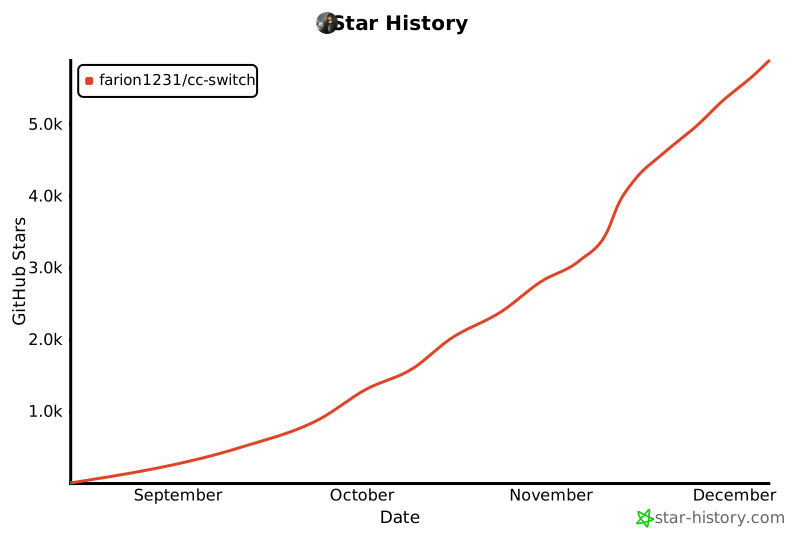](https://www.star-history.com/#farion1231/cc-switch&Date)
<td>SiliconFlow のご支援に感謝します!SiliconFlow は高性能 AI インフラストラクチャおよびモデル API プラットフォームで、言語・音声・画像・動画モデルへの高速かつ信頼性の高いアクセスをワンストップで提供します。従量課金制、豊富なマルチモーダルモデル対応、高速推論、エンタープライズグレードの安定性を備え、開発者やチームがより効率的に AI アプリケーションを構築・拡張できるようサポートします。<a href="https://cloud.siliconflow.cn/i/drGuwc9k">このリンク</a>から登録し、本人確認を完了すると、プラットフォーム内の全モデルで利用可能な ¥16 のボーナスクレジットが付与されます。SiliconFlow は OpenClaw にも対応しており、SiliconFlow の API キーを接続することで主要な AI モデルを無料で呼び出すことができます。</td>
</tr>
<tr>
@@ -42,8 +76,103 @@
<td>Cubence のご支援に感謝します!Cubence は Claude Code、Codex、Gemini などのリレーサービスを提供する信頼性の高い API 中継プラットフォームで、従量課金や月額プランなど柔軟な料金体系を提供しています。CC Switch ユーザー向けの特別割引:<a href="https://cubence.com/signup?code=CCSWITCH&source=ccs">このリンク</a>で登録し、チャージ時に「CCSWITCH」クーポンを入力すると、毎回 10% オフになります!</td>
<td>APIKEY.FUN のご支援に感謝します!APIKEY.FUN は、企業および個人開発者向けに安定・高効率・低コストな AI モデル API 接続サービスを提供する、プロフェッショナルなエンタープライズ級 AI リレープラットフォームです。Claude、OpenAI、Gemini などの主要人気モデルに対応し、料金は公式価格の 7% から利用できます。本プロジェクトの<a href="https://apikey.fun/register?aff=CCSwitch">専用リンク</a>から登録すると、最大で<strong>チャージ永久 5% オフ</strong>の特別優待も受けられます。</td>
<td>Atlas Cloud は、1 つの API で動画・画像生成や LLM(大規模言語モデル)を利用できる全モーダル対応の AI 推論プラットフォームです。複数のベンダーを個別に管理する手間を省き、一度の接続で 300 以上の厳選されたマルチモーダルモデルにアクセスできます。より低コストで API を利用できる、開発者向けの新しい<a href="https://www.atlascloud.ai/coding-plan?utm_source=github&utm_campaign=cc-switch">「コーディングプラン」</a>プロモーションをぜひチェックしてください!</td>
<td>CCSub のご支援に感謝します!CCSub は安定した低価格の AI API リレープラットフォームで、Claude Code 公式サブスクリプションの強力な代替です。1 つの API キーで Claude Opus 4.8、Sonnet 4.6、Haiku 4.5、GPT-5、Gemini、DeepSeek の全モデルを公式直接利用の約 1/3 のコストでご利用いただけます。VPN 不要で世界中から直接接続可能。Claude Code、Codex、Cursor、Cline、Continue、Windsurf など主要な AI コーディングツールすべてに対応しています。<a href="https://www.ccsub.net/register?ref=Y6Z8DXEA">こちらのリンク</a>から登録すると $5 の無料クレジットがもらえます。</td>
CC Switch には「共有設定スニペット」機能があり、APIキーやエンドポイント以外の共通データをプロバイダ間で引き継ぐことができます。「プロバイダ編集」→「共有設定パネル」→「現在のプロバイダから抽出」をクリックして、すべての共通データを保存してください。新しいプロバイダを作成する際に「共有設定を書き込む」にチェック(デフォルトで有効)を入れれば、プラグインなどのデータが新しいプロバイダ設定に含まれます。すべての設定項目は、アプリ初回起動時にインポートされたデフォルトプロバイダに保存されており、失われることはありません。
プリセットリストから公式プロバイダを追加してください。切り替え後、ログアウト/ログインのフローを実行すれば、以降は公式プロバイダとサードパーティプロバイダを自由に切り替えられます。Codex では異なる公式プロバイダ間の切り替えに対応しており、複数の Plus アカウントや Team アカウントの切り替えに便利です。
<td>感谢硅基流动赞助了本项目!硅基流动是一个高性能 AI 基础设施与模型 API 平台,一站式提供语言、语音、图像、视频等多模态模型的快速、可靠访问。平台支持按量计费、丰富的多模态模型选择、高速推理和企业级稳定性,帮助开发者和团队更高效地构建和扩展 AI 应用。通过<a href="https://cloud.siliconflow.cn/i/drGuwc9k">此链接</a>注册并完成实名认证,即可获得 ¥16 奖励金,可在平台内跨模型使用。硅基流动现已兼容 OpenClaw,用户可接入硅基流动 API Key 免费调用主流 AI 模型。</td>
</tr>
<tr>
@@ -42,8 +76,104 @@
<td>感谢 Cubence 赞助本项目!Cubence 是一家可靠高效的 API 中继服务提供商,提供对 Claude Code、Codex、Gemini 等模型的中继服务,并提供按量、包月等灵活的计费方式。Cubence 为 CC Switch 的用户提供了特别优惠:使用 <a href="https://cubence.com/signup?code=CCSWITCH&source=ccs">此链接</a> 注册,并在充值时输入 "CCSWITCH" 优惠码,每次充值均可享受九折优惠!</td>
<td>感谢优云智算赞助了本项目!优云智算是UCloud旗下AI云平台,提供稳定、全面的国内外模型API,仅一个key即可调用。主打包月、按次的高性价比 国模Coding Plan套餐,同时提供官转稳定海外模型。支持接入 Claude Code、Codex 及 API 调用。支持企业高并发、7*24技术支持、自助开票。通过<a href="https://www.compshare.cn/coding-plan?ytag=GPU_YY_YX_git_cc-switch">此链接</a>注册的用户,可得免费5元平台体验金!</td>
<td>感谢 Right Code 赞助了本项目!Right Code 稳定提供 Claude Code、Codex、Gemini 等模型的中转服务,并可选按量、包月两种计费模式。充值即可开票,企业、团队用户一对一对接。同时为 CC Switch 的用户提供了特别优惠:通过<a href="https://www.right.codes/register?aff=CCSWITCH">此链接</a>注册,每次充值均可获得实付金额5%的按量额度!</td>
<td>感谢 CTok.ai 赞助了本项目!CTok.ai 致力于打造一站式 AI 编程工具服务平台。我们提供 Claude Code 专业套餐及技术社群服务,同时支持 Google Gemini 和 OpenAI Codex。通过精心设计的套餐方案和专业的技术社群,为开发者提供稳定的服务保障和持续的技术支持,让 AI 辅助编程真正成为开发者的生产力工具。点击<a href="https://ctok.ai">这里</a>注册!</td>
<td>感谢 APINEBULA 赞助本项目!APINEBULA 是银河录像局旗下的企业级 AI 聚合平台,背靠大平台资源,面向开发者、团队与企业用户提供稳定、高性价比的大模型 API 接入服务。平台聚合 Claude、GPT、Gemini 等主流满血模型,一个接口,接入全球顶尖 AI 大模型,各大模型价格低至 1 折起,支持企业级高并发、正式合同、对公打款与开票服务,适合 AI 编程、Agent 开发、业务系统集成等多种场景!使用<a href="https://apinebula.com/02rw5X">此链接</a>注册并在充值时填写 <strong>"ccswitch"</strong> 优惠码可享<strong>九折优惠</strong>!</td>
<td>感谢 CCSub 赞助本项目!CCSub 是稳定、实惠的 AI API 中转平台,是 Claude Code 官方订阅的超强平替。一个 API Key 即可调用 Claude Opus 4.8、Sonnet 4.6、Haiku 4.5、GPT-5、Gemini、DeepSeek 全系列模型,价格约为官方直连的 1/3,全球直连无需梯子。兼容 Claude Code、Codex、Cursor、Cline、Continue、Windsurf 等所有主流 AI 编程工具。通过<a href="https://www.ccsub.net/register?ref=Y6Z8DXEA">此链接</a>注册即送 $5 体验额度!</td>
CC Switch 使用“通用配置片段”功能,在不同的供应商之间传递 Key 和请求地址之外的通用数据,您可以在“编辑供应商”菜单的“通用配置面板”里,点击“从当前供应商提取”,把所有的通用数据提取到通用配置中,之后在新建“供应商”的时候,只要勾选“写入通用配置”(默认勾选),就会把插件等数据写入到新的供应商配置中。您的所有配置项都会保存在运行本软件的时候,第一次导入的默认供应商里面,不会丢失。
- 系统托盘快速切换
- 单实例守护
- 内置自动更新器
- 原子写入与回滚保护
</details>
<details>
<summary><strong>macOS 安装</strong></summary>
CC Switch macOS 版本已通过 Apple 代码签名和公证,可直接下载安装,无需额外操作。推荐使用 `.dmg` 安装包。
- **Acknowledgment / 确认**: within 48 hours / 48 小时内
- **Initial assessment / 初步评估**: within 7 days / 7 天内
- **Fix for critical issues / 关键问题修复**: within 14 days / 14 天内
## Disclosure Policy / 披露政策
We follow a coordinated disclosure process:
我们遵循协调披露流程:
1. The reporter submits the vulnerability privately. / 报告者私下提交漏洞。
2. We confirm and work on a fix. / 我们确认并修复漏洞。
3. A patch release is published. / 发布修复版本。
4. The vulnerability is publicly disclosed. / 公开披露漏洞详情。
Reporters will be credited in the release notes unless they prefer to remain anonymous.
除非报告者希望匿名,否则将在发布说明中致谢。
## Security Updates / 安全更新
Security fixes are released as patch versions and announced via [GitHub Releases](https://github.com/farion1231/cc-switch/releases). We recommend always updating to the latest version.
# Using DeepSeek-Style Chat APIs in Codex: CC Switch Local Routing Guide
> Applies to CC Switch 3.16.0 and nearby versions. This guide is based on the repository documentation and code, and uses DeepSeek as an example of an OpenAI Chat Completions-compatible API. Screenshots are generated from the current frontend UI with de-identified sample data to avoid exposing a real API key or account balance.
## Why local routing is needed
The newer Codex CLI targets the OpenAI Responses API, while DeepSeek, Kimi, MiniMax, SiliconFlow, and many other providers expose the OpenAI Chat Completions shape, usually `/chat/completions`. These two protocols use different request bodies, streaming events, and response structures. If you put a Chat endpoint directly into Codex configuration, common results include an incorrect model list, 404/400 requests, or streaming responses that Codex cannot parse correctly.
CC Switch solves this by making Codex always talk to a local route and continue sending Responses API requests. The route detects whether the active provider is Chat-format, rewrites the request into Chat Completions for the upstream provider, and finally converts the Chat response back into the Responses shape that Codex understands.

The chain has four main steps:
1. When Codex routing is enabled, the local configuration is written as `http://127.0.0.1:15721/v1`, while `wire_api = "responses"` is kept in place.
2. The provider's `meta.apiFormat = "openai_chat"` tells the route that the real upstream is Chat Completions.
3. The route rewrites `/responses` or `/v1/responses` to `/chat/completions`, and converts the Responses request body into a Chat request body.
4. After the upstream responds, the route converts the Chat JSON or SSE stream back into Responses JSON/SSE.
## Prerequisites
Prepare these three things first:
- CC Switch installed and able to start.
- Codex CLI installed and run at least once, so the `~/.codex/config.toml` directory structure exists.
- An API key from DeepSeek or another Chat Completions provider.
DeepSeek's official documentation currently lists the OpenAI-compatible base URL as `https://api.deepseek.com` (other providers often use a base URL with a `/v1` suffix), and the Chat API path as `/chat/completions`. CC Switch's DeepSeek preset already contains these details, so prefer the preset and do not manually assemble the endpoint path.
## Step 1: Add a Codex provider
Open CC Switch, switch to the top-level `Codex` tab, and click the plus button in the upper-right corner to add a provider.
Choose the built-in `DeepSeek` preset. You only need to do two things:
- Enter your DeepSeek API key.
- Save the provider.

The preset already includes DeepSeek's request base URL, default model, model menu, thinking/reasoning parameters, and automatically enables `Needs Local Routing`. You can adjust the default model or model display names if needed; the protocol conversion is handled by the routing layer.
## Step 2: Enable local routing and route Codex
Go to the `Routing` page in Settings, expand `Local Routing`, and complete two toggles:
1. Turn on the main routing switch to start the local service. The default address is `127.0.0.1:15721`.
2. Turn on `Codex` under `Routing Enabled`. If you only want Codex to use local routing, you can leave Claude and Gemini off.

After routing is enabled, CC Switch points Codex's live configuration to the local route and manages authentication with a placeholder. The real DeepSeek key stays in the CC Switch provider configuration and is injected by the local route while forwarding requests, so you do not need to expose the key in Codex's live configuration.
## Step 3: Switch providers and restart Codex
Return to the Codex provider list and click `Enable` on the DeepSeek provider. If you see the `Needs Routing` marker, that provider must be used while routing is running; when the route is not started, CC Switch shows a prompt saying the routing service is required.
After switching, restart the current Codex terminal session. This is recommended because:
- The Codex process may already have read the old `config.toml`.
- After `model_catalog_json` is generated, the `/model` menu usually needs a fresh process before it refreshes.
Inside Codex, use `/model` to check whether the current model comes from the DeepSeek preset, such as `DeepSeek V4 Flash`. The Codex app currently does not support multi-model selection, so it defaults to the first configured model. Then send a small test prompt and confirm that the request count increases in the routing panel, or that a Codex request appears in usage/request logs.
## How to handle other Chat providers
DeepSeek, Kimi, MiniMax, SiliconFlow, and other common Chat-format providers already have presets in CC Switch, so use presets first. Only choose custom configuration for providers that are not covered by presets; in that case, fill in the API key, base URL, and models according to the provider's documentation, and set `API Format` to `OpenAI Chat Completions (requires routing)`.
If the upstream provider directly supports the OpenAI Responses API, you do not need to enable `Needs Local Routing`; CC Switch can connect through Responses directly without Chat conversion.
## FAQ
**Codex reports 404 or cannot find `/responses`**
Usually Codex routing is not enabled, or the upstream Chat base URL was written directly into Codex manually. Check whether `~/.codex/config.toml` points to `http://127.0.0.1:15721/v1`.
**DeepSeek upstream reports 404**
If you are using the built-in DeepSeek preset, first confirm that the active provider really comes from the preset and that Codex routing is enabled. Only custom providers require extra base URL checks: the base URL should be the service root, not the full endpoint path with `/chat/completions`.
**`/model` does not show DeepSeek models**
Restart Codex after saving the provider. CC Switch generates `cc-switch-model-catalog.json` and writes its path to `model_catalog_json`, but a running Codex process may not hot-load the model catalog.
The Codex app currently does not support multi-model selection, so it uses the first configured model by default.
**Routing is enabled, but requests still go to the wrong provider**
Confirm that all three states match: the current provider under the Codex tab is DeepSeek; the local routing service is running; and the Codex toggle is enabled under `Routing Enabled`.
**Can I use an official OpenAI Codex account through local routing?**
Not recommended. CC Switch blocks switching to official providers while local routing takeover is enabled, because accessing official APIs through a proxy may create account risk. Routing is mainly intended for third-party, aggregator, or protocol-conversion scenarios.
## References
- [CC Switch User Manual: Add Provider](../user-manual/en/2-providers/2.1-add.md)
- [CC Switch User Manual: Proxy Service](../user-manual/en/4-proxy/4.1-service.md)
- [CC Switch User Manual: App Routing](../user-manual/en/4-proxy/4.2-routing.md)
- [DeepSeek API Docs: Your First API Call](https://api-docs.deepseek.com/)
- [DeepSeek API Docs: Create Chat Completion](https://api-docs.deepseek.com/api/create-chat-completion)
- [DeepSeek API Docs: Multi-round Conversation](https://api-docs.deepseek.com/guides/multi_round_chat)
# Keep Codex Remote Control and Official Plugins While Using Third-Party APIs: CC Switch Setup Guide
> Applies to CC Switch v3.16.1 and later. This guide is based on the current code, user manual, and v3.16.1 release notes. Screenshots use de-identified sample data and do not include real Access Tokens or API keys.
## What this guide solves
Many Codex users want both of these at the same time:
1. Use models from DeepSeek, Kimi, GLM, MiniMax, SiliconFlow, or other third-party APIs, or use GPT models through an aggregator.
2. Keep Codex official-app capabilities such as mobile remote control and official plugins.
Previously, when switching to a third-party provider, the old behavior wrote the third-party API key into Codex `auth.json`, which could overwrite the original official ChatGPT / Codex login cache. The third-party model worked, but features that depend on the official login state disappeared.
The **Codex App Enhancements** switch added in v3.16.1 solves this conflict: the official Access Token stays in `auth.json`, while third-party provider information is written to `config.toml`. Codex App can still see an official account, but actual model requests follow the third-party provider currently selected in CC Switch.
This behavior already existed in v3.16.0 and was enabled by default. After some users reported that they did not want this behavior, v3.16.1 turned it into an explicit switch.
## Quick answer
Recommended order:
1. In the CC Switch Codex panel, switch to `OpenAI Official`.
2. Start Codex and log in once with an official ChatGPT / Codex account. A Free subscription is enough.
3. Return to CC Switch and enable `Settings -> General -> Codex App Enhancements -> Keep official login when switching third-party providers`.
4. Add or switch to a third-party Codex provider.
5. If the provider uses the Chat Completions protocol, such as DeepSeek / Kimi / MiniMax, also enable local routing and route Codex through it.
6. Restart Codex so `config.toml` and the model catalog are reloaded.

## Prerequisites
Prepare the following:
- CC Switch v3.16.1 or later.
- Codex installed and able to start. Installing both the app and CLI is recommended.
- An official ChatGPT / Codex account that can log in to Codex. A Free subscription is enough.
- A third-party API key, such as DeepSeek, Kimi, GLM, MiniMax, OpenRouter, SiliconFlow, or similar.
Do not manually copy or share the contents of `~/.codex/auth.json`. It stores official login cache and Access Tokens, so it is sensitive.
## Step 1: Switch back to OpenAI Official and complete official login
Open CC Switch and switch to the top-level `Codex` tab. First select the `OpenAI Official` provider, or add it from the preset providers if it is missing, and make it the current provider.

Then start Codex, preferably the CLI, and follow the official login flow to sign in with your ChatGPT / Codex account. This account can be on the Free plan. In this setup, it mainly preserves the official identity required by Codex App, and does not pay for third-party model usage.
After login, Codex stores the official login cache in `~/.codex/auth.json`. The key point for the following steps is: do not let third-party provider switching overwrite this file again.
## Step 2: Enable Codex App Enhancements
Return to CC Switch and open:
```text
Settings -> General -> Codex App Enhancements
```
Enable:
```text
Keep official login when switching third-party providers
```
This switch is off by default because some users do not want this behavior. Enable it only when you explicitly want "third-party API + official remote control / official plugins" at the same time.
After it is enabled, backend switching for third-party Codex providers uses a config-only write path:
-`auth.json`: keeps the official ChatGPT / Codex login cache.
-`config.toml`: stores the active third-party provider's model, endpoint, `model_provider`, and provider-scoped `experimental_bearer_token`.
## Step 3: Add a third-party Codex provider
Return to the Codex panel and click the plus button in the upper-right corner to add a provider. Prefer built-in presets such as DeepSeek, Kimi, MiniMax, GLM, or SiliconFlow.
Using DeepSeek as an example, after selecting the preset, you only need to enter the API key. The preset automatically configures the base URL, default model, model mapping table, and "Needs Local Routing" flag.
If your third-party provider natively supports the OpenAI Responses API, such as an aggregator that offers GPT models, local routing may not be needed.
If it only supports OpenAI Chat Completions, which is common for DeepSeek / Kimi / MiniMax paths, local routing must be enabled so CC Switch can convert Codex Responses requests into Chat Completions requests.
## Step 4: Enable local routing and route Codex when needed
Open:
```text
Settings -> Routing -> Local Routing
```
Complete two actions:
1. Turn on the main routing switch to start the local service. The default address is usually `127.0.0.1:15721`.
2. Under `Routing Enabled`, turn on `Codex`.

After takeover, Codex's live `config.toml` temporarily points to the CC Switch local route. The real third-party API key remains in the CC Switch provider configuration, and is projected into the `experimental_bearer_token` in `config.toml` when providers are switched.
## Step 5: Switch to the third-party provider and restart Codex
Return to the Codex provider list and enable the third-party provider you just added. After switching, restarting Codex is recommended for two reasons:
- Codex reads `config.toml` at startup.
- The Codex `/model` menu usually needs a restart before it reloads `model_catalog_json`.
After restart, you can run a quick verification:
- In Codex App, the account information still shows the official account. This is expected.
- In CC Switch, the current Codex provider is the third-party provider.
- If local routing is enabled, request logs or routing stats show Codex requests going through the local route.
- The third-party provider dashboard or balance records show actual model requests.
## How it works
Codex mainly uses two configuration files:
```text
~/.codex/auth.json
~/.codex/config.toml
```
They have different responsibilities:
-`auth.json` stores the official ChatGPT / Codex login cache, which Codex App needs to identify the official account and enable remote control and official plugins.
-`config.toml` stores runtime configuration such as the current model provider, base URL, model, model catalog, and provider-scoped token.
After `Keep official login when switching third-party providers` is enabled, CC Switch takes the third-party provider API key from the provider configuration and writes it under the current provider in `config.toml`:
```toml
model_provider="custom"
[model_providers.custom]
name="DeepSeek"
base_url="https://api.deepseek.com"
wire_api="responses"
experimental_bearer_token="sk-..."
```
At the same time, `auth.json` keeps the official login cache unchanged. Codex App can still identify the official account, while model requests follow the current provider and base URL in `config.toml`.
If the provider uses the Chat Completions protocol, CC Switch local routing adds another conversion layer:
```text
Codex Responses request
|
CC Switch local route
|
Third-party Chat Completions API
|
Converted back to Codex Responses response
```
This is why you can keep using official plugins / mobile remote control while moving model traffic to a third-party API.
## Side effects to understand
### Codex still shows the official account
This is the easiest part to misunderstand. After this capability is enabled, Codex App reads the official login state from `auth.json`, so it continues to display the official account.
That does not mean model requests are still going to official OpenAI. Actual traffic is determined by the current Codex provider in CC Switch, `config.toml`, and local routing logs.
### Do not use the Codex account display to judge billing
If you switch to DeepSeek, Codex can still display the official account, while model requests go to the DeepSeek API. Billing, quota, error codes, and data policy should all be understood according to the third-party provider. You can inspect specific request details in the usage panel.
### Restart Codex after changing model mappings
Codex reads the model catalog at startup. Even if CC Switch has generated a new model catalog, a running Codex process may not hot-load it, so restart Codex after editing model mappings.
### Turning the switch off returns to the old behavior
If `Keep official login when switching third-party providers` is turned off, third-party provider switching uses the compatibility behavior from older versions and may write `auth.json` again. If your goal is to keep official remote control and official plugins long term, keep this switch enabled.
## FAQ
**I switched to a third-party API. Why does Codex still show the official account?**
This is expected. Official account information comes from `auth.json`; the actual model provider comes from `config.toml` and the current provider in CC Switch.
**Is a Free subscription really enough?**
Yes. The official account is mainly used to obtain and preserve the official login state required by Codex App. Third-party model requests use the third-party API key configured in CC Switch.
**What should I do if official plugins or mobile remote control still do not work?**
Switch back to `OpenAI Official`, restart Codex, and complete official login once. Then confirm `Settings -> General -> Codex App Enhancements -> Keep official login when switching third-party providers` is enabled in CC Switch before switching back to the third-party provider.
**What if third-party requests return 404, the model list is wrong, or streaming responses are broken?**
If the provider uses Chat Completions, confirm that the provider form has `Needs Local Routing` enabled, and that `Settings -> Routing` has both the main routing switch and Codex takeover enabled.
**Can I switch back to OpenAI Official while local routing is enabled?**
Not recommended. CC Switch tries to prevent switching to official providers while local routing takeover is active, because accessing official APIs through a proxy may create account risk. Use official login only to preserve `auth.json`, and route model traffic to third-party providers.
**Why is this flow so complex? Can it be simplified?**
Because Codex App Enhancements and routing takeover can create unnecessary trouble for users who do not need them, these features are explicit switches instead of always-on behavior.
## References
- [Codex DeepSeek local routing hands-on guide](./codex-deepseek-routing-guide-en.md)
- [Add a Codex provider: Chat Completions routing and model mapping](../user-manual/en/2-providers/2.1-add.md)
ルーティング有効化後、Codex の live `config.toml` は一時的に CC Switch のローカルルートを指します。実際のサードパーティ API Key は CC Switch のプロバイダー設定内に残り、プロバイダー切り替え時に `config.toml` の `experimental_bearer_token` へ投影されます。
CC Switch v3.11.0 is a major update that adds full management support for **OpenClaw** as the fifth application, introduces a new **Session Manager** and **Backup Management** feature. Additionally, **Oh My OpenCode (OMO) integration**, the **partial key-field merging** architecture upgrade for provider switching, **settings page refactoring**, and many other improvements make the overall experience more polished.
- **OpenClaw Support**: Fifth managed application with 13 provider presets, Env/Tools/AgentsDefaults config editors, and Workspace file management
- **Session Manager**: Browse conversation history across all five apps with table-of-contents navigation and in-session search
- **Backup Management**: Independent backup panel with configurable policies, periodic backups, and pre-migration auto-backup
- **Oh My OpenCode Integration**: Full OMO config management with OMO Slim lightweight mode support
- **Partial Key-Field Merging (⚠️ Breaking Change)**: Provider switching now only replaces provider-related fields, preserving all other settings; the "Common Config Snippet" feature has been removed
- **Settings Page Refactoring**: 5-tab layout with ~40% code reduction
- **6 New Provider Presets**: AWS Bedrock, SSAI Code, CrazyRouter, AICoding, and more
- **Thinking Budget Rectifier**: Fine-grained thinking budget control
Provider switching now uses partial key-field merging instead of full config overwrite (#1098).
**Before**: Switching providers overwrote the entire `settings_config` to the live config file. This meant that any non-provider settings the user manually added to the live file (plugins, MCP config, permissions, etc.) would be lost on every switch. To work around this, previous versions offered a "Common Config Snippet" feature that let users define shared config to be merged on every switch.
**After**: Switching providers now only replaces provider-related key-values (API keys, endpoints, models, etc.), leaving all other settings intact. The "Common Config Snippet" feature is therefore no longer needed and has been removed.
**Impact & Migration**:
- If you **didn't use** Common Config Snippets, this change is fully transparent — switching just works better now
- If you **used** Common Config Snippets to preserve custom settings (MCP config, permissions, etc.), those settings are now automatically preserved during switches — no action needed
- If you used Common Config Snippets for other purposes (e.g., injecting extra config on every switch), please manually add those settings to your live config file after upgrading
This refactoring removed 6 frontend files (3 components + 3 hooks) and ~150 lines of backend dead code.
### Manual Import Replaces Auto-Import
Startup no longer auto-imports external configurations. Users now click "Import Current Config" manually, preventing accidental data overwrites.
### OmoVariant Parameterization
Eliminated ~250 lines of duplicated code in the OMO module via `OmoVariant` struct parameterization.
### OMO Common Config Removal
Removed the two-layer merge system, reducing ~1,733 lines of code and simplifying the architecture.
### ProviderForm Decomposition
Reduced ProviderForm component from 2,227 lines to 1,526 lines by extracting 5 independent modules (opencodeFormUtils, useOmoModelSource, useOpencodeFormState, useOmoDraftState, useOpenclawFormState), significantly improving maintainability.
### Shared MCP/Skills Components
Extracted AppCountBar, AppToggleGroup, and ListItemRow shared components to reduce duplication across MCP and Skills panels (#897, thanks @PeanutSplash).
### Settings Page Refactoring
Refactored settings page to a 5-tab layout (General | Proxy | Advanced | Usage | About), reducing SettingsPage code from ~716 to ~426 lines.
### Other Improvements
- Unified terminal selection via global settings with WezTerm support added
- Updated Claude model references from 4.5 to 4.6
---
## Bug Fixes
### Critical Fixes
- **Windows Home Dir Regression**: Restored default home directory resolution to prevent providers/settings "disappearing" when `HOME` env var differs from the real user profile directory in Git/MSYS environments
- **Linux White Screen**: Disabled WebKitGTK hardware acceleration on AMD GPUs (Cezanne/Radeon Vega) to prevent blank screen on startup (#986, thanks @ThendCN)
- **OpenAI Beta Parameter**: Stopped appending `?beta=true` to `/v1/chat/completions` endpoints, fixing request failures for Nvidia and other `apiFormat="openai_chat"` providers (#1052, thanks @jnorthrup)
- **Health Check Auth**: Health check now respects provider's `auth_mode` setting, preventing failures for proxy services that only support Bearer authentication (#824, thanks @Jassy930)
- Fixed Skill ZIP symlink resolution (#1040, thanks @yovinchen)
- Added missing OpenCode checkbox in MCP add/edit form (#1026, thanks @yovinchen)
- Removed auto-import side effect from useProvidersQuery queryFn
---
## Performance
- Parallel directory scanning + head-tail JSONL reading for session panel, significantly improving session list loading speed
- Removed unnecessary TanStack Query cache overhead for Tauri local IPC calls
---
## Documentation
- Sponsor updates: SSSAiCode, Crazyrouter, AICoding, Right Code, MiniMax
- Added user manual documentation (#979, thanks @yovinchen)
---
## Notes & Considerations
- **OpenClaw is a newly supported app**: OpenClaw CLI must be installed first to use related features.
- **⚠️ Common Config Snippet feature has been removed**: Since provider switching now uses partial key-field merging (only replacing API keys, endpoints, models, etc.), user's other settings are automatically preserved, making Common Config Snippets unnecessary. See the "Architecture Improvements" section above for migration details.
- **Auto-import changed to manual**: External configurations are no longer auto-imported on startup. Click "Import Current Config" manually when needed.
- **OMO and OMO Slim are mutually exclusive**: Only one can be active at a time. Switching to one automatically disables the other.
- **Backup is enabled by default**: Automatic hourly backup during runtime. Adjust the policy in the Backup panel.
---
## Special Thanks
Thanks to all contributors for their contributions to this release!
| `CC-Switch-v3.11.0-macOS.zip` | **Recommended** - Extract and drag to Applications, Universal Binary |
| `CC-Switch-v3.11.0-macOS.tar.gz` | For Homebrew installation and auto-update |
> **Note**: Since the author doesn't have an Apple Developer account, you may see an "unidentified developer" warning on first launch. Please close it, then go to "System Settings" → "Privacy & Security" → click "Open Anyway", and it will open normally afterwards.
### Homebrew (macOS)
```bash
brew tap farion1231/ccswitch
brew install --cask cc-switch
```
Update:
```bash
brew upgrade --cask cc-switch
```
### Linux
| Distribution | Recommended Format | Installation Method |
CC Switch v3.11.0 は大規模なアップデートです。5番目のアプリケーション **OpenClaw** の完全管理サポートを追加し、新しい**セッションマネージャー**と**バックアップ管理**機能を導入しました。さらに、**Oh My OpenCode (OMO) 統合**、プロバイダー切り替えの**部分キーフィールドマージ**アーキテクチャアップグレード、**設定ページのリファクタリング**など、多数の改善により全体的な体験がさらに向上しました。
CC Switch v3.11.0 是一次大规模更新,新增第五个应用 **OpenClaw** 的完整管理支持,同时带来全新的**会话管理器**和**备份管理**功能。此外,**Oh My OpenCode (OMO) 集成**、供应商切换的**部分键值合并**架构升级、**设置页面重构**等多项改进使整体体验更加完善。
**变更前**:切换供应商时,整个 `settings_config` 会覆写到 live 配置文件。这意味着用户在 live 文件中手动添加的非供应商设置(插件配置、MCP 配置、权限设置等)会在每次切换时丢失。为了弥补这个问题,之前版本提供了"通用配置片段"功能,让用户定义每次切换时都会合并的公共配置。
CC Switch v3.11.1 is a hotfix release that reverts the **Partial Key-Field Merging** architecture introduced in v3.11.0, restoring the proven "**full config overwrite + Common Config Snippet**" mechanism. It also includes several UI and platform compatibility fixes.
- **Restore Full Config Overwrite + Common Config Snippet**: Reverted partial key-field merging due to critical data loss issues; restores full config snapshot write and Common Config Snippet UI
- **Proxy Panel Improvements**: Proxy toggle moved into panel body for better discoverability of takeover options
- **Theme & Compact Mode Fixes**: "Follow System" theme now auto-updates; compact mode exit works correctly
- **Windows Compatibility**: Disabled env check and one-click install to prevent protocol handler side effects
---
## Reverted
### Restore Full Config Overwrite + Common Config Snippet
Reverted the partial key-field merging refactoring introduced in v3.11.0 (revert 992dda5c).
**Why reverted**: The partial key-field merging approach had three critical issues:
1.**Data loss on switch**: Non-whitelisted custom fields were silently dropped during provider switching
2.**Permanent backfill stripping**: Backfill permanently removed non-key fields from the database, causing irreversible data loss
3.**Maintenance burden**: The whitelist of "key fields" required constant maintenance as new config keys were added
**What's restored**:
- Full config snapshot write on provider switch (predictable, complete overwrite)
- If you upgraded to v3.11.0 and your providers lost custom fields, re-import your config or manually re-add the missing fields
- Common Config Snippet is available again — use it to define shared config that should persist across provider switches
---
## Changed
- **Proxy Panel Layout**: Moved proxy on/off toggle from accordion header into panel content area, placed directly above app takeover options. This ensures users see takeover configuration immediately after enabling the proxy, avoiding the common mistake of enabling the proxy without configuring takeover
- **Manual Import for OpenCode/OpenClaw**: Removed auto-import on startup; empty state now shows an "Import Current Config" button, consistent with Claude/Codex/Gemini behavior
---
## Fixed
- **"Follow System" Theme Not Auto-Updating**: Delegated to Tauri's native theme tracking (`set_window_theme(None)`) so the WebView's `prefers-color-scheme` media query stays in sync with OS theme changes
- **Compact Mode Cannot Exit**: Restored `flex-1` on `toolbarRef` so `useAutoCompact`'s exit condition triggers correctly based on available width instead of content width
- **Proxy Takeover Toast Shows {{app}}**: Added missing `app` interpolation parameter to i18next `t()` calls for proxy takeover enabled/disabled messages
- **Windows Protocol Handler Side Effects**: Disabled environment check and one-click install on Windows to prevent unintended protocol handler registration
---
## Notes & Considerations
- **Common Config Snippet is back**: If you relied on this feature in v3.10.x and earlier, it works the same way again. Define shared config that should persist across all provider switches.
- **v3.11.0 Partial Key-Field Merging users**: If you noticed missing config fields after switching providers in v3.11.0, re-import your config to restore them.
---
## Download & Installation
Visit [Releases](https://github.com/farion1231/cc-switch/releases/latest) to download the appropriate version.
| `CC-Switch-v3.11.1-macOS.zip` | **Recommended** - Extract and drag to Applications, Universal Binary |
| `CC-Switch-v3.11.1-macOS.tar.gz` | For Homebrew installation and auto-update |
> **Note**: Since the author doesn't have an Apple Developer account, you may see an "unidentified developer" warning on first launch. Please close it, then go to "System Settings" → "Privacy & Security" → click "Open Anyway", and it will open normally afterwards.
### Homebrew (macOS)
```bash
brew tap farion1231/ccswitch
brew install --cask cc-switch
```
Update:
```bash
brew upgrade --cask cc-switch
```
### Linux
| Distribution | Recommended Format | Installation Method |
CC Switch v3.12.0 is a feature release focused on provider compatibility, OpenClaw editing, Common Config usability, and sync/data reliability. It restores the **Model Health Check (Stream Check)** UI with improved stability, adds **OpenAI Responses API** format conversion, expands provider presets for **Ucloud**, **Micu**, **X-Code API**, **Novita**, and **Bailian For Coding**, and upgrades **WebDAV sync** with dual-layer versioning.
- **Stream Check returns**: Restored the model health check UI, added first-run confirmation, and fixed `openai_chat` provider support
- **OpenAI Responses API**: Added `api_format = "openai_responses"` with bidirectional conversion and shared conversion cleanup — simply select the Responses API format when adding a provider and enable proxy takeover, and you can use GPT-series models in Claude Code!
- **OpenClaw overhaul**: Introduced JSON5 round-trip config editing, a config health banner, better agent model selection, and a User-Agent toggle
- **Preset expansion**: Added Ucloud, Micu, X-Code API, Novita, and Bailian For Coding updates, plus SiliconFlow partner badge and model-role badges
- **Sync and maintenance improvements**: Added WebDAV protocol v2 + db-v6 versioning, daily rollups, incremental auto-vacuum, and sync-aware backup
- **Common Config usability improvements**: After updating a Common Config Snippet, it is now automatically applied when switching providers — no more manual checkbox needed
---
## Main Features
### Model Health Check (Stream Check)
Restored the Stream Check panel for live provider validation, improving the reliability of provider management.
- Restored Stream Check UI panel with single and batch provider availability testing
- Added first-run confirmation dialog to prevent unsupported providers from showing misleading errors
- Fixed detection compatibility for `openai_chat` API format providers
### OpenAI Responses API
Added native support for providers using the OpenAI Responses API with a new `openai_responses` API format.
- New `api_format = "openai_responses"` provider format option
- Bidirectional Anthropic Messages <-> OpenAI Responses API format conversion
- Consolidated shared conversion logic to reduce code duplication
### Bedrock Request Optimizer
Added a PRE-SEND phase request optimizer for AWS Bedrock providers to improve compatibility and performance.
Common Config Snippets are now applied as a runtime overlay instead of being materialized into stored provider configs.
**Before**: Common Config content was merged directly into each provider's `settings_config` on save or switch. This caused shared configuration to be duplicated across every provider entry, requiring manual sync when changes were needed.
**After**: Common Config is only injected as a runtime overlay when switching providers and writing to the live file — provider entries themselves no longer contain shared configuration. This means modifying Common Config takes effect immediately without updating each provider individually.
### Common Config Auto-Extract
On first run, if no Common Config Snippet exists in the database, one is automatically extracted from the current live config. This ensures users upgrading from older versions do not lose their existing shared configuration settings.
### Periodic Maintenance Timer Consolidation
Consolidated daily rollups and auto-vacuum into a unified periodic maintenance timer, eliminating resource contention and complexity from multiple independent timers.
- Skip unnecessary OpenClaw config writes when config is unchanged, reducing disk I/O
---
## Documentation
- Restructured the user manual for i18n and added complete EN/JA coverage
- Added OpenClaw usage documentation and completed settings documentation
- Added UCloud sponsor information
- Reorganized the docs directory and synced README feature sections across EN/ZH/JA
---
## Notes & Considerations
- **Common Config now uses runtime overlay**: Common Config Snippets are no longer materialized into each provider's stored config. They are dynamically applied at switch time. Modifying Common Config takes effect immediately without updating each provider.
- **Stream Check requires first-use confirmation**: A confirmation dialog appears when using the model health check for the first time. Testing proceeds only after confirmation.
- **OpenClaw User-Agent toggle defaults to off**: The User-Agent identifier must be manually enabled in the OpenClaw configuration.
---
## Special Thanks
Thanks to all contributors for their contributions to this release!
| `CC-Switch-v3.12.0-macOS.zip` | **Recommended** - Extract and drag to Applications, Universal Binary |
| `CC-Switch-v3.12.0-macOS.tar.gz` | For Homebrew installation and auto-update |
> **Note**: Since the author doesn't have an Apple Developer account, you may see an "unidentified developer" warning on first launch. Please close it, then go to "System Settings" -> "Privacy & Security" -> click "Open Anyway", and it will open normally afterwards.
### Homebrew (macOS)
```bash
brew tap farion1231/ccswitch
brew install --cask cc-switch
```
Update:
```bash
brew upgrade --cask cc-switch
```
### Linux
| Distribution | Recommended Format | Installation Method |
**変更前**: Common Config の内容は保存時または切り替え時に各プロバイダーの `settings_config` に直接マージされていました。これにより共通設定が各プロバイダーエントリーにコピーされ、変更時には一つずつ同期する必要がありました。
**変更後**: Common Config はプロバイダー切り替え時に live ファイルへ書き込む際のみ runtime overlay として注入され、プロバイダーエントリー自体には共通設定を含みません。つまり Common Config の変更は即座に反映され、各プロバイダーを個別に更新する必要はありません。
### Common Config 初回自動抽出
初回起動時にデータベースに Common Config Snippet がまだ存在しない場合、現在の live config から自動抽出します。これにより旧バージョンからアップグレードしたユーザーの既存の共通設定が失われないことを保証します。
CC Switch v3.12.1 is a patch release focused on stability improvements and bug fixes. It resolves a Common Config modal infinite reopen loop, a WebDAV sync foreign key constraint failure, and several i18n interpolation issues. It also adds **StepFun** provider presets, **OpenClaw input type selection** and **authHeader** support, upgrades the default Gemini model to **3.1-pro**, and welcomes four new sponsor partners.
- **Common Config modal fix**: Resolved an infinite reopen loop in the Common Config modal and added draft editing support
- **WebDAV sync reliability**: Fixed a foreign key constraint failure when restoring `provider_health` during WebDAV sync
- **StepFun presets**: Added StepFun (阶跃星辰) provider presets including the step-3.5-flash model
- **OpenClaw enhancements**: Added input type selection for model Advanced Options and `authHeader` field for vendor-specific auth header support
- **Gemini model upgrade**: Upgraded default Gemini model to 3.1-pro in provider presets
- **New sponsors**: Welcomed Micu API, XCodeAPI, SiliconFlow, and CTok as sponsor partners
---
## New Features
### StepFun Provider Presets
Added provider presets for StepFun (阶跃星辰), a leading Chinese AI model provider.
- New preset entries for StepFun across supported applications
- Includes the step-3.5-flash model (#1369, thanks @hengm3467)
### OpenClaw Enhancements
Enhanced the OpenClaw configuration with more granular control and better vendor compatibility.
- Added input type selection dropdown for model Advanced Options (#1368, thanks @liuxxxu)
- Added optional `authHeader` boolean to `OpenClawProviderConfig` for vendor-specific auth header support (e.g. Longcat), and refactored form state to reuse the shared type
### Sponsor Partners
- **Micu API**: Added Micu API as sponsor partner with affiliate links
- **XCodeAPI**: Added XCodeAPI as sponsor partner
- **SiliconFlow**: Added SiliconFlow (硅基流动) as sponsor partner with affiliate links
- **CTok**: Added CTok as sponsor partner
---
## Changes
- **UCloud → Compshare**: Renamed UCloud provider to Compshare (优云智算) with full i18n support across all three locales (EN/ZH/JA)
| `CC-Switch-v3.12.1-macOS.zip` | **Recommended** - Extract and drag to Applications, Universal Binary |
| `CC-Switch-v3.12.1-macOS.tar.gz` | For Homebrew installation and auto-update |
> **Note**: Since the author doesn't have an Apple Developer account, you may see an "unidentified developer" warning on first launch. Please close it, then go to "System Settings" -> "Privacy & Security" -> click "Open Anyway", and it will open normally afterwards.
### Homebrew (macOS)
```bash
brew tap farion1231/ccswitch
brew install --cask cc-switch
```
Update:
```bash
brew upgrade --cask cc-switch
```
### Linux
| Distribution | Recommended Format | Installation Method |
CC Switch v3.12.2 is a reliability-focused patch release that addresses Common Config loss during proxy takeover and improves Codex TOML editing accuracy. Proxy takeover hot-switches and provider sync now update the restore backup instead of overwriting live config files; the startup sequence has been reordered so snippets are extracted from clean live files before takeover state is restored; and Codex `base_url` editing has been refactored into a section-aware model that no longer appends to the end of the file.
- **Empty state guidance**: Provider list empty state now shows detailed import instructions with a conditional Common Config snippet hint for Claude/Codex/Gemini
- **Proxy takeover restore flow rework**: Hot-switches and provider sync now refresh the restore backup instead of overwriting live config files, preserving the full user configuration on rollback
- **Snippet lifecycle stability**: Introduced a `cleared` flag to prevent auto-extraction from resurrecting cleared snippets, and reordered startup to extract from clean state
- **Section-aware Codex TOML editing**: `base_url` and `model` field reads/writes now target the correct `[model_providers.<name>]` section
- **Codex MCP config protection**: Existing `mcp_servers` blocks in restore snapshots survive provider hot-switches via per-server-id merge instead of wholesale replacement, with provider/common-config definitions winning on conflict
---
## New Features
### Empty State Guidance
Improved the first-run experience with helpful guidance when the provider list is empty.
- Empty state page shows step-by-step import instructions
- Conditionally displays a Common Config snippet hint for Claude/Codex/Gemini providers (not shown for OpenCode/OpenClaw)
---
## Changes
### Proxy Takeover Restore Flow
The proxy takeover hot-switch and provider sync logic has been reworked to protect Common Config throughout the takeover lifecycle.
- Provider sync now updates the restore backup instead of writing directly to live config files when takeover is active
- Effective provider settings are rebuilt with Common Config applied before saving restore snapshots, so rollback restores the real user configuration
- Legacy providers with inferred common config usage are automatically marked with `commonConfigEnabled=true`
### Codex TOML Editing Engine
Codex `config.toml` update logic has been refactored onto shared section-aware TOML helpers.
- New Rust module `codex_config.rs` with `update_codex_toml_field` and `remove_codex_toml_base_url_if`
- New frontend utilities `getTomlSectionRange` / `getCodexProviderSectionName` for section-aware operations
- Inline TOML editing logic scattered across `proxy.rs` now delegates to the new module
### Common Config Initialization Lifecycle
The startup sequence has been reordered for more robust snippet extraction and migration.
- Startup now auto-extracts Common Config snippets from clean live files before restoring proxy takeover state
- Introduced a snippet `cleared` flag to track whether a user intentionally cleared a snippet
- Persisted a one-time legacy migration flag to avoid repeated `commonConfigEnabled` backfills
---
## Bug Fixes
### Common Config Loss
- Fixed multiple scenarios where Common Config could be dropped during proxy takeover: sync overwriting live files, hot-switches producing incomplete restore snapshots, and provider switches losing config changes
### Codex Restore Snapshot Preservation
- Fixed Codex takeover restore backups discarding existing `mcp_servers` blocks during provider hot-switches; changed MCP backup preservation from wholesale table replacement to per-server-id merge so provider/common-config MCP updates win on conflict while backup-only servers are retained
### Cleared Snippet Resurrection
- Fixed startup auto-extraction recreating Common Config snippets that users had intentionally cleared
### Codex `base_url` Misplacement
- Fixed Codex `base_url` extraction and editing not targeting the correct `[model_providers.<name>]` section, causing it to append to the file tail or confuse `mcp_servers.*.base_url` entries for provider endpoints
---
## Download & Installation
Visit [Releases](https://github.com/farion1231/cc-switch/releases/latest) to download the appropriate version.
| `CC-Switch-v3.12.2-macOS.zip` | **Recommended** - Extract and drag to Applications, Universal Binary |
| `CC-Switch-v3.12.2-macOS.tar.gz` | For Homebrew installation and auto-update |
> **Note**: Since the author doesn't have an Apple Developer account, you may see an "unidentified developer" warning on first launch. Please close it, then go to "System Settings" -> "Privacy & Security" -> click "Open Anyway", and it will open normally afterwards.
### Homebrew (macOS)
```bash
brew tap farion1231/ccswitch
brew install --cask cc-switch
```
Update:
```bash
brew upgrade --cask cc-switch
```
### Linux
| Distribution | Recommended Format | Installation Method |
CC Switch v3.12.3 is a major feature release that adds GitHub Copilot reverse proxy support with a dedicated Auth Center, introduces macOS code signing and Apple notarization for a seamless install experience, maps reasoning effort levels across providers, migrates OpenCode to a SQLite backend, enables Tool Search via the native `ENABLE_TOOL_SEARCH` environment variable toggle, and delivers a full skill backup/restore lifecycle. Additional improvements include proxy gzip compression, o-series model compatibility, Skills import rework, Ghostty terminal fix, Skills cache strategy optimization, Claude 4.6 context window update, and multiple bug fixes.
- **GitHub Copilot reverse proxy**: Full Copilot proxy support with OAuth device flow authentication, token refresh, and request fingerprint emulation ([⚠️ Risk Notice](#️-risk-notice))
- **Copilot Auth Center**: Dedicated authentication management UI for GitHub Copilot OAuth flow with token status display and one-click refresh
- **macOS code signing & notarization**: macOS builds are now code-signed and notarized by Apple, eliminating the "unidentified developer" warning entirely
- **Reasoning Effort mapping**: Proxy-layer auto-mapping — explicit `output_config.effort` takes priority, falling back to `budget_tokens` thresholds (<4 000→low, 4 000–16 000→medium, ≥16 000→high) for o-series and GPT-5+ models
- **OpenCode SQLite backend**: Added SQLite session storage for OpenCode alongside existing JSON backend; dual-backend scan with SQLite priority on ID conflicts
- **Codex 1M context window toggle**: One-click checkbox to set `model_context_window = 1000000` with auto-populated `model_auto_compact_token_limit`
- **Disable Auto-Upgrade toggle**: Added `DISABLE_AUTOUPDATER` env var checkbox in the Claude Common Config editor to prevent Claude Code from auto-upgrading
- **Tool Search env var toggle**: Tool Search enabled via Claude 2.1.76+ native `ENABLE_TOOL_SEARCH` environment variable in the Common Config editor — no binary patching required
- **Skill backup/restore lifecycle**: Skills are automatically backed up before uninstall; backup list with restore and delete management added
- **o-series model compatibility**: Chat Completions proxy correctly uses `max_completion_tokens` for o1/o3/o4-mini models; Responses API kept on the correct `max_output_tokens` field
- **Skills import rework**: Replaced implicit filesystem-based app inference with explicit `ImportSkillSelection` to prevent incorrect multi-app activation
- **Ghostty terminal support**: Fixed Claude session restore in Ghostty terminal
---
## New Features
### GitHub Copilot Reverse Proxy
Added full reverse proxy support for GitHub Copilot, enabling Copilot-authenticated requests to be forwarded through CC Switch.
- Implements OAuth device flow authentication for GitHub Copilot
- Automatic token refresh and session management
- Request fingerprint emulation for seamless compatibility
- Integrated into the existing proxy infrastructure alongside Claude, Codex, and Gemini handlers
### Copilot Auth Center
A dedicated authentication management UI for GitHub Copilot.
- OAuth device flow with code display and browser-based authorization
- Token status display showing expiration and validity
- One-click token refresh without re-authentication
- Integrated into the settings panel for easy access
### Reasoning Effort Mapping
Proxy-layer auto-mapping of reasoning effort for OpenAI o-series and GPT-5+ models.
- Two-tier resolution: explicit `output_config.effort` takes priority, falling back to thinking `budget_tokens` thresholds (<4 000→low, 4 000–16 000→medium, ≥16 000→high)
- Covers both Chat Completions and Responses API paths with 17 unit tests
### OpenCode SQLite Backend
Added SQLite session storage support for OpenCode alongside the existing JSON backend.
- Dual-backend scan with SQLite priority on ID conflicts
- Atomic session deletion and path validation
- JSON backend remains functional for backwards compatibility
### Codex 1M Context Window Toggle
Added a one-click toggle for Codex 1M context window in the config editor.
- Checkbox sets `model_context_window = 1000000` in `config.toml`
- Auto-populates `model_auto_compact_token_limit = 900000` when enabled
- Unchecking removes both fields cleanly
### Disable Auto-Upgrade Toggle
Added a checkbox in the Claude Common Config editor to disable Claude Code auto-upgrades.
- Sets `DISABLE_AUTOUPDATER=1` in the environment configuration when enabled
- Displayed alongside Teammates mode, Tool Search, and High Effort toggles
### Tool Search Environment Variable Toggle
Tool Search is now enabled via the native `ENABLE_TOOL_SEARCH` environment variable introduced in Claude 2.1.76+.
- Toggle available in the Common Config editor under environment variables
- Sets `ENABLE_TOOL_SEARCH=1` in the Claude environment configuration
- No binary patching required — uses Claude's built-in support
### macOS Code Signing & Notarization
macOS builds are now code-signed and notarized by Apple.
- Application signed with a valid Apple Developer certificate
- Notarized through Apple's notarization service for Gatekeeper approval
- DMG installer also signed and notarized
- Eliminates the "unidentified developer" warning on first launch
### Skill Auto-Backup on Uninstall
Skill files are now automatically backed up before uninstall to prevent accidental data loss.
- Backups stored in `~/.cc-switch/skill-backups/` with all skill files and a `meta.json` containing original metadata
- Old backups are automatically pruned to keep at most 20
- Backup path is returned to the frontend and shown in the success toast
### Skill Backup Restore & Delete
Added management commands for skill backups created during uninstall.
- List all available skill backups with metadata
- Restore copies files back to SSOT, saves the DB record, and syncs to the current app with rollback on failure
- Delete removes the backup directory after a confirmation dialog
- ConfirmDialog gains a configurable zIndex prop to support nested dialog stacking
---
## Changes
### Skills Cache Strategy Optimization
Optimized the Skills cache invalidation strategy for better performance.
- Reduced unnecessary cache refreshes during skill operations
- Improved cache coherence between skill install/uninstall and list queries
### Claude 4.6 Context Window Update
Updated Claude 4.6 model preset with the latest context window size.
- Reflects the expanded context window for Claude 4.6 models
- Updated in provider presets for accurate model information display
### MiniMax M2.7 Upgrade
- Updated MiniMax provider preset to M2.7 model variant
### Xiaomi MiMo Upgrade
- Updated Xiaomi MiMo provider preset to the latest model version
### AddProviderDialog Simplification
- Removed redundant OAuth tab, reducing dialog from 3 tabs to 2 (app-specific + universal)
### Provider Form Advanced Options Collapse
- Model mapping, API format, and other advanced fields in the Claude provider form now auto-collapse when empty
- Auto-expands when any value is set or when a preset fills them in; does not auto-collapse when manually cleared
### Proxy Gzip Compression
Non-streaming proxy requests now support gzip compression for reduced bandwidth usage.
- Non-streaming requests let reqwest auto-negotiate gzip and transparently decompress responses
- Streaming requests conservatively keep `Accept-Encoding: identity` to avoid decompression errors on interrupted SSE streams
### o1/o3 Model Compatibility
Proxy forwarding now handles OpenAI o-series model token parameters correctly.
- Chat Completions path uses `max_completion_tokens` instead of `max_tokens` for o1/o3/o4-mini models (#1451, thanks @Hemilt0n)
- Responses API path kept on the correct `max_output_tokens` field instead of incorrectly injecting `max_completion_tokens`
### OpenCode Model Variants
- Placed OpenCode model variants at top level instead of inside options for better discoverability (#1317)
### Skills Import Flow
The Skills import flow has been reworked for correctness and cleanup.
- Replaced implicit filesystem-based app inference with explicit `ImportSkillSelection` to prevent incorrect multi-app activation when the same skill directory exists under multiple app paths
- Added reconciliation to `sync_to_app` to remove disabled/orphaned symlinks
- MCP `sync_all_enabled` now removes disabled servers from live config
- Schema migration preserves a snapshot of legacy app mappings to avoid lossy reconstruction
---
## Bug Fixes
### WebDAV Password Clearing
- Fixed an issue where the WebDAV password was silently cleared when saving unrelated settings
### Tool Message Parsing
- Fixed incorrect parsing of tool-use messages in certain proxy response formats
### Dark Mode Styling
- Fixed dark mode rendering inconsistencies in UI components
### Copilot Request Fingerprint
- Fixed request fingerprint generation for Copilot proxy to match expected format
### Provider Form Double Submit
- Prevented duplicate submissions on rapid button clicks in provider add/edit forms (#1352, thanks @Hexi1997)
### Ghostty Session Restore
- Fixed Claude session restore in Ghostty terminal (#1506, thanks @canyonsehun)
### Skill ZIP Import Extension
- Added `.skill` file extension support in ZIP import dialog (#1240, #1455, thanks @yovinchen)
### Skill ZIP Install Target App
- ZIP skill installs now use the currently active app instead of always defaulting to Claude
### OpenClaw Active Card Highlight
- Fixed active OpenClaw provider card not being highlighted (#1419, thanks @funnytime75)
### Responsive Layout with TOC
- Improved responsive design when TOC title exists (#1491, thanks @West-Pavilion)
### Import Skills Dialog White Screen
- Added missing TooltipProvider in ImportSkillsDialog to prevent runtime crash when opening the dialog
### Panel Bottom Blank Area
- Replaced hardcoded `h-[calc(100vh-8rem)]` with `flex-1 min-h-0` across all content panels to eliminate bottom gap caused by mismatched offset values on different platforms
---
## Documentation
### Pricing Model ID Normalization
- Added documentation section explaining model ID normalization rules (prefix stripping, suffix trimming, `@`→`-` replacement) in EN/ZH/JA user manuals (#1591, thanks @makoMakoGo)
### macOS Signed Build Messaging
- Removed all `xattr` workaround instructions and "unidentified developer" warnings from README, README_ZH, installation guides (EN/ZH/JA), and FAQ pages (EN/ZH/JA); replaced with "signed and notarized by Apple" messaging
---
## ⚠️ Risk Notice
**GitHub Copilot Reverse Proxy Disclaimer**
The Copilot reverse proxy feature introduced in this release accesses GitHub Copilot services through reverse-engineered, unofficial APIs. Please be aware of the following risks before enabling this feature:
1.**Terms of Service**: This feature may violate [GitHub's Acceptable Use Policies](https://docs.github.com/en/site-policy/acceptable-use-policies/github-acceptable-use-policies) and [Terms for Additional Products and Features](https://docs.github.com/en/site-policy/github-terms/github-terms-for-additional-products-and-features), which prohibit excessive automated bulk activity, unauthorized service reproduction, and placing undue burden on servers through automated means.
2.**Account Risk**: There are documented cases of GitHub issuing warning emails to users of similar tools, citing "scripted interactions or otherwise deliberately unusual or strenuous" usage patterns. Continued use after a warning may result in temporary or permanent suspension of Copilot access.
3.**No Guarantee**: GitHub may update its detection mechanisms at any time, and usage patterns that work today may be flagged in the future.
Users enable this feature **at their own risk**. CC Switch is not responsible for any account restrictions, warnings, or service suspensions resulting from the use of this feature.
---
## Download & Installation
Visit [Releases](https://github.com/farion1231/cc-switch/releases/latest) to download the appropriate version.
Some files were not shown because too many files have changed in this diff
Show More
Reference in New Issue
Block a user
Blocking a user prevents them from interacting with repositories, such as opening or commenting on pull requests or issues. Learn more about blocking a user.
 Jason
Jason


